Rethinking Event Menus: From Buffets to Culinary Experiences that Celebrate Culture

Why does a crab cake taste right in Maryland—but not everywhere else? Because food is inseparable from place, people, and story. And that truth is reshaping how meetings and incentive programs approach food and beverage.
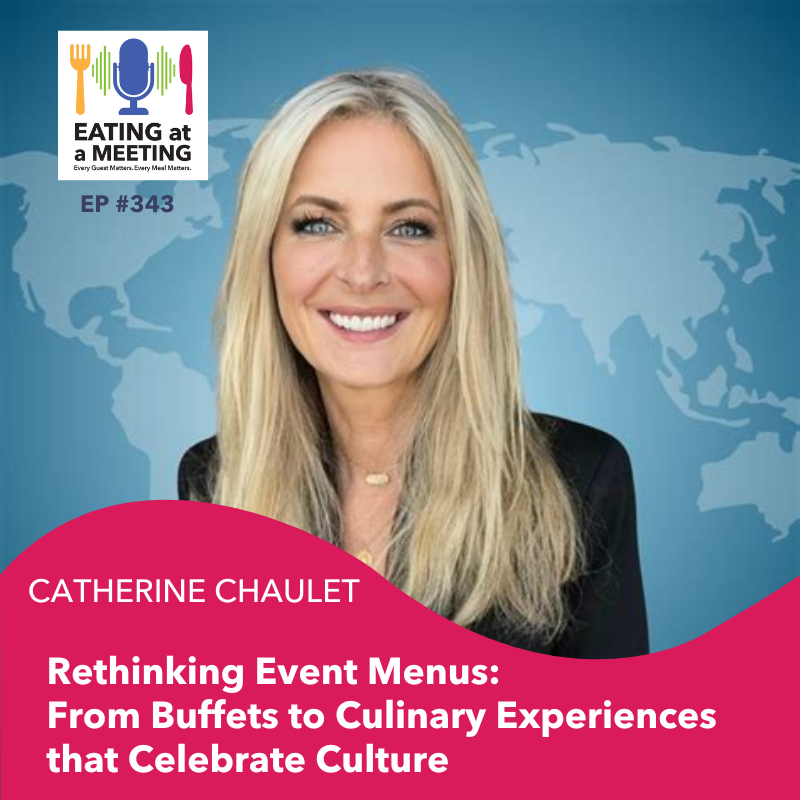
Recorded live at IMEX, this conversation with Catherine Chaulet, CEO and founder of Global DMC Partners, explores how rising costs, evolving guest expectations, and cultural awareness are driving a shift away from oversized buffets toward more intentional dining experiences.
As food and beverage inflation continues to outpace other event costs, planners are being challenged to deliver quality, inclusion, and sustainability on tighter budgets. Catherine shares what DMCs are seeing globally: fewer buffets, stronger chef partnerships, less alcohol, and more emphasis on food as a cultural connector.
From harvesting honey onsite to learning the story behind a traditional tagine, this episode shows how thoughtful menu design helps guests connect—one meal at a time.
“Every meal should connect you to appreciate a culture.”



Heard on the Episode
“The secret is knowing the chefs and having that personal relationship with the chefs. When you have this relationship and you give them that as a task, you know, build a menu that's going to cater for all these needs… it becomes a really fun thing for them and a wonderful experience for the guests.” ~ Catherine Chaulet (04:01)
“Every meal should connect you to appreciate a culture.” ~ Catherine Chaulet (11:38)
“All of the cod, you know, things… There's a fantastic story around that—it actually comes from the Viking. It tells you a lot more than just where you are. It tells you about history in general and how cultures have merged and created those wonderful dishes.” ~ Catherine Chaulet (07:47)
Key Topics Discussed
Event Menu Trends & Budgeting
• Rising costs and inflation impacting F&B planning.
• Creative strategies for offering quality within limited budgets. Cultural Culinary Experiences • Moving beyond buffets to immersive, locally inspired menus.
• Food stories and chef connections enrich the attendee experience. Diversity & Dietary Accommodation
• Addressing gluten-free, lactose intolerance, and other needs.
• Solutions for planners facing budget and diversity challenges. Sustainability & Local Sourcing
• Sourcing ingredients locally for cost and storytelling benefits.
• Sustainability integrated into food presentation and selection.
Alcohol Trends
• Less alcohol, more creative (and costly) mocktails.
• Tailoring beverage experiences to audience interests. Practical Partnerships
• DMCs as crucial partners for navigating destinations, venues, and chefs.
• Leveraging relationships for unique experiences and smoother planning.
Key Takeaways
Food as Cultural Connector: Menus should be designed to foster appreciation of culture, break down assumptions, and create shared moments. Budget Smart, Experience Rich: Planners are shifting spend from buffets to select, high-quality meals that tell stories and provide deeper connection. Chef Relationships Matter: Knowing local chefs enables customization for dietary, cultural, and sustainability goals—even with budget limits. Alcohol & Mocktail Trends: Event planners are responding to reduced alcohol consumption with elevated mocktail offerings. Storytelling Enhances Value: Sharing the food’s origin, the chef’s journey, and culinary history engages guests and enriches the event. Tips Establish Strong Chef Partnerships: Build relationships with local chefs to unlock creative, culture-rich menu options. Prioritize Experience Over Quantity: Swap large buffets for carefully crafted meals that reflect the local context and attendee needs. Sustainability with Story: Feature locally sourced ingredients and share their backstory for deeper attendee engagement. Communicate Dietary Needs Well: Early and clear communication with venues and DMCs prevents issues and ensures inclusivity. Curate Signature Dishes: Let each destination’s culinary traditions shine by focusing on authentic local specialties.
Like what you heard? Subscribe to our newsletter for more episodes and insider content delivered right to your inbox!
Tracy Stuckrath [00:00:00]: Yeah. So hello, how are you? Catherine Chaulet [00:00:03]: Great, how are you? Tracy Stuckrath [00:00:04]: I am good, thank you. Catherine Chaulet [00:00:05]: Good. Tracy Stuckrath [00:00:06]: So tell everybody who you are and what you do. Catherine Chaulet [00:00:10]: So I'm the CEO and founder of Global DMC Partners and we represent DMC's independent DMCs all over the world. And I love what I do. Tracy Stuckrath [00:00:22]: So well. Okay, so I'm going to ask you to start with my question of the day. I'm wandering around the show floor today asking everybody, with all of these destinations around the world, where would you want to eat? Where would be the first place do you think you want to go eat and why? Catherine Chaulet [00:00:38]: Okay, so this is a very tricky question. There is no way I can select one destination because as you appreciate the world the way we do, representing so many destinations, you realize the diversity of food all over the world and the beauty of being able to travel and appreciate all of that diversity in those different locations. So I really, and I'm from France, I'm from Paris, so that could have been an easy one to answer, but it's not because I mean even in the states we were just speaking about this, they are extraordinary food in certain states that I would have, you know, most people probably don't know about. Well, because we are in this industry and I'm very lucky to be able to travel. There are parts where I would eat certain food in this state and wouldn't want to eat it in another part of the world because this is where it should be at. Tracy Stuckrath [00:01:34]: Well, and like I grew up in Maryland. In Maryland. Catherine Chaulet [00:01:36]: Crab cake. Exactly. Tracy Stuckrath [00:01:38]: Like people who say, oh, this is a Maryland crab. Oh no it's not. Catherine Chaulet [00:01:41]: Yeah, yeah, exactly. Tracy Stuckrath [00:01:43]: All right, so you all just put out a study on the trends that you're seeing is were there any trends in there around food and beverage with your, with your destinations and the DMCs. Catherine Chaulet [00:01:57]: So the main trend right now has to do with budget as it relates to food and beverage. The biggest shock really is in the inflation on food and beverage and how this to some extent kicks came as a surprise. You know, usually you think of inflation and budget challenges with airfare, hotel fares, etc. AV, food and beverage. Not necessarily. And yet that came up as one of the biggest growth in terms of price hike of all of the items. So, so that was one and it. Tracy Stuckrath [00:02:31]: Was already number one expense. Catherine Chaulet [00:02:33]: We. Exactly, exactly. And a lot of negotiations with hotel is really around food and beverage because of the minimums, it's, etc. So that, that was number one. The second is addressing the diversity of, and how challenging it is when Budgets are limited to be able to cater to all of the different, you know, whether you're gluten free or lactose intolerant. When budgets are limited makes it a lot more difficult. As well as sustainability and food, this is a third element where how do you integrate sustainability behaviors with food and beverage? Tracy Stuckrath [00:03:15]: Right. Catherine Chaulet [00:03:16]: These are the main topics around fme. Tracy Stuckrath [00:03:19]: And are any of your locations, do they have not simple solutions, but are they finding ways to help their customers that are bringing their incentive trips to the destination? Catherine Chaulet [00:03:30]: So there are a lot of creative ways and I want to add one other trend that we have found very interesting. Alcohol. And more importantly, no more alcohol or much less alcohol is a big, big deal. Unfortunately, not necessarily cheaper because a lot of these mocktails are actually more expensive or very expensive and very sweet. So yes, the DMC is actually very good as an ally to manage cost of FNB as well as quality and the diversity. And the secret is knowing the chefs and having that personal relationship with the chefs. The chefs in whether you go to a hotel, a venue, etc. When you have this relationship and you give them that as a task, you know, build a menu that's going to cater for all these needs. Tracy Stuckrath [00:04:18]: Right. Catherine Chaulet [00:04:18]: And within this budget, usually they will take it if it's a friend, if they like you, etc. If you are one of many and you just impose this, it's not the same idea, but if you have maybe a little more time and want to build around what that chef is good at and that he will take into consideration your sustainability goals, the different needs, then it becomes actually a really fun thing for them and a wonderful experience for the guests. Tracy Stuckrath [00:04:49]: And I think that just from a DMC perspective, I mean, I'm a planner and I bring it to a destination, I don't know anything about that destination. Catherine Chaulet [00:04:56]: Exactly. Tracy Stuckrath [00:04:57]: And having that partner who has those relationships with the chef and the restaurants and the venues helps a lot. Catherine Chaulet [00:05:03]: And a lot of the chefs love it so much, but they also love sourcing their food in a certain way. So there's a whole story about where that food comes from, usually around. So sustainability cost from that standpoint is a lot less. But there's also the story about, you know, the harvesting of the food, the quality of the food. So it is more and more part of the experience that guests and attendees are interested in. And we see a lot of DMCs propose to their clients to actually put that story on the plates. You know, the origin, the chef stories around this and why this menu was prepared with these thoughts in mind. Tracy Stuckrath [00:05:42]: Now, my question of the day yesterday was because it was smart Monday, what was one smart thing that you've seen done with food and beverage? I mean, outside of what you've just said, is there anything like a specific story about a really fun, unique thing that somebody's done? Catherine Chaulet [00:05:57]: So I don't know that it is now still very unique, but again, unique for one may not be unique for something else. But we really have a chef's end, some venues that do a superb job actually bringing the food on site and where the people harvest the food and then use it. So it's not new news. But when it's done in a special way, it becomes an extraordinary experience. And we're seeing a lot of groups wanting different experiences for different age category or interest category. And being able to combine food with different expectations in terms of your audience is actually becoming more and more of a very unique trend. So some of them will be more interested in organizing more, making cocktails, for instance, but others will want to go in a beehive and harvest the honey and then use this. And then, of course, there's. Catherine Chaulet [00:06:59]: In any parts of the world, you go to Lisbon and you learn how to do a paste, but in the place. So all this seems, you know, been there, done that, but not really when it is done by someone that cares tremendously about the quality of the ingredients, about the history of that food, and share that with the groups at different levels. Tracy Stuckrath [00:07:20]: Well, in just thinking that, thinking through what you just said, too, it's the culture. They're allowing the culture culture of that company to come about and teaching the attendees that are participating. Catherine Chaulet [00:07:32]: Exactly, exactly. And there's so much more appreciation for culture when it combines both doing, sometimes just doing, but also tasting and getting the whole history around it. So again, I'll go back to Lisbon for. Or to Portugal, but all of the cod, you know, things well. There's a fantastic story around that it actually comes from the Viking. And so it tells you a lot more than just where you are. It tells you about history in general and how cultures have merged and created those wonderful dishes. Tracy Stuckrath [00:08:06]: And you're getting. Your planners are requesting a lot more of your DMCs in this fashion. Catherine Chaulet [00:08:14]: A lot more. A lot more. Food and beverage is a great, great way to integrate unique elements to the program and something that works with most of the audiences. The majority of people are somewhat foodies, you know, so the more you can. But it's not just the food, again, it's the history, it's the cultural, etc. This is a very hot trend, for sure. And the DMCs love that too, because in many ways you're going to have people that are going to show you this that have also a personal story. Right? So one thing we absolutely love in our industry and at Global DMC Partners is the fact that we introduce people to maybe cultures, destinations that they wouldn't go necessarily by themselves and sometimes they have preconceived notion. Catherine Chaulet [00:09:05]: I remember a trip we did to Morocco with some American clients and there was a little, you know, concern or tons of assumption, it was a bit hot at the time. And we brought them to a restaurant where a wonderful chef showed them and taught them how to create a couscous and a tagine. And it was her personal story too. And her personal story was a very interesting one. In charge of an entire family and why the vegetables are done a certain way, cooked a certain way, but also how she supports her entire community with this. They all fell in love with the food, with the person and with the country. And their preconceived notion of moronoko went away. They could relate at the same level. Catherine Chaulet [00:09:56]: We all in many ways share the same desires. We all have to eat, to eat and take care of each other. Right, exactly. Tracy Stuckrath [00:10:05]: So from the research, is there anything that your partners or your DMC partners are looking to do in 2026 around food and beverage? Catherine Chaulet [00:10:14]: So again, the cost is the big challenge. The budget is one of the toughest discussions. So finding ways to bring lovely, delightful, you know, dishes at the prison price point, that works with the budget, taking into consideration the different dietary requirements. And, and this is not going to, to change this. This is a big challenge right now. And so, but we're seeing, so there's a few trends we're seeing less of. You know, those big buffet. Tracy Stuckrath [00:10:46]: Right. Catherine Chaulet [00:10:47]: We're seeing less of that. Okay. What we're seeing is a lot of companies that invest in inside incentives and meetings, despite the fact that budget is challenging, do want to make sure that the quality is there. So they might reduce other things, but on some parts of the meals it's going to be top notch. So, you know, and I'm sure you're already aware of that. So breakfast, right. You know, coupons for breakfast is becoming big time. Why? Because the money is going to be spent on a lunch or a dinner a little bit more. Catherine Chaulet [00:11:24]: So there are some selections that are made around that. Tracy Stuckrath [00:11:28]: Okay, one final question for you. Finish this sentence for me. Every meal should. Catherine Chaulet [00:11:38]: Connect you to appreciate a culture. Okay? That's it. And enjoy the food. Just, you know, it's a fun time. And I think that especially today, taking time around food and around that connection that we make when we have a meal is more important than ever. Than ever. The world is frightening. And being able to sit at a table and eat together, break bread together at a time like this is very much needed. Tracy Stuckrath [00:12:15]: 100% agree. Catherine Chaulet [00:12:16]: That was one word. Tracy Stuckrath [00:12:19]: No, it wasn't even a word. Finish the sentence. So you're good? Catherine Chaulet [00:12:22]: Yes. Tracy Stuckrath [00:12:23]: Yep. No, that's good. Thank you very much. Catherine Chaulet [00:12:26]: Thank you. Tracy Stuckrath [00:12:26]: How can people find out about Global. Catherine Chaulet [00:12:28]: DMC Partners, globaldmcpartners.com, you'll get all the information, and we're looking forward to hearing more about you and to make you discover some extraordinary, extraordinary, extraordinary food and experiences and destinations. Okay, great. Thank you. Tracy Stuckrath [00:12:44]: Thanks. Catherine Chaulet [00:12:45]: Thank you.

President and CEO
As President and CEO of Global DMC Partners, Catherine drives the vision, growth, and success of the company and its network of worldwide partners. Before joining Global DMC Partners, she was a senior executive at Fidelity Investments, where she led two subsidiaries to global success.
Catherine’s influence extends beyond her role at Global DMC Partners. She serves as a French Foreign Trade Advisor (CCE) and is the Vice President and board member of the Promotion for French Attractiveness Committee. In these capacities, she plays a pivotal role in promoting French economic interests on a global scale.
A dancer at heart and a lover of life, Catherine’s lifelong mission is to explore and share the world’s dances, cuisines, and cultures. And here’s a fun fact: despite being a true Parisian, Catherine absolutely hates cheese! We’re still trying to figure out how she manages to enjoy French wine without it. Her unique tastes and zest for life make her a truly fascinating leader and individual.