354: Event F&B: Designing Menus That Respect People & Ingredients
Imagine sitting down at an event, ready to enjoy dessert… and realizing the kitchen can’t tell you what’s in it.
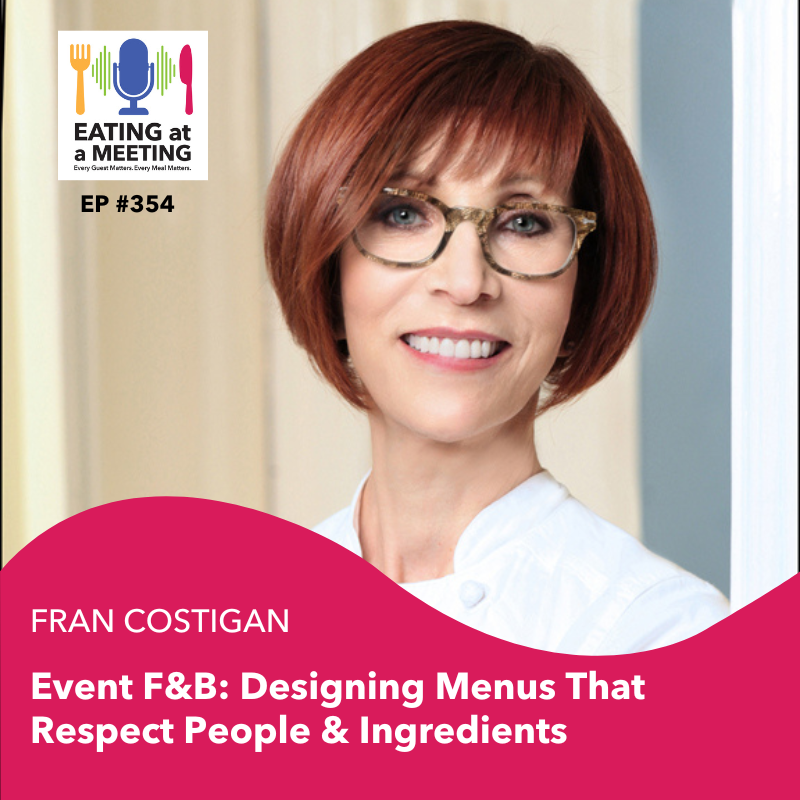
Tracy is joined by internationally recognized vegan pastry chef, cookbook author, and culinary educator Fran Costigan to talk about what should be one of the easiest wins in event food and beverage: designing menus that respect both people and ingredients.
Fran has spent decades teaching chefs—many of them in traditional kitchens—how to create plant-based desserts that are stunning, delicious, and practical to execute. And here’s the truth she keeps proving: most kitchens already have what they need. What’s missing is the mindset, the training, and the commitment to transparency.
We dig into:
• Why hotel and catering pastry teams still treat vegan (and dairy-free) desserts like a “special request”
• How to build one great dessert for everyone instead of creating multiple “separate but sad” options
• The real issues with hidden ingredients (hello, seasoning mixes with wheat flour) and why labeling matters
• Smarter sweeteners and why “dairy-free” doesn’t always mean safe
• Practical swaps and techniques chefs can use right now—without reinventing their pantry
• Why gluten-free isn’t automatically “healthier,” and what planners should understand when designing menus


Heard on the Episode
“Instead of thinking about, ‘I’m going to do a regular, a traditional dessert and a plant-based dessert...why not just do one fabulous dessert for everyone?’”
~Fran Costigan 05:03
“We want to make food that tastes good. There’s no point if it doesn’t taste good. And serve reasonable portions, and then we’re good to go.”
~Fran Costigan 08:34
“Labeling and keeping items separate is critical.”
~Fran Costigan 27:52
“Every meal should be delicious, satisfying, and, you know, in my opinion, have a lot of vegetables incorporated…”
~Fran Costigan 53:06
Key Topics Discussed
Inclusive, Allergen-Friendly Desserts
Designing one fabulous dessert for everyone, minimizing separate prep.
Smart swaps for plant-based and gluten-free baking.
Event Menu Planning
The evolving expectation for vegan and allergen-free options at events.
Clear menu labeling for allergens, animal products, and transparency.
Ingredient Quality & Kitchen Habits
Why classic pastry kitchens don’t “get” vegan baking—and how that’s changing.
Importance of using familiar, high-quality ingredients for universal appeal.
Minimizing Food Waste
Repurposing ingredients and desserts to reduce waste.
Practical kitchen tips for zero-waste baking.
Tips for Event Planners
Proactively communicate dietary needs and confirm ingredient details.
Ask venues what plant-based and allergen-friendly menu items they can offer with mainstream ingredients.
Key Takeaways
A single inclusive dessert saves time, costs, and respects all guests’ needs.
Ingredient transparency and detailed labeling are non-negotiable for guest safety.
Most pastry kitchens already have the basics for preparing vegan sweets—no need for special-order ingredients.
Repurposing food creatively and smart batch prep can help minimize waste.
Guest satisfaction rises when menus are familiar but thoughtfully inclusive.
Tips
Ask about grains, legumes, and allergen-free staples already in the kitchen to build menus.
Batch cook and label carefully to maximize efficiency and inclusion.
Don’t overlook the power of seasonal, produce-forward desserts like poached pears.
Make desserts that taste great first—don’t let dietary tags be an afterthought.
Encourage ongoing staff training around allergen handling, handwashing, and proper glove use.
Like what you heard? Subscribe to our newsletter for more episodes and insider content delivered right to your inbox!
Tracy Stuckrath [00:00:07]:
Hey everyone, and welcome to another episode of Eating at a Meeting. Chef Fran is internationally recognized as an authority on vegan desserts, and I will give you her website later to look at. She's a professionally trained pastry chef, a cookbook author, a consultant, a culinary instructor, and she's the director of vegan pastry at I'm gonna. Is it Robu. Did I say that right?
Fran Costigan [00:00:29]:
Ruby. Like Ruby.
Tracy Stuckrath [00:00:31]:
Ruby. Okay, Ruby. That's easy. Okay. And she's. Which is the world's leading online culinary school. And if you. When you look at pictures of her desserts, they are delicious.
Tracy Stuckrath [00:00:43]:
They look fantastic and. But they're free of eggs, dairy, white sugar, cholesterol. So we could. They should be good for us. Right? So, Fran, I'm so excited to have you here again and thank you so Stepping in at the last minute to talk to you.
Fran Costigan [00:01:00]:
Oh, thank you, Tracy. It's my pleasure. I'm delighted to have been able to just juggle a little. I'll go to the gym a little later.
Tracy Stuckrath [00:01:10]:
That is what I'm going to do later too.
Fran Costigan [00:01:12]:
Okay. Got to, you got to keep it moving. Got to keep it moving. Yes, ma'am. And absolutely. Absolutely. So I'm happy to see you on Zoom and I'm looking forward to seeing you in Philly. And we'll get together in person to eat some of— Philadelphia has amazing restaurants that I think for the most part are quite aware.
Fran Costigan [00:01:37]:
And, you know, I moved here from New York and I think Philly has an equal or even better food scene at this point for me. Hardly any place that I go doesn't speak vegan to some degree, which is really fabulous.
Tracy Stuckrath [00:01:54]:
Well, and I think we're getting more and more of it, but I still think that there are some things to tackle. And actually, let's just start with that one thing I want to tackle. I mean, you've talked about and you've trained online and in person people who are not vegan how to make vegan pastries. So can— why do traditional hotel pastry kitchens not get this? And why is it so hard for them to provide vegan pastries? Or even dairy, you know, I mean, vegan pastries, but even dairy-free pastries?
Fran Costigan [00:02:30]:
I— that is the million-dollar question. It doesn't make any sense to me. Because whenever, you know, I have done some work within hotels or at big conferences, for example, I presented a demo at the ACF convention, national convention, maybe 2 years ago. It was a hotel kitchen. We did the prep and made my chocolate cake to live for. That's what it's called. And the kitchen is— oh, wherever I am in an environment, like, then the staff says, "Oh my God, that was so easy and that's so delicious." And I don't use any— I made it my business. You know, I made it a point for myself when I was transitioning from what used to be the traditional kitchen, butter, sugar, egg kitchen, that was my pastry work, to creating a modern vegan kitchen.
Fran Costigan [00:03:28]:
I didn't want to use any hard-to-source ingredients, and I wanted to keep ingredients as real as possible and quality. So my flours, should be familiar to any pastry kitchen. I use organic AP and I use whole wheat pastry flour and sometimes some spelt, and I know how to do things with gluten-free flours. I use real cocoa powder, you know, a quality high percentage. Today, we have a plethora of plant milks that work for everyone. And while I am not soy averse, in fact, I eat soy on a regular basis and I have for over 30 5 years and I feel great. It's not a problem for me. I'm not allergic to nuts, but many people are.
Fran Costigan [00:04:18]:
And I want to include as many people as possible. I'm talking about non-plant eaters as well. That means making something that's delicious. I use oat milk and it's rich. It has enough protein. It's wonderful. Sugar, You know, I feel that I have an opportunity with my platform because I have students all over the world and many are professional chefs to talk about organic regenerative and GMO products. So we can get all these sweeteners now without a problem at all.
Fran Costigan [00:04:56]:
So why they aren't doing it, you know, I keep going in there and And you, it's easier. Instead of thinking about, "I'm going to do a regular, a traditional dessert and a plant-based dessert that is free of nuts and free of soy and free of many of the allergens," why not just do one fabulous dessert for everyone?
Tracy Stuckrath [00:05:23]:
Right! Yeah, exactly!
Fran Costigan [00:05:26]:
So hard. You know, for me, the example has always been lentil soup. People know lentil soup. We want foods that are familiar to people, right? I mean, a chocolate cake is familiar. Chocolate pudding is familiar. So is lentil soup. Well, leave the chicken stock out of the lentil soup and make it with vegetable broth. Now, you don't have to make lentil soup for vegans.
Fran Costigan [00:05:55]:
And lentil soup for everyone else.
Tracy Stuckrath [00:05:59]:
It saves money and it saves time.
Fran Costigan [00:06:01]:
And saves money and saves your headache. It saves your headache. You know, when I go to an event, I, again, I'm plant-based, but I, I don't have other allergies, so I don't have to worry as much. But I still, I want to see things labeled. I want to see real ingredients. And, you know, I think I was talking to you earlier. This is some soup that I made for myself for a couple of days. I happen to love squash soup this time of the year.
Fran Costigan [00:06:33]:
I roasted ahead. I've had it in my fridge. And this morning I thought, you know, I've been eating more sweets than usual. I'm going to more parties than usual. Let me have some squash soup in the fridge. I had homemade vegetable stock from scraps. Yeah, I threw it in my Vitamix and I added some spices that I like and I use non-irradiated sustainable spices. I prefer Burlap and Barrel and I had soup in 5 minutes.
Tracy Stuckrath [00:07:07]:
Wow, that's amazing. So you just made the soup in the Vitamix and then you heated it up?
Fran Costigan [00:07:17]:
Or you heated it up in the Vitamix? In the Vitamix. Yeah. I mean, I didn't even grab a pot.
Tracy Stuckrath [00:07:22]:
That's awesome.
Fran Costigan [00:07:23]:
I'm ready. And my breakfast this morning was— I happen to like soy yogurt. And some of the ones that you can buy in the supermarket are very nice. But I just found a way of using a box of organic soy milk that doesn't have any gums or anything else in it. Organic soybeans and water, some probiotic tablets, one for each cup of soy milk. So, it's 4 for the quart. And I put it into— I mix it up right in the container. I mean, I'm not a lazy cook, believe me, but when I can save steps, I do.
Fran Costigan [00:08:06]:
And then I put it in my Instant Pot for 10 hours overnight and I have soy yogurt. It's just wonderful. It's wonderful. That's amazing.
Tracy Stuckrath [00:08:16]:
Again, that saves you money. Yeah.
Fran Costigan [00:08:18]:
It saves a lot of money and there's lots of protein. And then I can add whatever I want to it, my own blueberries and flax and chia and so on. My granddaughter was here last week and she loved it. She just loved it. We want to make food that tastes good. There's no point if it doesn't taste good. And serve reasonable portions, and then we're good to go. You know, behind me, I have a king cake that I made that was a test, not the one that I brought to the party last night.
Fran Costigan [00:08:51]:
So there was the traditional one and there was mine. But oftentimes, there's just mine because people in my sphere have come to learn that my desserts are delicious. They don't What does vegan taste like?
Tracy Stuckrath [00:09:06]:
Exactly. Yeah. Oh, well, I mean, if it's still— it's like if Mikey likes it, right? Or let's see if Mikey likes it. Okay. I want to jump back to one thing that you said because you did, you were a traditional pastry chef. So, and I know we talked about this probably 4 years ago, but can you remind listeners why you switched?
Fran Costigan [00:09:25]:
Absolutely. I'd be happy to. I was, I had stomach aches. My entire life. I remember being from a very young age, just always having old, what I would call old-fashioned stomachaches. And I got used to them. Not used to them insofar as enjoying them, but just became a part of my life and was never figured out. No doctor ever said, oh, you are whatever.
Fran Costigan [00:09:54]:
And then I was working I was working in a traditional pastry shop on the Upper East Side of Manhattan. That was my first job out of culinary school. And I went to culinary school at a very advanced age. My kids were already in junior high, but that's another story. And my digestive upsets just got worse and my allergies felt awful. And I did not want to give this job up because this, to me, this was my dream job. I just loved it. I loved the action.
Fran Costigan [00:10:32]:
I had eggs on the counter. I had heavy cream. I had gallons of white sugar. But I had to actually leave. That's how much discomfort I was experiencing. And so I went into— I started doing some other work. I wasn't feeling happy about it. And, you know, they say when the student is ready, the teacher shows up.
Fran Costigan [00:10:56]:
I went to buy a beach read kind of book. I was in doing some other work and I was in Palm Desert and I picked up a book called Food and Healing by Dr. Ann Marie Colvin, who was the founder of the Natural Gourmet Cookery School in New York City. And I thought, isn't that odd? I am in New York and I don't know about this school. And her idea that what you ate impacted how you felt just made common sense to me. And I scanned the book and I went, oh, I bet I'm lactose intolerant, which I am, which you probably know the hard number, but certainly over 80% of people of adults are, or children are lactose intolerant today. So my intention was to give up dairy, and I never could really stomach it. I never liked drinking milk.
Fran Costigan [00:11:57]:
My mother gave me ice cream for breakfast because I'm sure the pediatrician said, get milk into that kid. Very clever, right? Set me up for a lifetime of sweets. And so without really thinking about it, I gave up all animal foods. I went to the Natural Gourmet. I took food and healing course that was a few months long and it just made sense to me. But the most important thing is within days, certainly less than a week, I, my stomach aches went away. My allergies cleared up. My weight stabilized.
Fran Costigan [00:12:35]:
I was just in a better mood. And I know that there are many people, my chef friends were saying, "Well, you can't be a chef anymore. You can't taste this and that and other." I felt that my culinary choices expanded rather than contracted. There were so many more foods for me to try that I had been ignoring. So, that's really what happened. I never looked back. When I And then for a short time, I shunned all sweets because I thought that's not good. And then my son, who was about 14 or 15 at the time, said, "Mom, you're not putting a candle in a sweet potato and telling me that's my birthday cake." True.
Fran Costigan [00:13:19]:
So I went with what was available in terms of baked goods. And at that time, we're going back 35 years, brown, dry, dry and sticky, gummy, no recipes that made any sense. And I I just decided I was going to work with what was available in the day, which was not what's available today, to create desserts that were delicious and just happened to be plant-based. So, plant-based, that means, you know, no dairy, no eggs, no white sugar, no cholesterol, and they're parve as well. They're for everyone.
Tracy Stuckrath [00:13:58]:
Okay. So tell me about the white— tell everybody about the white sugar.
Fran Costigan [00:14:02]:
So white refined white sugar or what you see in the supermarket, table sugar it's called, is the only food substance that I am aware of that is refined to like 99%. It's the only edible food substance that we put in our mouths that doesn't have to go through digestion. Digestion starts in your mouth with saliva. It just hits. It just hits. And so it's actually worse than— your pancreas goes crazy. It's really unhealthful. It spikes everything.
Fran Costigan [00:14:41]:
And for people who are vegan, ethical vegans, this sugarcane is processed through bone char and bleach, and neither of those processes are okay for many people. Now, beet sugar was the sugar of choice for vegans for many years because it is not processed through bone char. However, beet sugar in this country is a highly genetically modified crop. And so it kind of fell out of fashion. But today, you know, we have all these Organic cane sugar. This is one brand that I think is quite reliable, Wholesome. And now, they're doing regenerative as well. So, you use it one for one for white sugar.
Fran Costigan [00:15:34]:
And anyone who is baking or doing desserts knows that old-fashioned desserts were very sweet. I cut the sugar somewhat, but my first boss, in a vegan restaurant said, "I took all the sugar out of the brownies." And he passed again. "We're making brownies, not brown bread. Put the sugar back in." Right! I mean, these are true. But, of course, sugar has matter to a dessert. So, there's a small percentage, you can't really see it here, a small percentage of the molasses that is inherent in the cane. Remains in this organic sweetener. And by the way, organic and vegan sugar are one and the same, and oftentimes, they are ethical as well.
Fran Costigan [00:16:27]:
So, the crystal can be, depending on the brand, very fine or a bit more coarse. The color can be super, very, very light brown or beige, A little bit darker. But no matter what, the crystal is always larger than a white sugar crystal. So what I do is very simple. You see all those containers behind me? I lightly grind the sugar in a food processor. I don't grind it to powder. Well, I do that, too, but for most of my desserts, I lightly grind it in a food processor and then I store it until it's needed. I can do powder, like a caster sugar, as well.
Fran Costigan [00:17:14]:
And we have coconut sugar that we like to use, also, sucanat or sugar— whole sugarcane. Sugarcane, natural, it's got all different names, is the sugarcane without the molasses extracted. So, it's a very nice sweetener. I use that sometimes instead of brown sugar. So we have all those choices in granulated sweeteners, and then there are liquid sweeteners as well.
Tracy Stuckrath [00:17:40]:
Wow.
Fran Costigan [00:17:41]:
Okay. All of this is readily available to all chefs, to restaurant chefs. They come in big quantities for people to use.
Tracy Stuckrath [00:17:51]:
Yeah. So just talking about those chefs again, what was the ones that have taken your class? What is their biggest aha moment? Like when you're teaching them about turning vegan, making vegan pastries?
Fran Costigan [00:18:05]:
They just can't get over how good things taste. You know, they're like, oh my God, that was so easy. And I have these ingredients. I mean, maybe going out to find some agar, which is the vegetable derived from seaweed, replace it. But it's a gelling agent that has been used for millennia in Asian cuisine. So it's not something that's made up and it's not highly processed. Process. That is a substitute for gelatin.
Fran Costigan [00:18:36]:
It's actually easier to use if you understand. In terms of the, like, giant wow factor has been my chocolate cake, which is a 2-bowl cake with no apparent egg replacer. That's something that we can talk about as well. And I went back to, well, what did they do during the war when there weren't eggs available? They use chemical leaveners, baking powder, baking soda, and vinegar. Boom. You have a nice cake. It's amazing. But aquafaba, which is the liquid from cooked chickpeas, when my students do their Baked Alaska assignment, they just go crazy.
Fran Costigan [00:19:21]:
Everyone goes crazy. I teach that at Rancho La Puerta Spa. And Again, I have vegans in my class and plant curious, but I have many traditional homemakers and professional chefs who are coming to understand that if you don't offer a delicious vegan dessert, and we're not talking about sorbet, sorbet is delicious, but it's not enough. That's like, I don't want pasta with vegetables. I want a meal. That it's just so doable and so easy and economical. But you have to follow the same rules. You know, you don't throw out measuring, weighing ingredients, buying quality ingredients, learning the basics, the foundational technique for making Any dessert is included in my Essential Vegan Desserts course because we are making desserts.
Tracy Stuckrath [00:20:26]:
And one of the things that I was looking at, Lupi Whisk, who's cooked— my computer's falling off the screen, off my stand, you know, and another gluten-free chef, pastry chef that I just found as well, you know, and the importance of measuring because it's different densities of flours. And so it's not like measuring cup, but weighing it.
Fran Costigan [00:20:49]:
It's so important. It's so important. I have this. This is a small— I think it's called a jeweler's scale for small ingredients. Now, because my students are international, people are using different flours. I spoke about this yesterday at my live event for my Essential Vegan Desserts course at Ruby. I wanted to go back and really Let's review. I love doing for myself.
Fran Costigan [00:21:18]:
There's always something new to learn in culinary, and I love that, but review is good. Now, if I were in a school or in a, you know, if I were right here and I were using King Arthur flour and everyone was using King Arthur flour, 1 cup weighs 120 grams. Bob's Red Mill Organic AP weighs 136. Bob's.
Tracy Stuckrath [00:21:43]:
Interesting.
Fran Costigan [00:21:45]:
The whole list. American, ATK, Rose, everyone you can think of has a slightly different— some are slightly different and some are very different. Bob's and what is it? King Arthur. Every bag of flour you get, you look at it and it says 11.7% protein. That's important to know for the gluten. Property. Bob's Red Mill, and I'm a fan of Bob's, believe me. They say between 10 and 12, depends on the batch.
Fran Costigan [00:22:20]:
These are things that are important. So, because I have people all over the country and all over the world who are using different flours, I suggest, you know, the recipes say 1 cup. Whisk your dry ingredients first because they settle. So just whisk before you measure. My way of measuring is to overfill the cup and without pressing down, just take a flat knife and write down, check it twice and write down what that weighed and keep a notebook. Because I remember when I was writing Vegan Chocolate and I wanted gram weight in there, I was looking at French Culinary Institute and, you know, everybody had their own weight charts. I think King Arthur's is very good. They're good for a start, but you really need your own and you really need to weigh.
Fran Costigan [00:23:13]:
And, you know, it's actually easier because you just keep zeroing. So, here's your mixing bowl. You keep zeroing it out and then you go, "Here's the flour. Here's the whole wheat pastry flour. Here's the sugar." And everything goes in the bowl. And there you have it.
Tracy Stuckrath [00:23:29]:
Yeah, that's, and that's what I try to do. I've got it on there. And, but I have to tell you that I am, because I am gluten-free and I have succumbed, if you want to say that word, because I always make a cherry pie for Christmas and I always make it from scratch, but I am using the King Arthur gluten-free boxed recipe. You know, it comes in a box and I love it.
Fran Costigan [00:23:55]:
The pie crust. Pie crust.
Tracy Stuckrath [00:23:56]:
The pie crust.
Fran Costigan [00:23:57]:
Oh, that's cool.
Tracy Stuckrath [00:23:59]:
Yeah, I have actually— now I'm doing— my mom actually made her pecan pie and her pumpkin pie this year using that as well. And what I did, because it comes out with two crusts, but for me, for my cherry pie, mine's a fully covered cherry pie, I am taking 2 boxes of the thing and making it. So I'm getting— because I'm adding a little bit more, I want a little bit more pastry on my cherry pie. And so I'm like taking a quarter more of that and then just making my mom pie crusts, single-size, single pie crusts from that. But that's what I've been using. I'm cheating in a way, but it's simple.
Fran Costigan [00:24:42]:
Well, I don't think that's cheating. I think that's practical. I really do. Now, my gluten-free, all-purpose flour mix of choice is the Bob's Red Mill 1:1. It comes in the blue bag and it's complete. There's some xanthan in it. I know I'm hearing more and more and more from people about the problems they're having with gums, but there's a small amount in there and, for a certain gluten-free I would be surprised if the boxed pie crust mix doesn't have something like xanthan gum in it.
Tracy Stuckrath [00:25:22]:
It probably does. I'd run down and get it.
Fran Costigan [00:25:24]:
You know, but then it's a small— it's a very small amount and you're not eating pie every single meal, every single day. It's the way I look at it. I don't like when I see in a recipe or a book. Whether— I mean, I caution people about just— well, they say, "That didn't work for me." "Well, where'd you get the recipe?" "Well, I found it out there." Well, okay. Let's stick with reliable recipe writers and chefs. But I don't necessarily think if I'm doing a cake that uses 50% all-purpose flour and 50% whole wheat pastry flour, which is my choice of flour mix. I think the whole wheat pastry flour adds some flavor and some nutrition. Although I don't see desserts as necessarily, you know, a cake as you're going to get your nutrition, but less harmful for sure.
Fran Costigan [00:26:28]:
I don't think that— I see all the time, use that or equivalent amount of gluten-free flour mixes. I don't think that works. They behave differently. They suck up liquid differently. The temperature is different, but certainly doable. I mean, one of my favorite recipes, and, again, I'm not gluten-free, but I'm very aware of that for people. One of my favorite recipes is a gluten-free brownie that stays fudgy. There's prune puree in it.
Fran Costigan [00:27:01]:
Which really keeps them fudgy. You know, prune purée was used a lot in French bakery items.
Tracy Stuckrath [00:27:08]:
So, interesting.
Fran Costigan [00:27:09]:
Not really making things up. We're looking at, I think, traditional ways of doing things and doing them differently. You know, there are so many desserts that are naturally gluten-free. A truffle, a chocolate truffle, for example. Made with oat milk and a high percentage of a certified gluten-free chocolate is gluten-free and quite delicious. One of my favorite truffles is made with tahini. It's fabulous, but I know that sesame seeds are a highly allergic food, so I'm careful about them. And I think labeling and Keeping items separate is critical.
Tracy Stuckrath [00:27:59]:
It really, really is. And, you know, in— well, yesterday I— was it yesterday? I posted a picture from a cafeteria I was in, and the menu, digital menu board, said chicken quesadilla and then cheese quesadilla, and it said contains wheat and dairy. And then it came down to the bottom, it said nachos. Those, but it didn't have any allergen kind of labeling, and it gave you, you know, lettuce, beef, chicken, whatever. Beef was spelled B— or no, meat was spelled M-E-E-T. Oh my goodness. I know. I did tell them, I'm like, you need to fix that.
Tracy Stuckrath [00:28:35]:
But I was asking, I'm like, is there's no labels on that? And the guy's like, hey, the, the spice probably is not gluten-free. And I'm like, okay, tell me about that. And he pulled out the Lowry's taco seasoning mix and, and brought it to me, and right smack in the middle is wheat flour in it. So I'm glad that I've asked, and I'm glad that he took the wherewithal to show that to me. But that is a hidden ingredient. And you were just talking about the labeling, and it's like, it's so important, not just for me as a person that's gluten-free, but also as somebody who's vegan or who is kosher, right? Understanding what those ingredients are is imperative. And I'm like, I don't want your recipe. I just want to know if it's going to hurt me.
Tracy Stuckrath [00:29:28]:
Yeah.
Fran Costigan [00:29:28]:
And again, you know, I think the work you're doing is so tremendously important, and thank you for that. I don't have allergies other than not wanting to have dairy or animal products, but I read labels all the time. I am amazed by what you find on a label. And hopefully, they're all disclosed. Now, people used to say to me, "What makes chocolate vegan?" And way back when, I thought that was a silly question. Then we know there are no silly questions. But I was like, "Well, if it doesn't have dairy in it, it's vegan." No, we want the sugar to be vegan. But today, I have found milk powder listed on labels of chocolate bars.
Fran Costigan [00:30:15]:
And as chocolate becomes more and more expensive, and I'm sure that you are reading about the chocolate-flavored chocolate, you're going to see more milk powder in chocolate. So, you need to know who your purveyors are. You need to read labels. You need to understand what's going on.
Tracy Stuckrath [00:30:37]:
And Well, even those— sorry, I didn't mean to cut you off.
Fran Costigan [00:30:42]:
No, I was gonna say support those companies that are being transparent.
Tracy Stuckrath [00:30:46]:
And yesterday we were staying in a hotel and I made my mom some coffee, and she doesn't use creamer, but it made me look. It says dairy-free creamer. Some of those dairy-free creamers are not dairy-free because of milk powder or something like that, right?
Fran Costigan [00:30:58]:
Isn't that crazy?
Tracy Stuckrath [00:30:59]:
Why do you call it that?
Fran Costigan [00:31:01]:
Yeah, it's crazy. And they have So many ingredients in that little bitty thing.
Tracy Stuckrath [00:31:07]:
Exactly. Okay. So we've— it's Veganuary. So I'm glad we're having this conversation. So how— and, but it's also Dry January and, and we were chatting before we got online that you have— I mean, I'm dry. I've been dry 7 years now. And, but you're, towing in it, I guess you could say, right? Can you— let's talk about the Dry January from a perspective of being vegan as well. Is there a way to do that? Is there consideration in that, or is, you know, just Dry January? Why are you choosing to do that?
Fran Costigan [00:31:49]:
Yeah, well, in terms of wines, there are companies doing vegan wines now. And it's a very, you know, it's an interesting process. I visited one of the wineries in Italy and the wine was delicious. This was a number of years ago. I have found over time that while I do enjoy a glass of wine with a, you know, if I'm out at a special dinner or event that I wasn't feeling great after. I think my metabolism is changing as I'm older. Something has changed. And because I don't really eat junk food, I'm not pure.
Fran Costigan [00:32:33]:
Every once in a while, I'll have a nice vegan burger or love the French fries at Goldie's in Philadelphia, Mike Solomonov's restaurant. But for the most part, I noticed that once I cut the junk out of my diet, I'm sensitive to how I feel after eating or drinking particular items. And I consistently was not feeling my best after drinking. So I just naturally stopped doing it. And I lead— I'm very lucky to lead a pretty social life with Les Dames de Scofié and restaurants and, and so on. I realized that what I was missing were the flavors that I liked. I like bitters. I think that has something to do with the fact that I'm tasting so many sweets.
Fran Costigan [00:33:22]:
You know, when I'm testing a recipe, I can make something 4 times as I did with this king cake. I had never had one. I had never seen one. And so I kept testing and I kept eating them. Oh, that's good. Well, let's see how long it takes till it's stale. Oh, that's good. That adds up.
Fran Costigan [00:33:40]:
So, I love broccoli rabe. I like bitter vegetables and I like bitter drinks. And one of the drinks that I really thought I would miss since I have cut down and decided that for January, I'm going to cut it out completely was Campari. And then I found this wonderful— I think this is made by San Pellegrino and it's called San Bitter. And it tastes Delicious. I put some lime in it. I love it. I love it.
Fran Costigan [00:34:11]:
Absolutely love it. And I feel great. And, you know, my son, who— he also said to me, Mom, I'm just not really drinking anymore. I don't like the way that I feel. We were saying earlier, I think 50— alcohol consumption in the United States is down 54%. Something is going on.
Tracy Stuckrath [00:34:33]:
Well, I posted a couple of weeks ago that, I don't know if you saw it, but Jim Beam is stopping production in their Kentucky factory or distillery for the year, for 2026. And then I know Jack Daniel's also cut, let go of 600 people earlier last year. And so the numbers are there and it, I mean, it's still a small percentage, but it's an opportunity to grow revenue with a different formulation, kind of like you're doing with the vegan options, right? I'm like, right, why not offer them?
Fran Costigan [00:35:09]:
And I'm seeing them, you know, certainly at the events I go to, we have always a non-alcoholic version of an alcoholic drink, or, you know, I think of it as vice versa, just always. And I'm very curious about who's taking what? Just to understand. Now, I'm not making judgments about people who do wine, and I'm not saying I will never have a glass of wine again, but I'm not going to in January. It just feels like a good time to reset. I mean, I eat a lot of vegetables as a matter of course. You give me beans, greens, and grains for the rest of my life, And I'm really happy with that. I mean, that's food that I happen to love, but I'm just finding that I feel better. So I'm going to do it for this month.
Fran Costigan [00:36:05]:
I mean, my plant-based is not just in January. It's been for 35 years that I've been eating this way and knock on wood, but all my, all those numbers that you go to the doctor to have checked are really good. So I'm going to keep doing it, plus I like the food and I allow myself to have a small piece of dessert when I want it because, you know, I feel like it's made with wholesome ingredients. I look at recipes today and I think, "Wow, 4 eggs or 5 eggs and a cup of heavy cream and 3 cups of white sugar. Who does that today or why?".
Tracy Stuckrath [00:36:48]:
Right.
Fran Costigan [00:36:49]:
Why? It's not necessary. By the same token, I am not a fan of the non— the NSSs, the non-sugar sugars.
Tracy Stuckrath [00:36:59]:
Yeah. Because those have some side effects as well.
Fran Costigan [00:37:02]:
Yes.
Tracy Stuckrath [00:37:03]:
Some of those gums do. Yeah.
Fran Costigan [00:37:05]:
Yeah, absolutely.
Tracy Stuckrath [00:37:07]:
I remember, is it mono? What's that sugar? I don't remember. I remember getting cookies from them a long time ago and I love them, but when you eat them over— that sugar begins with an M. I think it's refined from monk fruit. No, no, it'll come to me when we're, when we're done talking. But yeah, so how, you know, as a person who goes to a lot of events, what what are you expecting as a person who eats plant-based, right? Meaning, and how often do you not have something to eat or not provided something? What are you looking for?
Fran Costigan [00:37:53]:
From time to time, I am— I do not feel provided for, and I don't understand it in today's world. There are times that I know I'm going to a restaurant that doesn't have vegan options on the menu. For example. But if I know I'm going, I will contact the restaurant and let them know ahead. I think that's the right thing to do. I have been in situations where it's just a spontaneous situation and I go in and I let the server know. For the most part, I am accommodated even if there is nothing vegan on the menu. And by accommodated, I mean, you know, not just a plate of pasta with some steamed vegetables.
Fran Costigan [00:38:35]:
I find that really insulting, or a salad, but something clever. I went to a restaurant in Philadelphia a couple of years ago. My kids were in town and they wanted to go there and they were known— it was a brunch situation. They're known for their truffle scrambled eggs. And I didn't see anything vegan on the menu. They made me a scrambled tofu with some truffle oil. It was lovely and greens on the plate. There are times that I'm stuck with a baked potato or a salad and I note it and then I want to talk with the restaurant later, not necessarily in the moment, but to offer some constructive information to them because sometimes they just don't know.
Fran Costigan [00:39:22]:
They just don't know. Yeah.
Tracy Stuckrath [00:39:25]:
Yeah. They don't know that the options are out there. Like you said, like, here are all— I mean, when you started 35 years ago and when I started being gluten-free 20-something years ago. I mean, the options that we have today are much different than the options that we had back then, right? And my mom— even my brother was allergic to dairy or eggs when he was a baby. And so I'm like, there's no internet, and he's 55. So I mean, she had just had— she's like, I just did it.
Fran Costigan [00:39:58]:
Yeah.
Tracy Stuckrath [00:39:59]:
Yeah.
Fran Costigan [00:40:00]:
So how do you address the idea of gluten-free people who are eating gluten-free who aren't really celiac? Yeah. And then they're eating all the white starches instead of whole grains and so on. I know your diet is varied. I think there has to be some education around healthy gluten-free choices.
Tracy Stuckrath [00:40:32]:
Oh, 100%. People think that eating gluten-free is healthy. Gluten-free, I mean, there's a Nature's Bar. I, I've named, I think that's the brand of it, but there's a gluten-free fig bar and there's a regular fig bar, right? Same?
Fran Costigan [00:40:47]:
What?
Tracy Stuckrath [00:40:47]:
It's Nature's Basket is the brand and we eat it here. My dad eats the non-gluten-free one and I eat the gluten-free one, but It— what's the difference? I guess just the fig part, the— and it's made— we eat the blueberry flavored one, so I guess it's the cake that's the difference part of it. But it is still full of sugar, right? Yeah, I mean, it's a cookie, so it's not like— and then when you're thinking gluten-free, I mean, we make the King Arthur gluten-free pancakes and, and waffles here in our house, and But that still has sugar. Both of those have sugar in the, in the mix. So it's not that it's necessarily healthier to eat gluten-free, but it's healthier for somebody who gets sick from gluten.
Fran Costigan [00:41:33]:
Exactly. Exactly.
Tracy Stuckrath [00:41:35]:
Yeah.
Fran Costigan [00:41:35]:
And I, I think, you know, one of the reasons that for the most part I don't use mixes or I, I mean, there are a lot of people now who say they buy Betty Crocker cake mixes. And instead of using the egg, there's a way to just make a vegan cake. If I can add my own sweetener, which is organic, which is sustainable, which is chemical-free, and use a little bit less but still keep it as dessert, that would be my choice for the most part. But we want people to be safe, not overwhelmed. What is your position on oats? Because I get that question all the time. And you know, what I say is oats don't contain gluten on their own, but there's cross-contamination. Is that correct?
Tracy Stuckrath [00:42:26]:
It is correct. Yeah. So majority of the oats that are out there are processed on machinery that processed wheat. So you do have to look for, you know, certified gluten-free oats if you, if you're true celiac, but some celiacs can't even eat oats in general. I don't necessarily, I don't, there's a.
Fran Costigan [00:42:48]:
Protein that something that doesn't work right.
Tracy Stuckrath [00:42:51]:
But yeah, so if you're serving oats and it doesn't even matter if they're steel cut oats, they need to be certified gluten-free. But, and Zigo is a brand that out, that is actually certified gluten-free. And actually you would like this too, they are also testing for— they test for over 400 different chemicals on the wheat, so, or the, on the oats to make sure that they're chemical-free as well.
Fran Costigan [00:43:19]:
Oh, I love that.
Tracy Stuckrath [00:43:20]:
From pesticides. Yeah. I've got a bag downstairs, but that would require me leaving. But, but yeah, so they're, you know, looking for, for Zego brand or other ones that are certified gluten-free is important. And the oat milk, in looking at the oat milks, I'm like, There's one, a lot of them that have gums in them. I think Malk, M-A-L-K, doesn't, but a lot of them have gums in them too.
Fran Costigan [00:43:44]:
So lots of gums. Yeah. Oatly came out with one that's called Simple. Simple. And it doesn't have any gums.
Tracy Stuckrath [00:43:51]:
Oh, good.
Fran Costigan [00:43:52]:
And that's one that my son, for example, really likes. When I'm doing a dessert and I need to have a substitute for a heavy, you know, for a really rich cream, I will use their full fat. But there are ways to take the leaner, you milks that are— or make your own. Nothing to it, really, but time. Less expensive. And then you don't have gums in them. And then just add some extra fat to them. I did an experiment with— I wanted to show my students and followers that people say, well, when you make your own nut milk or oat milk or grain milk, it separates.
Fran Costigan [00:44:34]:
You have to shake it. So I poured some Oatly into a glass bottle and let it sit. And that's, you know, when the container says shake, that's what you do. You shake well. There's a reason for it. I'm using chocolate. I'm using fine chocolates that are ethically made and are high percentage because the higher the percentage, The lower the sugar, I'm looking to see if there's lecithin and what other things are in them. But for truly gluten-free people— I love them.
Fran Costigan [00:45:10]:
Yep. I'll use this. I don't like their white chocolate, but most white chocolate is— Valrhona has a new white chocolate and white chocolate has been the holy grail for the vegan community. It's delicious. It's made with almonds. So, that leaves out a large percentage of the population. But then again, you know, they're just— and we're really talking to the restaurateurs and the convention centers out there. You don't have to reinvent the wheel anymore.
Fran Costigan [00:45:44]:
You know, you can— for people who want absolutely sugar-free, gluten-free. Yeah, let's make some beautiful baked apples, poach some pears. What could be nicer?
Tracy Stuckrath [00:45:58]:
You know, I love that idea of a poached pear. That's awesome.
Fran Costigan [00:46:01]:
Gorgeous, gorgeous, with some beautiful— you know, depending what's in season, get something red or red syrup on there. Raspberries or cranberries. I prefer to do seasonal eating, so I love cranberries. Oh my gosh, it's just gorgeous. And they can look fabulous. You could drizzle with a little bit of chocolate. You could do some ice cream. I mean, there's a lot that you can do with that.
Fran Costigan [00:46:30]:
And people forget about this. And it's not expensive and not especially labor-intensive either.
Tracy Stuckrath [00:46:39]:
Yeah. Well, and you showed something on your Instagram feed that you did cranberries in the Vitamix. And I love the fact that Vitamix commented on what you did. Yeah, he made a juice just before the holidays.
Fran Costigan [00:46:51]:
Yes. All I did was take, you know, I washed my organic cranberries. I was like, well, let me just see what goes on here. Added water. I wanted to make cranberry. I like tart flavors. I really do. And I just made myself some fresh cranberry juice.
Fran Costigan [00:47:07]:
It was fabulous. I added, maybe I added a little sweetener. I know I added lime. To it, but it was so enjoyable.
Tracy Stuckrath [00:47:16]:
Good, that's awesome. Okay, I have a couple of rapid-fire questions I want to ask you.
Fran Costigan [00:47:20]:
Okay.
Tracy Stuckrath [00:47:22]:
What is one kitchen habit that you wish every kitchen venue practiced?
Fran Costigan [00:47:28]:
Oh, that's gotten to tomorrow, that's for sure. I— people wearing gloves. And I wear gloves when I am tossing or coating, touching my food. But I see that people aren't changing their gloves. They go and answer the phone and so on. I think there needs to be more awareness about serious handwashing and changing gloves.
Tracy Stuckrath [00:47:59]:
Oh, that's huge. I love that because it is— I mean, it's— you're touching food that people are— especially raw vegetables and stuff. That's— people are going to eat those right away. Yeah.
Fran Costigan [00:48:09]:
Yes.
Tracy Stuckrath [00:48:09]:
What's the most misunderstood part of vegan pastries?
Fran Costigan [00:48:17]:
Oh, that they're going to— that they're hard to make, that you need to refit your kitchen with ingredients particular to vegan pastries instead of understanding that it is a traditional pastry kitchen pantry. And that they're going to taste good for what they are. In fact, they're not. I mean, we are both members of Les Dames du Scoffier International, different chapters. And for example, we had our holiday party in December, and I was specifically asked to bring my orange almond olive oil bunch cake because people have been tasting this cake and loving it. And there was, there was the traditional dairy dessert, dairy egg dessert, and then there was these two cakes. And I got a call later from our member who organized the event saying the servers and the cooks at this venue were eating the crumbs. Of this cake.
Fran Costigan [00:49:29]:
Truly. So, spoken to the chef, and she just was saying she had no idea what plant-based was. She didn't understand it. But here she was eating the crumbs. You know, there's a thing. It's still making dessert. And in many cases, it's easier. It's just you're going to make meringue from aquafaba.
Fran Costigan [00:49:55]:
You don't have to worry about raw egg whites, salmonella, or overbeating your egg whites. It's simple.
Tracy Stuckrath [00:50:04]:
That's so true. And those— that meringue is so good.
Fran Costigan [00:50:07]:
I mean, isn't it wonderful?
Tracy Stuckrath [00:50:09]:
Yeah, it really is. Okay. One ingredient you hate seeing wasted.
Fran Costigan [00:50:16]:
Oh, I don't like food waste at all. So I re— purpose. You know, I try to use every bit, really root to tail, of my vegetables. And if things are going a little south with my vegetables, I put them in the freezer and make stock. When I have a cake or a cookie that has gone— is a little past its prime, I never waste that. So, I don't waste desserts. They go in the freezer. Cake or cookie crumbs become a press crust or a topping on a chocolate pudding.
Fran Costigan [00:50:55]:
Super easy. Or people do cake balls all the time with that. A little bit of leftover ganache, a little bit of leftover frosting, make a ball, put it in your freezer. So, I am absolutely in love with that.
Tracy Stuckrath [00:51:10]:
I love those ideas.
Fran Costigan [00:51:12]:
It's so easy. It's really easy. And I just, you know, there are people who are hungry and I have the privilege of having beautiful food in my home and a pantry full of food. I don't wanna waste anything.
Tracy Stuckrath [00:51:27]:
No, I agree with you. Okay, one, two more questions. One question that event planners should always ask their hotel or convention center or catering partner, about what they can produce, you know, plant-based? What's a good question to probe about that?
Fran Costigan [00:51:47]:
Oh, that's a very interesting question. I think that we can ask them about their— what they stock, because most kitchens will have grains, will have some dried beans. Talk about Can you, when you serve the non-plant-based or however you— when you serve your traditional salad for your dinner or lunch, how about putting some chickpeas on the salad for protein? Just give them a help on what they can do so that we are getting— I believe in protein at every meal. I'm not protein crazy. I think in this country we're a little nuts about it. I don't know anybody who is— let me not say that. There are people who are food insecure, but for the most of us, we're getting enough protein. But I want to make some actionable suggestions to the venue on how they can do the plant-based items for their event super easily with foods that they have already.
Tracy Stuckrath [00:52:58]:
Okay, awesome. And then the final question is finish this sentence: every meal should?
Fran Costigan [00:53:06]:
Every meal should be delicious, satisfying, and, you know, in my opinion, have a lot of vegetables incorporated in the meal. Lots of flavor, super easy, and batch cook so that you can make yourself these meals.
Tracy Stuckrath [00:53:29]:
Awesome. I love that. Okay, now I am going to tell everybody how they can get a hold of you. I've already put your website up here at the bottom.
Fran Costigan [00:53:37]:
Okay, thank you.
Tracy Stuckrath [00:53:39]:
You're welcome.
Fran Costigan [00:53:41]:
Well, you can, you can reach me through my website and or at fran costigan, fran@francostigan.com. Follow me on Instagram at Good Cakes Fran. On Facebook, I am Vegan Pastry Chef.
Tracy Stuckrath [00:53:58]:
Fran Costigan.
Fran Costigan [00:53:58]:
And there are lots of recipes on my website, mostly sweets, as you would expect. Some savory, too, because I do happen to love savory food. I like food. I like to eat. And I like a cookie. I like, to me, a cookie. I like crunchy cookies. A little cookie after a meal, to me, is like the exclamation point.
Fran Costigan [00:54:22]:
Meal's done.
Tracy Stuckrath [00:54:23]:
Meal is done. Well, thank you, thank you, thank you, thank you for stepping in at the last minute when— my pleasure— when my guest had to go take care of family business. And I really, really appreciate it. It's good to see you, and I will see you in person in like 5 days, 4 days.
Fran Costigan [00:54:41]:
Great, look forward to it. Thank you, Terri. Thank you very much. It was lovely to talk with you.
Tracy Stuckrath [00:54:47]:
Likewise, thank you. Have a good day, everybody. Thank you for tuning in. This is the first episode of the year and we're gonna kick it off next week. I actually am interviewing a chef from 12th Street Catering next Wednesday in Philly from their catering kitchen, so I'm excited to bring you them. Until then, stay safe and eat well. Thanks. Thanks for listening to the Eating at a Meeting podcast.
Tracy Stuckrath [00:55:12]:
We're Every meal matters. I'm Tracy Stuckrath, your food and beverage inclusion expert. Call me and let's get started right now on creating safe and inclusive food and beverage experiences for your customers, your employees, and your communities. Share the podcast with your friends and colleagues at our Eating at a Meeting Facebook page and on all podcast platforms. To learn more more about me and receive valuable information, go to tracystuckrath.com. And if you'd like more information on how to feed engagement, nourish inclusion, and bolster your bottom line, then visit eatingatameeting.com.