352: How Event Food Can Feed Communities: The Javits Center Model
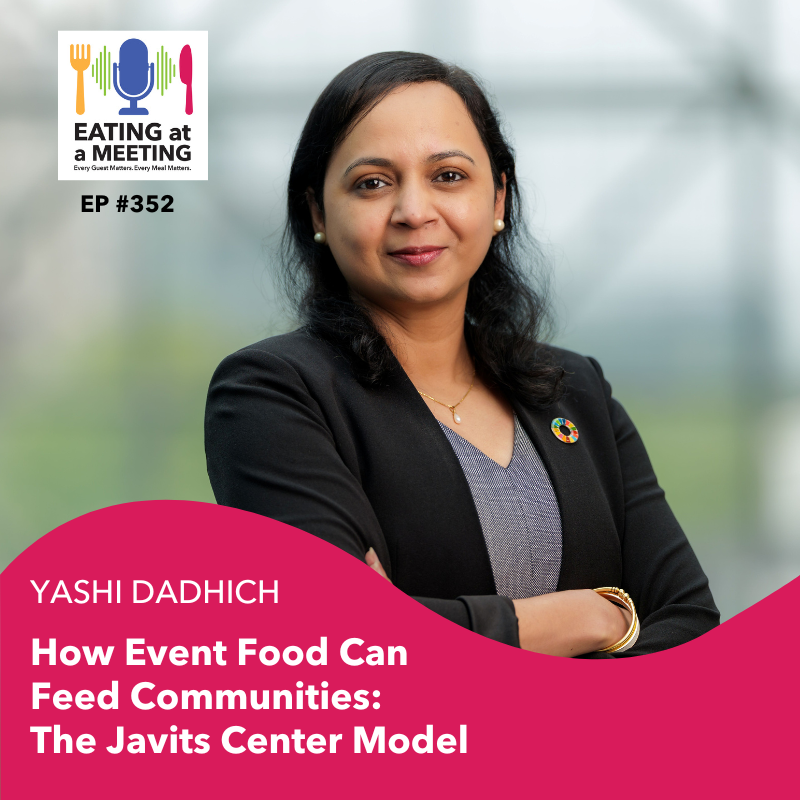
When I first toured the Javits Center rooftop farm back in October 2022, I walked past rows of lettuce, herbs, and apple trees on top of a convention center, tasted apples the chef had just brought down from the orchard, and went home with honey from the hives above the show floor. That visit completely changed how I think about what event food can do.
Now I’ll be talking with Yashi Dadhich, Director of Energy & Sustainability at the Javits Center, about how a convention center best known for massive trade shows is also growing tens of thousands of pounds of produce on its roof—using it first to feed attendees and staff—and then donating the surplus to help nourish their neighbors.
From a one-acre rooftop farm and greenhouse to partnerships with organizations like Rethink Food and local pantries, Javits has built a food donation program that connects:
• Farm-to-table menus for events
• Rescued prepared food and ingredients after events
• Community impact, feeding New Yorkers facing food insecurity
• Sustainability goals, including waste reduction and energy savings
For those of us planning meetings and events, this is a powerful blueprint for turning “leftovers” into impact—without sacrificing service, safety, or the bottom line.
We talk about:
• How their rooftop farm and kitchens are designed to reduce waste and maximize donation
• What it takes to build strong food-rescue partnerships
• How planners can plug into donation systems when they book a venue like Javits
• Why feeding your community should be part of your event success metrics
If you’ve ever looked at what’s left on the buffet and thought, there has to be a better way, you’ll want to join this conversation with Yashi and bring your questions about working with venues on food donation and rescue.
What do you want to know about donating event food or partnering with venues on food rescue?


Heard on the Episode
“We grow everything from arugula to zucchini and a lot of fruits, vegetables, herbs. It’s quite impressive that we are able to grow what we grow on a rooftop farm in the middle of a concrete jungle.”
~Yashi Dadhich 06:09
“We were able to donate about 80 tons of food last year … that’s mind blowing.”
~Yashi Dadhich 12:14
“Our first step is making sure the food safety regulations are met … we also get a certification from the state’s agriculture department—GAP Good Agricultural Practices.”
~Yashi Dadhich 15:20
“If you see anything on that floor that you would use at your home or put in your living room, then that means it can be donated.”
~Yashi Dadhich 44:16
Key Topics Discussed
Javits Center’s Rooftop Farm
Growing over 20,000 lbs of produce yearly
Greenhouse for year-round herbs
Collaboration across culinary, farming, engineering, cleaning, procurement
Food Donation and Community Impact
Donating surplus produce and event food (over 80 tons/year)
Pre-planning and partnerships with local organizations (food banks, nonprofits)
Tracking and data-driven reporting for impact
Food Safety and Certification
GAP (Good Agricultural Practices) certification
Documentation for donated and harvested produce
Rigorous standards for safe donation (temperature, packaging, vehicle refrigeration)
Waste Management & Zero Waste Operations
Internal composting for rooftop farm
Organic recycling: converting waste into bioslurry powering neighborhood energy
Diverting waste from landfill and reducing costs/emissions
Event Planning Best Practices
Total food utilization (menu planning, drying/canning, chef collaboration)
Aligning operational and client sustainability goals
“Javits Cares” initiative for donating non-food items (hangers, mattresses, displays)
Key Takeaways
Collaboration is key: cross-department teamwork enables farm-to-table and food donation success.
Pre-planning and setting strategy in advance dramatically cuts food waste and boosts community impact.
Robust food safety protocols (including certifications) ensure donated produce and meals are safe and compliant.
Waste diversion goes beyond compost—organic recycling can power buildings and reduce emissions.
Tracking, data collection, and aligning with partner organizations’ missions are essential for meaningful donation.
Tips
Start with a pre-event sustainability plan, no matter the venue’s resources.
Seek creative partnerships for food donation and surplus redistribution.
Track all donated items—not just food—for expanded community benefit.
Train teams to recognize donation opportunities in day-to-day operations.
Invest in waste management infrastructure, including composting and recycling.
Like what you heard? Subscribe to our newsletter for more episodes and insider content delivered right to your inbox!
Tracy Stuckrath [00:00:02]:
Hey everybody, and welcome to another episode of Eating at a Meeting. And this week, as I mentioned two weeks ago, that I was really focusing on how we can give back to our communities with the food and beverage that we serve at our events. And I'm excited to bring to you today Yashi Dotich, who is the director of Energy and Sustainability at the Javits center in New York City. They have a one acre garden, and correct me if maybe you've increased the size of it, a one acre garden on the rooftop of one of their buildings. And they, they grow vegetables, they grow honey. If you grow honey, they grow apples. And so we're going to talk about, Yashi and I are going to talk about how they do that and then actually the donations, how they actually feed the communities around them with the surplus food that they have from that farm today. So welcome to the show.
Tracy Stuckrath [00:00:52]:
How are you?
Yashi Dadhich [00:00:53]:
Thank you. I'm doing great, thanks. How are you?
Tracy Stuckrath [00:00:55]:
I am good. Okay, so tell everybody what. That's a big title. I said that to you a minute ago. Director of Energy and Sustain. Can you tell everybody what that means? Because that's really big title.
Yashi Dadhich [00:01:10]:
It really is. So it includes. I'm going to take a step back and I'm going to share what Javit center is.
Tracy Stuckrath [00:01:16]:
Yep, that'd be great.
Yashi Dadhich [00:01:17]:
And then I'll dive a little bit deeper into what I do here at Javits. So Javits center is six city blocks. We run from 34th Street street to 40th street, from 11th Avenue through 12th Avenue. Wow. And we have more than 3 million square feet total for our entire building. So as you can imagine, we, we have use a lot of energy within the building and we host a lot of events here as well. And we are also known to be one of the busiest convention centers in the country. And what I do coming back to my title is work with our multiple team.
Yashi Dadhich [00:02:02]:
We have a small sustainability team, but one thing that we take a lot of pride is it's not a silo. It's not just one department. We collaborate with multiple teams within Javits and that includes our engineers, that includes our electricians, cleaning teams, our farmers, our culinary team. On an everyday basis, that's my job, to kind of learn from different departments what they are doing in, then identify those areas of opportunity where we can collaborate and work towards our commitments and mandates that we comply towards.
Tracy Stuckrath [00:02:45]:
And who are just to jump in there, who are those commitments and mandates coming from? Is it the city? Is it your ownership? Is it the food and Beverage company. What is that?
Yashi Dadhich [00:02:56]:
We are a state entity, so we need to comply to some of the state regulations, which includes direct executive orders from our government, and we comply to those. And we also comply to some of the local laws that we have within the city. And then on top of that, we have our own commitments as an organization, as a corporate ourselves. My job in a nutshell is to make sure that we are complying to all the mandates and reaching our goals to get to our commitments as well.
Tracy Stuckrath [00:03:30]:
Well, and I want to say too, there's probably a commitment from some of your clients that are coming in who have their own corporate go that they want to put on top of yours, if you already. And so I'm sure maybe you're incorporating those in the end, in the long run after you've been given them.
Yashi Dadhich [00:03:46]:
Yes, and that happens all the time. So we have multiple events which we host, and many of those event management organizations, they have their own commitments. And one of the pledges, which is called the Net Zero Carbon Events pledge, our former CEO was actually involved in the creation of the pledge and we had a proud signatory of that pledge. So multiple events that we host are also the signatories of the same pledge. So there is alignment in that. So when they're coming to us to host their event, they have certain requirements, certain expectations, and they many a times are pleasantly surprised with multiple initiatives in the practices that we have in place. Because when they are coming here, they start with the very basics and we are already above and beyond in multiple of those areas.
Tracy Stuckrath [00:04:44]:
That's amazing because it's. There's planners who don't necessarily know, hey, we've got. I'm starting out in this journey of sustainability and in reaching these goals. And. And you're already there saying, hey, we've got your back. You know, we've got these goals that we've already, that we set for ourselves that actually help you in ways that you may not have thought of.
Yashi Dadhich [00:05:05]:
Yeah. So that happens a lot. And many times I would also share that events come to us where they have no idea about it and they have all those big goals. And in turn, what happens is it becomes more of an educational journey for the clients and we provide them the resources that they would need and then we help them and support them in meeting their own goals from that particular event, while also making sure that we are complying and meeting our own commitments too.
Tracy Stuckrath [00:05:39]:
That's fantastic. Now let's talk about the farm and the donation aspect of this. So I said earlier that it's an acre farm. Is it still just an acre? Just an acre?
Yashi Dadhich [00:05:49]:
Yes, it is. Yes.
Tracy Stuckrath [00:05:51]:
You can't grow the building.
Yashi Dadhich [00:05:53]:
Yes. We have the one acre rooftop farm and we also have 3,500 square feet greenhouse.
Tracy Stuckrath [00:05:59]:
Okay.
Yashi Dadhich [00:06:00]:
On the rooftop.
Tracy Stuckrath [00:06:01]:
And what. So I mentioned vegetables and I mentioned apples. What do you grow on that farm and in that greenhouse?
Yashi Dadhich [00:06:09]:
Yes. So when we are having these conversations with members of our local community and many a times our clients as well, we take a lot of pride in sharing that we grow everything on this tiny farm, which is only an acre. If you think about it, it's not such a big footprint, but we grow everything from A to Z, including from arugula to zucchini and a lot of fruits, vegetables, herbs. It's quite impressive that we are able to grow what we grow on a rooftop farm in the middle of a concrete jungle.
Tracy Stuckrath [00:06:47]:
Right, exactly. And how much, I mean, are you growing enough to. You're not, I'm going to say, I'm going to assume that you're not growing enough to feed a 17,000 person convention.
Yashi Dadhich [00:07:00]:
No, it's not. But what we do is we are growing about £20,000 per year. But again, you know, it depends because we are growing a lot of herbs also. Okay. So it's smaller even though it's smaller weight, poundage wise. But the impact of it is huge in terms of utilizing our own resources within Javits center, reducing the waste and saving some cost associated with specifically the herbs. Because as you can imagine, herbs are expensive when you go and purchase it from an outside vendor. And one of the requirements specifically for the herbs is you have to purchase a minimum of one kilo of any herb that you want to use.
Tracy Stuckrath [00:07:49]:
Wow.
Yashi Dadhich [00:07:50]:
And even though we host events with so many attendees, the culinary team doesn't need that much herbs all the time. So what we did was there is again, going back to my initial point of it requires a lot of collaboration. So the team sustainability team at Javits works very closely with the farmers, with the culinary team and, and all of us come together and identify those areas of opportunity and then plan ahead. So we are always working a year ahead as to what the farm is going to look like and what are we going to grow during the peak season. And that's what we came up with last year, that why don't we utilize our greenhouse space to grow some herbs in that way we can have fresh herbs throughout the year.
Tracy Stuckrath [00:08:45]:
Well, and is there an opportunity also to dry your own herbs? You know, like.
Yashi Dadhich [00:08:49]:
So there is.
Tracy Stuckrath [00:08:50]:
So that you're also or canning any of the vegetables and things that you have there so that you can use them later on in the year when that's out of season.
Yashi Dadhich [00:08:59]:
Absolutely. So we do practice something called total food utilization. Okay. So any of the produce that we are harvesting on our farm, we try to utilize majority of it within our own operations, either for our clients or for our own stakeholders, especially our own team members. We do use a lot of basil to create pesto sauce, and we use it for a lot of pastas.
Tracy Stuckrath [00:09:28]:
Okay, well, and then what do you. And then I'm assuming, because I know you do donate the what you don't need at that time, how have you incorporated it into feeding the community that you serve?
Yashi Dadhich [00:09:41]:
Absolutely, yeah. So we take a lot of pride in being a good neighbor within this area. And what we do is our first goal any given time is our client who we are serving and making sure that our client needs are met, but at the same time ensuring that there is no food going to waste from our operations. So specifically, when we talk about the food grown at the farm, the peak season for the farm is the summer time. And it's the same time when it's a little bit slower on our events. So the way we try to balance it is that's the time that we would open it up to the local community and engage with our local community partners to make sure that we are able to utilize all this nutritious, nutrition, dense food that we have grown right here and then extend that to address the food insecurity within the city.
Tracy Stuckrath [00:10:50]:
And that's kind of amazing. And for people who are listening, who are not event planners. Right. I mean, there's a peak season of spring and fall. Right. You know, outside of the peak season of growing on a farm. And so that's really important to know. I mean, you are still growing, growing during those time frames, but your bulk of that with the amount of sun that you get during the summertime, especially on a really tall building, that's really interesting thing to think about in what you have to also collaborate with all the departments in the building.
Yashi Dadhich [00:11:22]:
Yeah, we collaborate internally with multiple teams. We collaborate with our local vendors, local community partners, and we truly believe in having that positive impact. And the collaboration that we work towards, it just leads to that multiplier impact. And that's where like we start seeing the progress that we want to see as a society.
Tracy Stuckrath [00:11:49]:
Yeah.
Yashi Dadhich [00:11:50]:
How.
Tracy Stuckrath [00:11:51]:
I'm going to jump into some. Some specifics, but do you have numbers on how much you've donated to the local Community. And then I want to jump into how we do that.
Yashi Dadhich [00:11:59]:
Yes. So specifically about food. We were able to donate about 80 pounds of food last year in 2024 and this year.
Tracy Stuckrath [00:12:11]:
Not 80 pounds. 80. You said 80 pounds. 80.
Yashi Dadhich [00:12:14]:
I'm sorry, 80 tons.
Tracy Stuckrath [00:12:15]:
80 tons, okay.
Yashi Dadhich [00:12:16]:
Because yes, 80,000 was actually more than 80,000 was only from one event in summer. That's mind blowing. It's a specifically, specifically food related show. Okay. And we have about £86,000 from that one event. 99. And recently, like literally last 10 days, we had another produce show and we donated about 39,000 pounds pounds.
Tracy Stuckrath [00:12:49]:
Wow.
Yashi Dadhich [00:12:50]:
Food within the local community.
Tracy Stuckrath [00:12:52]:
And that was, and just for, for clarification, that was food that vendors brought in as well to be in their booths and things. And so instead of that going into the trash, you were able to repurpose. So it wasn't just what was in the, what was grown on the farm, it was what was brought in by those suppliers or those exhibitors.
Yashi Dadhich [00:13:13]:
Yes. And there is like I'll take a minute to give a shout out to the event producers in the show management and the exhibitors for that too because they recognize before coming to Javits that they will have that amount of food left over. And then they engage with some of the local community partners before time. And then on our end we make sure the logistics are in place and we support in different areas and collect all the data.
Tracy Stuckrath [00:13:46]:
That's really cool because I think that's another valid point. So they're coming with some of the donors. They've already got a list of people they want to donate to. So it's not relying on you picking those vendors and those donors. But it's a collaboration between the planner and the venue.
Yashi Dadhich [00:14:02]:
Yes. And that's usually just one partner within the local community. And then we do have events when they come in and they haven't planned it ahead of time. So towards the tail end of it, we find that there is like maybe 100 sandwiches which were boxed and were not used. So at that point we work again with our local established community partners and then we donate it to them to ensure one of the most important things for us is to make sure that the food is safe to donate no matter where it is coming from, even if it's coming from the event or if it is coming from our farm. So we ensure that all those standards are met before we donate anything.
Tracy Stuckrath [00:14:53]:
And that's really, really important because I think a lot of people, a lot of planners get pushback from venues all over the country saying, well, we can't donate because we're going to get sued, you know, or we could potentially get sued for food safety reasons, but can you walk through that? And I know under. I was talking about it the other day, actually yesterday, you know, the Food Donation Improvement act helps reduces that liability or. And nobody's been sued under it.
Yashi Dadhich [00:15:20]:
I will still say that even at Chavez, even though we donate a lot of food, our first step is making sure the food safety regulations are met. So that is a very big priority for us. And going back to even the produce from our farm that we donate, we ensure that it meets all the food regulations. And to that point, we also get a certification from the state's agriculture department. And it's an annual certification which is called GAP Good Agricultural Practices, which ensures that the any kind of food that is harvested from our farm is safe for consumption and it is safe for donation.
Tracy Stuckrath [00:16:08]:
That's fantastic. And what are the additional. I mean, are there any steps that you have to document that you have to provide to those donation company or the companies that are coming to pick it up to show that it's safe?
Yashi Dadhich [00:16:24]:
So our GAP certification definitely helps. It's very stringent in our farmers keep up on every day to make sure everything is logged and everything is food safe. And any, anything that they see, even like, you know, something which is looking a little wilted, they would not take the chances. And so, like, even, like I would say, if the requirement is that you need to be at from A to Z somewhere in the middle of it. Our team's culinary team and our farmer's team, they go above and beyond to make sure that it is not 100%, but it's a 200%. Because we do not want to risk anything in terms of, especially with food. We want to address food insecurity within the community, but we want to be very careful about it as well.
Tracy Stuckrath [00:17:17]:
Right. And two weeks ago, my guest was talking about, like, the pallets of food that some people will deny because the box fell over a box. So they're not going to take the entire shipment. And so that's where we have to look at that address. And so I love the fact that you're talking about that and you're not going to throw the entire crop away, but you're going to look at how, you know, what you can do with it from that point forward. So kind of talked about this a little bit. But from. Can you walk us through that journey of tomato or an apple, you know, and from the rooftop farm to the greenhouse into the event menus.
Tracy Stuckrath [00:17:52]:
And you said it's like a year long planning. I'm like, you're thinking about what you're growing for, Chef to design the menus.
Yashi Dadhich [00:17:58]:
Yes. So tomato is actually a great example.
Tracy Stuckrath [00:18:01]:
Okay.
Yashi Dadhich [00:18:02]:
And in 2025, we are just wrapping up the report. So we harvested about 1200 pounds of tomatoes, seven different categories, varieties of. And yeah. And again, going back to how collaboration within our own teams is at the heart of our operations.
Tracy Stuckrath [00:18:24]:
Okay.
Yashi Dadhich [00:18:25]:
So our culinary team meets with the sustainability team and our farmers each week during the peak season during summer. And we actually have those meetings from March through November. And we look at the farm. That's the first thing that we do every Monday morning. That's my first meeting, by the way, of the week. And that's my favorite, hands down. So what we are looking at is where are we in the growing cycle and then how much like harvest are we expecting from the farmer's side? And on the culinary side, we try to align it with the events.
Tracy Stuckrath [00:19:05]:
Okay, that.
Yashi Dadhich [00:19:06]:
Okay, this is looking great. And then it goes to the point where, oh, this tomato is a little too small. Maybe we need a little bit bigger for this event, specifically for that particular dish that the chef is working.
Tracy Stuckrath [00:19:19]:
Right.
Yashi Dadhich [00:19:19]:
Or the other way around too. It works both ways. And then once that is done, then it keeps going to the next phase of it. That, okay, this is what we have done now. We have the next event coming in. And what we also do is during the planning phase of it, we identify that each crop has its peak kind of time of the year where it will taste at its best. So tomatoes are our star crops, especially during the summer months because they are at its peak. And then during the rest of the months, they are like a staple crop.
Yashi Dadhich [00:20:02]:
So we work that kind of concept into our catering menu as well. So when the culinary team in our sales team are having those conversations with our clients and potential clients, they already have that embedded into their menus. And they present it in a way where it is always mentioned that, you know, it's coming from our farm. So it highlights that those benefits that an event has when they're choosing Javits as their venue for the event, you've.
Tracy Stuckrath [00:20:40]:
Got all these dishes and maybe 500 people.
Yashi Dadhich [00:20:43]:
You.
Tracy Stuckrath [00:20:43]:
They said 500 people were coming and only 400 people come. What. What is the next step in that whole process?
Yashi Dadhich [00:20:50]:
Yeah, and that always happens. No matter where you talk to which culinary team you talk to, it's always better. Even in our homes, right. When we are hosting somebody we would always have a little bit extra, then we would have less. Right. So it's the same concept, especially like when we are talking about events at a bigger scale. So there is always that surplus food which is there. And once we know that the event is wrapped up and all attendees are done with their meals and the food is still intact, packaged in the correct boxes, it was maintained at the same temperature throughout the day, then only we open it up to the local community and then it goes to the point where, okay, we have this.
Yashi Dadhich [00:21:44]:
And then they may also make sure that it is, they understand that it is time sensitive.
Tracy Stuckrath [00:21:49]:
Okay.
Yashi Dadhich [00:21:49]:
So they'll come and pick it up within that time frame. And then only we donate it many a times if something needs refrigeration, then we donate it when we're donating it during that planning process, we ensure that the vehicle that is coming to pick up the food or the produce is refrigerated.
Tracy Stuckrath [00:22:09]:
Okay. Yeah. I mean, that's a lot of different things to think through. And, and, and, and when you think through an event menu kind of like that, I'm like, okay, so you have 500 people coming for a filet mignon, mashed potatoes, asparagus, that's very bland buffet plated dinner or whatever. But it's not something that was in a chafing dish. Right. It's something completely different. And so.
Tracy Stuckrath [00:22:36]:
Well, and maybe it's still in a chafing dish in the back of the house, but those are the things that you have to think through. And one of the things that I think probably some venues stop doing this or don't do it is because of that thought process that Those steps, those SOPs, standard operating procedures to make sure that, hey, you've got this the right way so that it's easy to donate. And I guess that comes with each different partner that you, you've selected in the community, right?
Yashi Dadhich [00:23:04]:
Yeah. And it also depends on the event in itself.
Tracy Stuckrath [00:23:08]:
Okay.
Yashi Dadhich [00:23:08]:
Because what kind of food are they planning to serve to their attendees? Because to your point, if it was a plated meal, then the possibility of it being donated of anything which is left over are very slim because it was already exposed and then it would not comply under those food safety regulations.
Tracy Stuckrath [00:23:32]:
Okay.
Yashi Dadhich [00:23:33]:
So it depends on what is the client looking for. And then we work around that.
Tracy Stuckrath [00:23:39]:
Okay.
Yashi Dadhich [00:23:40]:
And anything that we are not able to donate because of the food safety regulations, we work very closely with our cleaning teams.
Tracy Stuckrath [00:23:50]:
Okay.
Yashi Dadhich [00:23:51]:
Capture all of that and then send it for composting.
Tracy Stuckrath [00:23:55]:
Okay. And is there local composting in New York in downtown New York City.
Yashi Dadhich [00:24:02]:
I'll answer that question in two ways.
Tracy Stuckrath [00:24:04]:
Okay.
Yashi Dadhich [00:24:04]:
One is going to the farm, because we take a lot of pride in being zero waste operations. And so nothing goes out of that farm. Actually, we have multiple compost bays on the rooftop right next to the farm, and any of that organic matter or the produce which is not safe for consumption is composted right there.
Tracy Stuckrath [00:24:29]:
Oh, wow.
Yashi Dadhich [00:24:29]:
And is actually at the end of the year collected, and that compost is spread back for the following year.
Tracy Stuckrath [00:24:37]:
It's put on your own farm.
Yashi Dadhich [00:24:39]:
Yeah.
Tracy Stuckrath [00:24:40]:
Wow. Okay. All right. That's awesome.
Yashi Dadhich [00:24:42]:
So last year was an amazing time, exciting time for Javits because we did not purchase any outside compost.
Tracy Stuckrath [00:24:53]:
That's huge. Wow. And that's everything.
Yashi Dadhich [00:24:58]:
Yes, yes. So it not only reduce. Helps us in reducing the waste, the organic waste, we are also reducing the emissions. We are reducing the cost associated with the purchase of the compost that needs to be spread back onto the farm. And not just that, because the quality is so high for that compost, it is nutrient dense. So the next year's crop and the entire harvest cycle produces that kind of yield.
Tracy Stuckrath [00:25:30]:
That's amazing.
Yashi Dadhich [00:25:31]:
Excited?
Tracy Stuckrath [00:25:31]:
Yeah. They're. Why Boston Resort in London or in. In the uk, They're. It's a huge property. Lots and lots of acres. The actual golf attendant said, Superintendent said, please stop giving me your compost because I'm having to cut the grass more often because it was so nutrient dense. It is.
Yashi Dadhich [00:25:51]:
It really is very nutrient dense. And then I also wanted to expand on that a little bit further. To answer your question completely, the second part of the food waste is that is collected from our own operations, from the events we collect that. And it's a process which is called organic recycling. And that's actually a preferred way than composting. So what it does is it goes to a facility very close to Javits, and all of the organic waste is collected and converted into an engineered bioslerry. Bio.
Tracy Stuckrath [00:26:32]:
Is that bio sludge? Okay, yes.
Yashi Dadhich [00:26:35]:
Okay, exactly. Biosludge. It's. The technical term is engineered bioslurry.
Tracy Stuckrath [00:26:41]:
Okay.
Yashi Dadhich [00:26:42]:
So once that slurry or sludge is created from the organic waste, then that is transported literally within three miles to a waste water treatment plant. And it goes through that entire process over there. And ultimately that is used for energy and powering up multiple residential and commercial buildings in Brooklyn.
Tracy Stuckrath [00:27:08]:
Wait, so your. Your sludge, slurry is powering, like, energy, like putting the lights on and some houses?
Yashi Dadhich [00:27:17]:
Yes, ma'. Am. Yep.
Tracy Stuckrath [00:27:19]:
That's amazing.
Yashi Dadhich [00:27:20]:
It Is it is super cool. Because not a lot of people think about it when we are talking about organics waste. Organics waste has a lot of different ways to be put it back into our own society, into our own community in different ways. And which is beyond composting because that's one that everybody thinks of. And we take a lot of pride in different ways in which we are diverting our own organics waste to JavaScript Center.
Tracy Stuckrath [00:27:54]:
That's just mind blowing. And it's exciting to think through that. Hey, in your goal of being zero waste. And we can talk into what that means. Exactly. And I think I want to mention posts that I saw on LinkedIn too is like the waste that comes from the containers that the food is just given to you or sold to you from your food distribution companies, et cetera. But it shows that the partners that we have in venues are doing a lot more than we think they are.
Yashi Dadhich [00:28:28]:
That's correct. So I'm happy to kind of elaborate a little bit on that. So we work again, going back to my initial opening remark that we work with multiple teams. And one of the teams that we work very closely is our procurement team. So we work with them to help them identify some of the language and then also kind of those metrics to identify which are the vendors when we are evaluating a particular RFP that this particular vendor is getting more higher score because of these different initiatives that they have on their end. So that's one. And then what we have also done is with the help of our culinary team, we have created a tier system. So when an event is coming to us and they say that they want to have plastic cups for water.
Yashi Dadhich [00:29:27]:
So what that brochure includes is multiple different options for any kind of serviceware that any client will probably need for their event. And that includes multiple options. So one being the most sustainable and then there is one in the middle and then one being the least sustainable option. So all of our teams combined are nudging the client during the conversations towards the making the correct choices.
Tracy Stuckrath [00:30:01]:
And I love that because it's a team effort. It's not just one. It's not the CSM pushing this. It's the variety of different people that the CSM interacts with that helps make our events successful. Because it's not just that one person. That person is working with everybody in your building to make it successful.
Yashi Dadhich [00:30:22]:
Yeah, everybody. Like it's at the heart of our operations.
Tracy Stuckrath [00:30:26]:
I would say that's fantastic.
Yashi Dadhich [00:30:28]:
So.
Tracy Stuckrath [00:30:31]:
What elements of your approach can be adopted by other convention centers and hotels and venues that, that don't have a rooftop farm, that don't do this. And I really want to think through on the food donation side of that too, like what can we think through and how can those other venues do the same thing that you're doing?
Yashi Dadhich [00:30:53]:
Yeah. So one thing very important to understand is each venue, each hotel has their own story. This is our story. And we definitely want to inspire others to create their own story and identify what kind of impact they want to have. This was in our roots, this was in our vision, which turned, transformed into our purpose. And all the teams come together to help us reach that purpose and we work collaboratively on that. But to give answer to your question, one simple thing is engaging in pre planning that helps cut the waste at the end of any event, any kind of initiative. And that's something that can be used cross sector, not just for events, not just for venues.
Yashi Dadhich [00:31:51]:
If there is that strategy put together in that pre planning phase, then the outcomes are always like better planned and better resources are deployed for it.
Tracy Stuckrath [00:32:04]:
No, that's so true. And it can't be a last minute thing. You have to think through it across the board. And I think planners have to put this in their RFPs and saying, hey, what can you do? And I want to jump into the thinking through those partners that you have for donating the food. And I know it depends on the event, whether it's chafing dishes or plated food or whatever, but how do you go about finding those organizations? And I'm sure because of what you've done, more and more organizations know who you are and what you're doing. But I mean, because there are people like you've got a food bank which is going to take more prepackaged food than maybe a Meals on wheels. Right. Kind of organization.
Tracy Stuckrath [00:32:45]:
How do you pick those organizations to work with?
Yashi Dadhich [00:32:49]:
Yeah. Couple of things that we want to make sure is A, that our mission, missions align because that's ultimately what we're trying to do. And if we are looking to collaborate with any other organization, we want to make sure that there is that synergies which are aligning at the very beginning of it. And then secondly, we also make sure that it's many a times when you look at those kind of collaborations, the missions might align, but the processes might not align.
Tracy Stuckrath [00:33:26]:
Okay.
Yashi Dadhich [00:33:26]:
Because for us it's very important that it's not just the talk. We want to walk the walk till the end of it.
Tracy Stuckrath [00:33:35]:
Okay.
Yashi Dadhich [00:33:35]:
And we want to capture the data. So when we say that we donate food from our farm or we are donating food from our events, we make sure, and we double check on our end also that it is going where it's supposed to go and it has been utilized the way it is supposed to be utilized. So we just don't leave it at a very high level that it was donated and that's it. We want to know where exactly it went.
Tracy Stuckrath [00:34:06]:
Okay.
Yashi Dadhich [00:34:07]:
And in terms of the food from our farm, we go and we volunteer also and sometimes which are then donated to the local community. Yeah.
Tracy Stuckrath [00:34:19]:
Oh, that's so cool. So you're, you're also donating your time outside of just your food?
Yashi Dadhich [00:34:25]:
We do, yes, we do try to do that a couple of times in a year. And then one of the most important elements for us is to track progress.
Tracy Stuckrath [00:34:37]:
Okay.
Yashi Dadhich [00:34:38]:
Around this. And anytime we're looking to collaborate with any of the local community partners, data is very important for us. So we make sure that we are not only kind of making sure that things are going where they're supposed to go, but we are also capturing the information, we are also capturing the data to be able to log that back into our own progress.
Tracy Stuckrath [00:35:04]:
So what are some of those metrics that you are capturing when looking at those partners and then internally as well?
Yashi Dadhich [00:35:11]:
Absolutely. So waste is a very, very big topic for us, as you can imagine. And if we talk only about food related waste, so we track it internally within our kitchens. Our culinary team has a state of the art system which is called waste not 2.0. So it's a AI equipment where, you know, all our teams, when they're prepping something within the kitchen, they take pictures of it and then it knows that if you're putting anything in the trash, was it part of the food prep or was it towards the end of the meal? Everything that is captured within our kitchen is tracked with all of the teams and is shared back with the sustainability team. In terms of the food waste that is going for, the organic recycling for being converted into the slurry or the sludge. That data is shared with us from our waste hauler because they are the ones responsible for it. So we track that very closely as well.
Yashi Dadhich [00:36:21]:
Then anything coming from the events which is being donated. We work very closely with wherever the food is being donated and ensure that we get how many meals were donated or how many pounds of produce was donated and what was it ultimately used for and where was it donated.
Tracy Stuckrath [00:36:40]:
Yeah, because you might give a couple of heads of lettuce or more than a couple of heads, but you know, and what did they do with that lettuce or that cabbage? You know, how was that utilized? And cause the food bank could then give that head of lettuce or that head of cabbage to somebody to take home and eat. Or they could have made it into slaw at their own venue to feed people.
Yashi Dadhich [00:37:02]:
Yep, absolutely.
Tracy Stuckrath [00:37:04]:
And how have. And I'm. I'm assuming planners have, you know, even the ones that haven't thought about it, and even the ones that have thought about it and are. To the level of you are. What has their engagement been in. In this entire process?
Yashi Dadhich [00:37:19]:
So, as I mentioned, you know, we host multiple different kinds of. Of events. So it always depends on what kind of the event it is and then their own priorities. We might host an event where sustainability waste is not at all on their agenda. And we also host events which are not only focused on reducing their food waste, but are also focused on engaging with the attendees and educating them about making those correct choices, not just for that particular event, but continuing that even in their personal lives too.
Tracy Stuckrath [00:38:00]:
That's interesting.
Yashi Dadhich [00:38:01]:
So, yeah, yeah, yeah, we, we work with a wide range of events.
Tracy Stuckrath [00:38:07]:
There was years ago when I worked the Vancouver Olympics, which was 2010. After the Olympics, it came back, went back there for mpi, wec and. But I remember their napkins that had stats on it, talking about when they built the building, how they worked to make sure that the water. Because it's built over water. Similar. You guys are right near water too. Like, how did you protect. How did they protect that environment? Right.
Tracy Stuckrath [00:38:33]:
How did. What did they give back? And, and I think. And I, I loved it because it was educating the people who were attending the event, not just the planners. And that sounds like what you guys are doing.
Yashi Dadhich [00:38:44]:
Yeah. And in fact, we do have an event coming in, a first event of the next year. They are planning to engage their attendees in multiple activities, and one of them includes pickling.
Tracy Stuckrath [00:38:58]:
Oh, fun.
Yashi Dadhich [00:38:59]:
Yeah, yeah. So they want to. They want to educate the attendees that vegetables don't need to be thrown away all the time. You can be creative and creative. Make pickles.
Tracy Stuckrath [00:39:12]:
I need to introduce you to that chef that I was talking about before we came on air, the Zero Waste chef and what he's teaching people. And there's a couple actually in New York as well that I would love to introduce you to, because there it's in that mindset, and I think it's. But we do have to educate our attendees and ourselves as planners on how we can give back to our communities through food donation, but also by reducing the amount of waste that we produce from our events.
Yashi Dadhich [00:39:43]:
It's very, very important.
Tracy Stuckrath [00:39:44]:
Yeah. I was chatting with somebody the other day. This has nothing to do with food, but it was a planner that's saying, yeah, and oh, hey. And management came in and said, we're changing our entire theme for this convention and now we have to trash everything that was already produced. And I'm like, okay. I just thought about all that signage, all of that stuff that was already pre printed with those logos. Where does all that go? Thankfully, it wasn't food. And then actually another Planner posted on LinkedIn a couple of weeks ago that she couldn't make her food and beverage minimum, so she partnered with the convention center or the hotel for them to prepare food for a community organization to spend that money to meet their minimum, to put it out into the community instead.
Tracy Stuckrath [00:40:30]:
And I love it because she's like, we've already elevated our food to the highest level that we could get to meet the demographics. And that's the solution that they came up with together, which is a great solution. I muted myself by accident. I told you I was going to do that. You know what, what sparks and what continues to spark this Javits, the Javits Cares program. I'm like, what is. And this is going to be a really funny pun, but what sparks the electrician, you know, to keep doing this and all the different department. What are, what are they getting out of this?
Yashi Dadhich [00:41:06]:
What are they getting out of it? I'll answer that first. They get. They take a lot of pride, Tracy, in what they do. We had an event recently where the sustainability team was not informed or not involved in it at all. That event had a lot of merchandise that they sold during the event, which included T shirts, sweatshirts, sweatpants, like, you know, all kind of apparel merchandise for the event. And you would expect that, okay, there will be some hangers, but you would not expect about 35,000 hangers. What left?
Tracy Stuckrath [00:41:49]:
Wow. What do you do with that?
Yashi Dadhich [00:41:52]:
As I said, I had no idea about it. Neither did my team. So the cleaning team, they were the ones who took the initiative. They saw it and they were like, oh, wait a minute, this is something that can be reused. So they started collecting it. And there was only one person in the back of the house on that particular day and that person took the charge of collecting all the hangers and putting them in the bags.
Tracy Stuckrath [00:42:21]:
Wow.
Yashi Dadhich [00:42:22]:
And fast forward, we had 35, more than 35,000 hangers. Multiple pallets were full, our dock was full. Even a 30 yard open top dumpster was full. Wow. So it's kudos to the person who identified that opportunity right then and there and acted immediately upon it that, no, this should not go in waste. This should be stored. And then let's check with our sustainability team. And we were able to capture it.
Yashi Dadhich [00:42:57]:
We stored it. It took us some time to align with the local partners, and we were able to donate it. More than half of it has already been picked up, and we're waiting for the last portion of it to be picked up this week.
Tracy Stuckrath [00:43:12]:
And are there hangers being used by companies that are. Have clothes to give to people or is it being melted to make more hangers?
Yashi Dadhich [00:43:21]:
Oh, no, no. So it is not being recycled. It is being reused within New York area and it is actually being used by goodwill. And multiple local entities came together to help us identify which local organization can use that amount. It's a lot. Yeah, it was a lot. Lot of hangers that we had. So, Tracy, going back to your question of what sparks us to do that, it's that commitment.
Yashi Dadhich [00:43:55]:
It's that pride moment which our team members take in doing something for the community. That's what drives us. And obviously, like, we have our data that we track, we have our own commitments that we need to make sure that we are meeting in terms of our waste diversion from the landfill. But also, there is that simple training to the multiple teams that we work with that, hey, listen, if you see anything on that floor that you will use at your home or you will put it in your living room, then that means that can be donated. So they just move it into the area. And we work with the local community partners. We had an event recently which left multiple mattresses, and those mattresses and the display units from that particular event were donated to veterans in the area.
Tracy Stuckrath [00:44:55]:
Wow.
Yashi Dadhich [00:44:55]:
Wow. So we get. We get a lot of, like that positive story out of it. Instead of just dumping those things, all those items into waste.
Tracy Stuckrath [00:45:07]:
And I just go to the cost of that.
Yashi Dadhich [00:45:09]:
Cost of that.
Tracy Stuckrath [00:45:10]:
I don't know. I feel like I'm echoing the.
Yashi Dadhich [00:45:14]:
The.
Tracy Stuckrath [00:45:14]:
You're having to pay a hauler to come get that from you. So there's an expense to that. And do you put that back on the planner and charge them for that hauling or.
Yashi Dadhich [00:45:25]:
We do.
Tracy Stuckrath [00:45:25]:
Okay.
Yashi Dadhich [00:45:25]:
Yes.
Tracy Stuckrath [00:45:26]:
Okay.
Yashi Dadhich [00:45:27]:
Yes. Because this is the initiative that we at Javits have, which is called the Javits Cares. If we didn't have that, all those items were left behind to be trashed. So even hangers, mattresses, they were all left behind to be trashed. If we didn't have that program in place. And if our cleaning teams are. Multiple teams did not get involved in all this process, they would still be paying for the trash, and it would be actually going to the landfill.
Tracy Stuckrath [00:45:59]:
Wow.
Yashi Dadhich [00:45:59]:
But this program helps us in diverting, not only diverting this waste from our landfill, but it also helps us in being that good neighbor that we want to be.
Tracy Stuckrath [00:46:11]:
Okay, on that note, is there any specific story from your food donations that really sticks out to you?
Yashi Dadhich [00:46:18]:
So I would go to the summer months, especially for our farm season, because that's the peak of the farm season. You know, every single crop loves that season. They, you know.
Tracy Stuckrath [00:46:30]:
Right.
Yashi Dadhich [00:46:31]:
It's at the peak, the taste wise, everything. So what we did, and we started this last year and where we usually donate our food from the farm to this particular, like, local community partner. And what we did differently was they have their own. Own culinary team, their chefs.
Tracy Stuckrath [00:46:55]:
Okay.
Yashi Dadhich [00:46:56]:
So the two chefs teams are on. And theirs. The two chef teams combined together and they collaborated to create meals. And all of those meals, like, more than 1500 meals, were donated locally to, like, different. Different organizations where they could be using those meals. So, like, when we launched this program last year, we donated it to Covenant House for the Youth, and we supported them. And this year we donated it to alliance for Positive Change, and that was to support all New Yorkers in need, especially who are dealing with chronic health issues.
Tracy Stuckrath [00:47:42]:
Okay, nice.
Yashi Dadhich [00:47:44]:
So, and the planning of it was very thoughtful in the sense that it was not just like one dish was created. It was balanced, nutritious meal, which was created. It had protein, it had options for vegetarians. It had carbs in it. It had all the different nutrients that you would need in a balanced meal.
Tracy Stuckrath [00:48:09]:
With food that was grown organically with the best possible composting. Yeah.
Yashi Dadhich [00:48:15]:
Yes. And then obviously it needs to be supported. We don't grow rice or pasta.
Tracy Stuckrath [00:48:19]:
Yeah, yeah. That would be another big endeavor.
Yashi Dadhich [00:48:24]:
Yeah.
Tracy Stuckrath [00:48:26]:
All right, so are there any goals that you have for 2026?
Yashi Dadhich [00:48:30]:
2026? We want to continue having that impact within our community. We want to continue increasing that waste diversion where organics is one area that we are focusing on. We want to continue making sure that we divert the organics from landfill, because as you probably already know, the emissions, carbon emissions from the organics is way more than the other waste streams that we have here at Javitston. We will continue working on meeting our own commitments and working towards reducing our waste.
Tracy Stuckrath [00:49:10]:
Okay. All right. Can I ask you a couple of rapid fire questions?
Yashi Dadhich [00:49:14]:
Yep.
Tracy Stuckrath [00:49:14]:
What's your favorite Crop that grows at the Javits Center. Is there anything that's growing right now?
Yashi Dadhich [00:49:20]:
Carrots.
Tracy Stuckrath [00:49:21]:
Carrots. Okay.
Yashi Dadhich [00:49:22]:
They are so sweet and tender right now. I don't think I've ever tasted carrots this delicious ever. Wow.
Tracy Stuckrath [00:49:32]:
Okay, what's a farm to table dish that you that served at Javits that you wish that every planner could taste at least once?
Yashi Dadhich [00:49:41]:
Beet salad.
Tracy Stuckrath [00:49:42]:
Oh, my gosh. I love beet salad. How do you make What's. What's added to that beet salad?
Yashi Dadhich [00:49:47]:
Arugula, I would say, obviously, beets. And our chefs, they do a magical job with it. They create it in a way that there are multiple textures which are combined. And, like, the way it looks, it looks aesthetically pleasing because they incorporate not just the greens in the red from arugula, from beetroot, but also they decorate it with the herbs grown right in our greenhouse. So from aesthetics to the palette, it's delicious.
Tracy Stuckrath [00:50:21]:
Okay. Awesome. One sustainability habit. You'd love every event, event attendee to adopt today.
Yashi Dadhich [00:50:30]:
I would say pause before you throw your trash, because whatever is that waste receptacle, it takes only a fraction of a second to recognize that what needs to go where. And if you do your part, it's going to help all of us and our future generations.
Tracy Stuckrath [00:50:51]:
I love that. Okay, partners aside, what word would you hope people use to describe Javits? Food, donation, Work.
Yashi Dadhich [00:51:01]:
Community. We want to be that good neighbor in our local community. We want to support our local community because when communities thrive, we all do better as a society.
Tracy Stuckrath [00:51:14]:
Yep. Okay. And then last that I've been asking, everybody is finish the sentence. Every meal should.
Yashi Dadhich [00:51:23]:
Every meal should be fun.
Tracy Stuckrath [00:51:25]:
Oh, I like that. Yeah. And you.
Yashi Dadhich [00:51:28]:
Yeah. It shouldn't be boring, because if it's boring, then you won't enjoy it, and then there will be a part of it which will be left over. If it's fun, you will always finish it.
Tracy Stuckrath [00:51:39]:
That is so true. Yeah. Fun and delicious. Exactly. Yeah.
Yashi Dadhich [00:51:44]:
Yeah.
Tracy Stuckrath [00:51:44]:
Yashi, how can everybody find out about Javit center? And how can they connect with you if they have any questions?
Yashi Dadhich [00:51:53]:
Absolutely. Javit Center. We are on multiple social media channels, including LinkedIn, Instagram, and We are very active. Our amazing marketing and communications team is always on it, and they're very responsive to any requests that come our way. Our website is javacenter.com we have a sustainability page. You can go on that, take a look at our multiple reports, multiple initiatives that we have. And as for me, I am available on LinkedIn. You can feel free to reach out to me on that.
Tracy Stuckrath [00:52:28]:
Okay, awesome. And Javits, just so everybody's clear, it's spelled with an S and not a Z because I have made that mistake myself. So when you're looking at it, it's Javits, J, A V I T S Center on all the social media platforms. I thank you so much. This was such an enlightening conversation and I and you have created this humongous job, but I think we can still start small.
Yashi Dadhich [00:52:55]:
That is so true. Thank you, Tracy.
Tracy Stuckrath [00:52:57]:
You're welcome. It's been a pleasure, everybody. Thank you so much for tuning in. Next week we will. I will actually have somebody from North Carolina talking about they are actually one of the partners that a convention center or event planner can partner with to pick up food from their events. So I'm excited to continue this conversation of pick surplus donations feeding our community. So until then, stay safe and eat well.
Yashi Dadhich [00:53:22]:
Thanks.
Tracy Stuckrath [00:53:24]:
Thanks for listening to the Eating at a Meeting podcast where every meal matters. I'm Tracy Stuckrath, your food and beverage inclusion expert. Call me and let's get started right now on creating safe and inclusive food and beverage experiences for your customers, your employees, and your communities. Share the podcast with your friends and colleagues at our Eating at a Meeting Facebook page and on all podcast platforms. To learn more about me and receive valuable information, go to tracystuckrath.com and if you'd like more information on how to feed engagement, nourish inclusion, and bolster your bottom line, then visit eating@ameeting.com.