351: Anaphylaxis And Events: Why Allergy Safety Can’t Be An Afterthought
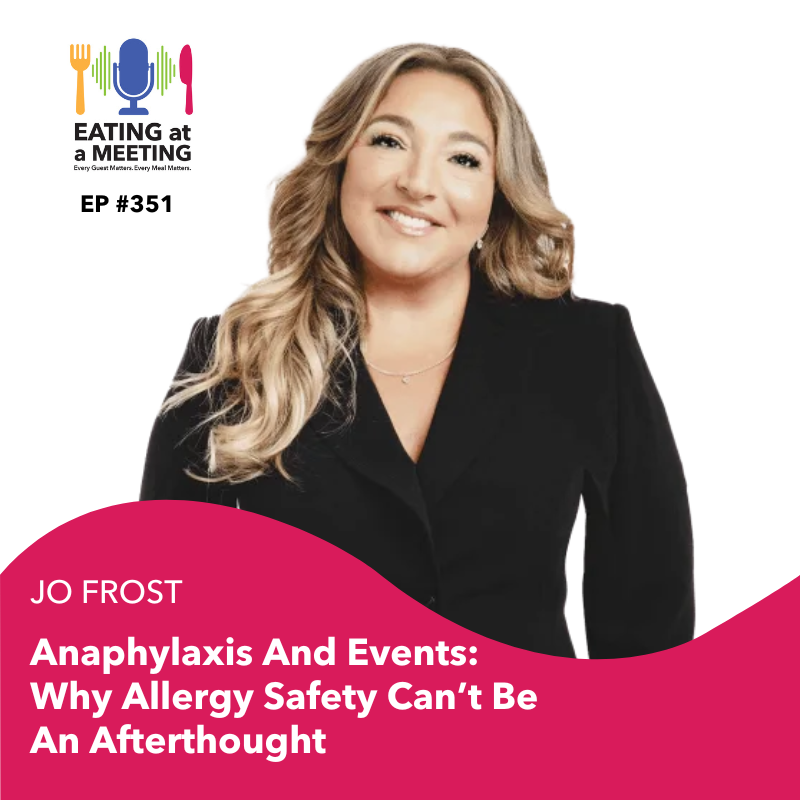
When Kerry Washington recently shared on Jimmy Kimmel Live that she often eats in bathrooms at high-profile events because her food allergies aren’t taken seriously, the allergy community felt it. And when FARE posted that clip, Jo Frost — who lives with life-threatening anaphylaxis herself — commented, “hear you and see you @kerrywashington DITTO.”
That one word — DITTO — carried decades of lived experience.
In this episode of Eating at a Meeting LIVE, Jo and I talk about what it really means to navigate everyday life — restaurants, airplanes, school cafeterias, and event spaces — when a trace amount of nuts, shellfish, or airborne particles can shut down your body.
Jo has survived more anaphylactic shocks than she’s willing to count. She’s been dismissed in restaurants, pushed back on by airline crews, and told “it should be fine,” even when the stakes were life or death. She’s also been sounding the alarm for years, insisting that ignoring anaphylaxis is as dangerous as “putting a loaded gun in my face.”
If you plan menus, host families, work in hospitality, or manage any food service environment, Jo’s perspective is essential. Her story echoes what millions live with — and what our industry must do better.
Every Guest Matters. 🩷 Every Meal Matters.


Heard on the Episode
"I have eaten in the bathroom... or in the back of an Escalade en route to a red carpet event, because there hasn’t been an inclusive menu."
~Jo Frost (02:20)
"The price to pay is life... I can’t risk that, it’s like being in a place with a loaded gun."
~Jo Frost (08:45)
"It’s people investing in people. At the end of the day, we’re talking about humanity over greed and profit."
~Jo Frost (19:51)
Key Topics Discussed
Realities of Severe Allergies
What it’s like to live and work with anaphylaxis
Invisible dangers: airborne triggers, lack of menu labeling, cross-contact on site
Event Access & Missed Opportunities
Making the impossible choice: career vs. health risk
The physical and emotional toll of constant vigilance
Safety Protocols & Advocacy
Safety checklists for venues and families
Crew and staff training: how to respond, emergency planning, and teamwork
Policy & Legal Progress
The Addie Act (CA): mandatory allergen labeling
Epinephrine access in schools and public venues
Empathy & Education
Why it’s about people, not just policies
The role of media, humor, and minimizing attitudes
Event Planning Solutions
Menu labeling, cross-contact controls, staff training
Visibility and proactive accommodation
Key Takeaways
Safety First, Always: For guests with anaphylaxis, attending an event can be as dangerous as being in a room with a loaded gun; safety is non-negotiable.
Planning = Protection: Scanning environments, clarifying menus, and training teams can be the difference between life and death.
Empathy Over Everything: A culture of care—where guests aren’t seen as burdens and staff treat every risk as critical—raises the bar for everyone.
Policy-Powered Progress: Legal mandates like the Addie Act show what’s possible, but change starts with “people investing in people.”
Empower, Don’t Exclude: Inclusion means everyone has a seat at the table—and knows exactly what’s in front of them.
Tips for Event Planners & Hospitality Leaders
Ask, Don’t Assume: Always invite guests to disclose allergies—never leave it off the RSVP.
Label Everything Clearly: List all ingredients and top allergens for every menu item, not just “gluten free/dairy free.”
Staff Must Be Trained: Everyone on your event team, from kitchen to floor, should recognize anaphylaxis and know how to respond.
Build Safety Systems: Make allergen safety a process, not a “Joe will handle it” afterthought.
Normalize Inclusion: Treat every accommodation as essential, not as a favor.
Like what you heard? Subscribe to our newsletter for more episodes and insider content delivered right to your inbox!
Tracy Stuckrath [00:00:01]:
Hey everyone and welcome to another episode of eating at a meeting and this is a special episode because it's not on wednesday and so i'm very very excited to bring to you today my guest jo frost many of us grew up watching and learning from jo who has guided families for decades as super nanny and she's also lived her entire life navigating severe food allergies and anaphylaxis her perspective is real grounded and incredibly important and i'm excited to talk to her today about her experience attending events and get her guidance as what we can do when we're hosting events in our own house or events in california when you're going to the grammys right or i don't know if you're going to go to the grammys but so joe thank you so much for being.
Jo Frost [00:00:46]:
Here thank you I appreciate thank you.
Tracy Stuckrath [00:00:50]:
So let's start with how we connected which was last week or two weeks ago kerry washington was on the jimmy kimmel show and he asked her he's like oh i heard you had food allergies and she's like yes i do and this is what i'm allergic to and she is allergic to seafood and jimmy was like does that include fish she's like yes that would be seafood and freshwater fish as well as mango msg all nuts except for almonds and peanuts and a couple of other ones.
Jo Frost [00:01:25]:
Okay that's interesting yeah that's interesting because terry and i would have similarities in the fact that we are both allergic to seafood so that's a crustacean right so lobster shrimp crab yep but i can eat fish okay so it sounds like you're saying she's allergic to fish.
Tracy Stuckrath [00:01:52]:
As well yeah she's allergic to fish and crustaceans and mollusks right exactly so.
Jo Frost [00:01:57]:
Mollusk i can eat i love mussels they're so good and i love to eat swordfish and a variety of different fishes really so that can work for me and then nuts okay nuts all nuts is off off the chart for.
Tracy Stuckrath [00:02:17]:
Me really okay wow so we have.
Jo Frost [00:02:20]:
Similarities in our in some of our food allergies are anaphylaxis to to those certain foods but we have you know i felt heard yeah i felt heard when kerry washington spoke about you know eating in the bathroom i have ate in the bathroom i have yeah quickly grabbed something to eat that i've made from home to eat in the back of an escalade car that's taking you to a red carpet event right so that you can eat whilst you're there something that's going to last for hours so that you have something in your tummy i've walked red carpets where you know my own publicist might be carrying a protein shake i can quickly you know drink down before having to sit down and and join other people at a table where there there hasn't been an accommodation there hasn't been there hasn't been an inclusive menu or an accommodation of if you have allergies please point that out please mention that you know so i felt very heard in the fact that was mentioned because i think what she's really talking about is what million millions of us experience every day in no matter what part of america you live in at some point you will of repetitively come across either a host or an event or a restaurant or a place or a person or a brand or an airline where there is not any exclusivity to the fact that there are millions of us who live with life threatening allergies yeah life threatening and so yeah i made that comment because i get it ditto so.
Tracy Stuckrath [00:04:32]:
Ditto exactly so do you like when you rsvp for those events i'm assuming you have to rsvp they're not asking.
Jo Frost [00:04:39]:
That question no no we're giving it we're giving it and i say we are as in as in my representation but it's not a consideration and it is one where you have to weigh up whether you attend based on how long it's going to go on for can you get an idea of what's going to be served what does that look like how big are the tables how many of you at the table you know because certain foods are just they're airborne you know rave yours you know i can't sit at a table if thai food is being served like that that's not something that that works for me because you know the smell of the nuts the smell of the peanut the smell of the cashew the smell of you know will trigger that for me you know wow again again there needs work but i think you know this is a country that does need a lot of work with respect to inclusivity yeah the it reminds me.
Tracy Stuckrath [00:05:47]:
Of the ocean's eight movie you know with sandra bullock and all of them and cate blanchett was the hired like food allergy specialist right and like and that's this huge gala was it at the met it was yeah yeah i have to go back and look but it was well i don't know if the met because that's it was jewelry yes it was a jewelry i think it was a jewelry but that should be what is done because and actually i remember asking a couple of years ago when two of the two of the actors that were up for the golden globes or the oscars were vegan and i wanted to know like for the dinner are you serving or will you have something for them to eat and somebody reached out to me or responded to me and said do not even question that we wouldn't do that but with this experience that you and carrie have explained it's like it's not necessarily done i think that was a.
Jo Frost [00:06:42]:
Rather hostile response whereas you know you should have been received with a warm welcome of we absolutely take pride as a company in making sure everybody is relaxed and confident and comfortable in those settings that they will be in and i think it makes all the difference to people like us in our community especially and we're talking about something specific which is still important you know but not everyone's going to the met gala not everyone's going to a red carpet event not everybody's walking that the reality is is that no matter where we are the consideration of that is important we could say the same for those with disabilities you know invisible and physical disabilities right you know to have access to be able to be in a place where that's considered so that you know where food is prepped and you're considering cross contamination again where your most loyal customers so it just really resonates for the fact that we do still have a long way to go with respects to having the mindset of understanding especially as we are seeing this increase right you know that that one needs to be mindful of that but again it's high ratio of people that would require training staff that would require looking at menus that actually then could accommodate perhaps a menu where they wouldn't have to worry about that you know looking at those top allergens and so yeah you have to look at the risk factor there are many things that i get invited to and some of them are just too high risk so i.
Tracy Stuckrath [00:08:32]:
Don'T go wow and those could be opportunities for you that you're missing out of you know in your career or with you know networking with other people in in your field of work absolutely.
Jo Frost [00:08:45]:
Absolutely and there are many of those opportunities because the risk is just too high for me and that the price to pay is is life and and i can't trouble with that that's like being in a place with a loaded gun for me you know i can't i can't risk that you know for something that i can easily say no to and protect myself well yeah yeah.
Tracy Stuckrath [00:09:11]:
So and you've openly spoke about and i was reading a lot about you and how you handle this and you scan every room as you enter can so what does that safety checklist look like for you when you're going well actually what if you're going into one of the houses that you're working with one of the families or you know if you're going on set how does that vary in those different scenarios.
Jo Frost [00:09:33]:
Well i i i set the standard of what that is to protect myself so if we think about if we think about helping families so i'm not anaphylaxis to dogs i'm highly allergic to animals you know if they lick me this saliva will create hives and eticura oh wow and breathing problems with asthma so all animals were either you know they went to the neighbors or to a family member the children and the parents were explained to why and you know they were all like oh my god i didn't realize you know we would make sure that you know as as a company to protect me that places were cleaned so you know there's not residue of like lots of dander around right so there's like minimum risk of things like that and then foods so there's a lot of hugging and kissing that goes on when i'm helping families and children and you know we're filming filming for over two hundred hours when we were filming the super nanny show or nanny on tour or really any one of my formats helping families and so foods were a concern americans do love peanut butter and jelly sandwiches yes we do a lot of trail mix and nuts and things like that so they would be they would be given you know the download of what my medical condition was and what that entailed and then crew would go in and make sure that that was all taken away and removed and they you know would obviously be given that when we came back animals if they needed to be boarded you know they would be paid for so that the animals could be boarded for the days that i was there so really what's happening is that crew are going in knowing what i specifically need to protect me to do my job with diligence with a family so that they successfully have the outcome that they need i have unfortunately i have had an anaphylactic i did go into anaphylactic shot whilst filming once wow and that wasn't to do with the family actually was a mistake on one of the crew's behalf situation that was overlooked and i didn't see anything physically but trusted a situation and of course you know that's always an awful situation because you know obviously you're in the hospital with anaphylaxis and the crew member feels absolutely awful because it's been a sight you know lucky enough i'm here to tell the story of that but you know it's it's hyper you know it's hyper vigilance in order to be able to protect and you make sure that your crew absolutely know how to administer epipens and the importance of that they absolutely know what those signs and symptoms are they know where my epipens are at all times and so you know you're i'm carrying that with me always anyway right right so it's just the in it's information it's not just but it's the information that's necessary for those you know should you need.
Tracy Stuckrath [00:12:44]:
It well and that has i think that story that you just shared has kind of really helped you fundamentally change and educate the rest of the crews on how it has to be to make sure that it's safe for you and it that edu i think it's education across the board right because a lot of people don't realize that it is life threatening or you know something.
Jo Frost [00:13:06]:
Because it's been minimized right because it's it's minimized people are laughing about it joking about it media will be irresponsible about it it'll be written you know anaphylaxis will be written into movies or series where you know the signs or the symptoms you know are incorrect or the administration of epinephrine is incorrect or you know it's plotted as the twist to be killing people oh that just.
Tracy Stuckrath [00:13:37]:
Happened this week it did tell me about that it was in the show all her fault yeah so yeah that.
Jo Frost [00:13:48]:
Was a really good that was a.
Tracy Stuckrath [00:13:49]:
Really good series it was yeah but in the end it's how he died.
Jo Frost [00:13:53]:
Yes that's right yeah that's right so again you know what and it's it's there i mean you know i mean i think i think i remember watching was it hitch yes yep you know and you know just you're having anaphylactic shock and like the first thing they offer is a load of benadryl and you're like where's the epipens where's the epinephrine you know where's my emergency plan where's the action plan and then again you know peter rabbit and then another you know all the you know just the responsibility i think i think it's important that if you're going to put it in there right you know then just make sure you get it right but again there's loads of opportunities where it by default minimizes the reality of it being known as a serious medical condition in the same way that we call everything an allergy you know i have allergies to mold i have allergies to animals i'll sneeze in the seasonal calendar year but anaphylaxis is life threatening for me you know and that's no joke that's no joke and it's a real it's a real risk and as i've mentioned that elimination to make sure that you can protect yourself and be safe you've got to take the threat out the room right you know you've got to take the threat out the room as much as you can so you asked me what does it look like for me it looks like well it looks like advocating for myself because there's not an option to not do that to advocate myself which means i'm i'm smelling when i walk into a room and i'm looking and scanning when i walk into a room and i'm looking at surfaces and yeah if there's any contact of anything and what are people you know what are what do people have in their hands what just get out their bag on the airplane right how is somebody's attitude to what i've just said you know are they are they listening and taking that on board and are they going to provide safety for me and health and safety standards that are with inclusion so that everybody is safe and everybody has the same that doesn't change and it's i think when you're in the community you get it you understand it because it's draining right exhausting it takes an awful amount of energy to be hyper vigilant all the time when you're out because your home is your safe space and so that requires an element of understanding how you take care of your mental health and your emotional health living with such a medical condition because it can take its toll and it's keeping that anxiety at a healthy place that doesn't take you to paranoia right i guess maybe the right word looking for you want to be hyper vigilant but you don't want to be completely paranoid about absolutely everything but you do learn i believe over time if you are recognizing how to take care of your mental health living with anaphylaxis over time you start to fine tune a balance with.
Tracy Stuckrath [00:17:32]:
That okay and i think that's important because it's i've had people like well similar to you just stay home and don't go to that event but we all we can't stay at home all the a hundred percent of the time we have to be able to get out we have to be with our families we have to be in communities we have to go to work and you know if we're going to put how many one in every ten people has a food allergy you want us all to stay at home that's i don't think that's realistic it's two in.
Jo Frost [00:18:03]:
Every classroom now right you know two children in every classroom you know and again you know again it's different in different countries right you know here we need nurses that can literally be able to administer epinephrine we need medical kits in every public event or schools or libraries anything to do with children and family we should have medical kits as we see heart defibrillators we should have epinephrine on walls you know like the medical kit goes in places so that you know that can be easily accessible but we also need to understand the importance of staff being trained in restaurants or airport flight crew or for me what's fundamentally very important as well is the training that's necessary in our nurseries in our daycare centers you know that that we have trained staff and and labeling on menus and and prep areas to to minimize our concerns right so things are not vague right yeah they're.
Tracy Stuckrath [00:19:16]:
Not vague well and you've got i mean i know a restaurant might not have a huge kitchen but when you're thinking about events and event spaces i mean those are larger spaces you can find a spot in somewhere in a tent or somewhere in a convention center to make that food in a safe in a safe environment so that you can feed people and not but it takes systems and processes and it's not what i was reading something today it's like if it's just in one person's head that's not a system that's just somebody like hey hope i hope joe's going to be okay it's not letting everybody else know yeah i mean look.
Jo Frost [00:19:51]:
Law and policy is important we need that right you can establish if we can establish policies that change laws to protect everyone but really what are we talking about right we're talking about people investing in people we are talking about empathy right the more we can educate the more we empathize to others right so that can keep all of us safe safe so that we can all have a beautiful experience wherever we are together we are talking about human beings investing in other human beings that's you know humanity rightness kindness consideration we're talking about we're talking about humanity over greed and profit yep at the end of.
Tracy Stuckrath [00:20:45]:
The day at the end of the day yeah yeah now so we were talking about laws like the addy act i think you're are you familiar with the addie act that just got passed.
Jo Frost [00:20:54]:
In california tell me more about i haven't been filled in about what exactly.
Tracy Stuckrath [00:20:59]:
Has happened now so it was it was signed into law in october so it is restaurants that have food facilities i should say that have more than twenty locations nationwide all right yes must now label for the top nine allergens.
Jo Frost [00:21:14]:
Yeah let's just talk two words it's become the standard and now we have.
Tracy Stuckrath [00:21:18]:
Accountability period yep and that unfortunately is only in california and hopefully those companies that are doing that have to now will now implement it in all their other venues or their locations even because they have to do it in california correct we can hope right well we.
Jo Frost [00:21:35]:
Have we have to hope and we have to keep pushing and we have to keep making sure you know that we're fighting for that right yeah so that we're fighting for that so yeah you know our children our families are safe and that standard sets a good precedent for others to be able to follow and for that to now you know not just be california but other states right and the account and the accountability of that the importance of the accountability of that you know right yeah.
Tracy Stuckrath [00:22:05]:
Which is incredibly important right yes exactly yeah and i know that thomas just got in i think in new york now all daycares now have to have epinephrine on site and in the state.
Jo Frost [00:22:18]:
Of new york yeah yeah a major victory yes yes a major victory to dina and thomas a major victory to the foundation in being able to push that through now in new york and again we want that everywhere else exactly our children should be safe in a space where they thrive to learn and have fun and play and it be joyful and for staff to be properly trained in understanding anaphylaxis and allergies and for and for this it requires leadership with empathy and compassion and education to understand the severity of that every child should be able to be dropped off at daycare and have a beautiful day without any parent ever worrying whether they're going to see their child again because they have anaphylaxis to whatever that is and here again here again we see such strength and leadership from this foundation you know in the face of of such tragedy that's happened and it's it shouldn't take that it just it shouldn't take that no no it just shouldn't take children's lives we see this you know in london again with natasha's foundation you know and the work that they're doing and the importance of being able to have a person that will be appointed right across the uk to these circumstances but but at the price of us losing our children you know and adults yeah you know it should not be it should it just should not be the rule should be that those that are the proprietors you know are training even with you know you hear all the excuses why is the high turnaround with staff and then customer service and training management skills period that should be on the board period full stop.
Tracy Stuckrath [00:24:28]:
Yeah yeah well and it's it's interesting because the food codes are changing in in some of the states to require labeling but one person told me that salmonella and food safety in that respect has a higher priority than a food allergy and so they're not going to get dinged if they're not labeling the food properly and that's not california that's another state but i'm like why would somebody's death not warrant you know potential death not warrant but it's they're looking at it as one person versus a couple hundred people who could get sick from food poisoning right but i think death is a lot yeah it's it deaf is death right yeah you cannot.
Jo Frost [00:25:12]:
Come back from that yeah death is death and again what are we talking about you know we're talking about an attitude we're talking about a lack of education we're talking about a lack of empathy we're talking about true leadership in understanding what do we do to keep our children and adults safe when they have a life threatening medical condition right yeah i've i've had you know i again i i've been into fancy restaurants and i've had you know i've been told by staff you know not absolutely there's nothing in there like you have to you you know you're reading everything you're hyper vigilance like did the tone of their voice did it line up with what they said did their body language match that like i need to speak to the chef please if that's okay and you know when you get i find that it predominantly happens in either the very young or the very old but when you get either the old or the very young as staff they're too embarrassed to say they don't know what it is so you know i'll use the word anaphylaxis like i think there should be a distinguished difference between anaphylaxis and just allergy because allergies people think oh people automatically think oh you're saying there's an allergy but are you just being pretend pretentious and you're saying that you have a gluten allergy you have celiac are you just having a fad is it just a fad that you don't want to eat anything with gluten in it and you're like no this will kill me like this is severe right and this is the stakes this is the stakes of where we're at which is no different to if you're in a container thirty nine thousand feet up in the air you would hope that your servers and your flight crew want to minimize death period right death you know your epinephrine pen is giving you an allocated amount of time right it may you may survive you may not right right but the idea is is that as soon as you start to feel those signs and symptoms and you've administered that you have an allocated amount of time you may be then putting the second epipen in but you know nine one one get to the hospital straight away and you just pray that you're gonna live you know you're not even praying at that moment you're like alive like you're holding on to dear life you're holding on to dear life in that moment trying to gaze and catch on i mean i remember my last anaphylaxis shock and i just remember looking into the doctor's eyes thinking can i hold on to what this guy is telling me right now hold on to it like is this okay is this going to be all right and again that shouldn't be a compromise it should just be a.
Tracy Stuckrath [00:28:13]:
Compromise so when you've administered your epipens and then you're at the hospital what is that next course of action i mean are they giving you more epinephrine at that point or what are they doing.
Jo Frost [00:28:26]:
I don't know what they're doing okay because by the time i've had one or two injections of epinephrine everything then goes into a very sharp focused sort of vision tunnel vision for me and i'm trying to breathe because i'm i mean you know it's really funny because because i sat here before we got into this interview and i i thought i meant really write down like each step of what it is but if i could explain it my ears start to itch and then my face gets hot and then my saliva increases and then my heart rate increases and then my face starts to swell and then my eyes get swollen and i can't see and my face starts to come right up and it goes out and swollen and then my lips and i can't talk and everything feels really tight and puffy and there's no room to talk because my throat is closing up i feel like i'm trying to get air out of a really tiny narrow straw all i can focus about is is staying alive and please god please stay alive just keep breathing one next breath after the next i'm dizzy i'm gasping for breath i'm wheezing the feeling of dread comes over there's panic that's high my body is itching my body is hot my skin is clammy cold and the chest pains at that point i'm thinking to myself is this cardiac arrest is this cardiac pain and that's happening all in microseconds of just altogether the same thing and just praying that i can come through that you know come through that moment and then there's a moment where things start to become easier very slowly and easier and easier and then i feel like a come down from that then my body has been holding it's just been holding and my i can feel like like almost an internal bruising of where you've of where your lungs have been overworked right right because you know my body has felt attacked right i mean that's what it is right my body feels like it's attacked and then the next several days for that after that event is one of recovery physically one of recovery and mentally it's physically and then it's mentally and it's emotional too you know it's the emotional impact of that as well you know so again it's i think it's hard for anybody who hasn't lived through one of these to really understand the severity of it but you shouldn't have to you should never have to in order to empathize what one human being goes through let alone over thirty five million and the impact of that worldwide to recognize the importance of what we do to change that through policy and law and trained staff to protect every individual whether that's in a daycare whether that's in a restaurant whether that's in an event whether that's labeling on menus prepping areas training staff that's what it will take and so it's important to it's important to continue to educate it's important when you have the opportunity and again it is people investing in people you know and changing that when they are at the top of the chain of what they can do i've had fantastic i travel you know i travel a lot for work and i've had flight crew that have been absolutely on board with anything they can do to accommodate we want you safe we want you safe on this flight we want you to you know we want you to feel good even passengers but then i've had passengers that just minimize you know you're getting gaslit they're literally minimizing like oh it can't be that bad or the or the the sort of the kind of myths like you know oh a small amount amount won't hurt you or i'll be told like i'll just scrape that off and it'll be fine like scrape that off you're like you can't scrape that off the food and it'll be fine like you know that that's not going to work you know or for some oh but you'll outgrow it it'll be fine and some people do i never outgrew any of mine so you've had.
Tracy Stuckrath [00:33:53]:
Them for your whole life yeah yeah.
Jo Frost [00:33:55]:
My whole life over fifty years wow yeah you know and and and again you know those myths not everyone's outgrowing and you know their allergies and and the the labeling you know the labeling i think is is incredibly important and i think it's one again that's just about league legalities because it's wrong i think it's morally wrong it's ethically it's wrong you know like for those that are just finding out about themselves or their kids and are doing everything they can do to protect them you know the labeling is so incredibly important because i've read i've seen on apple juice may contain nuts an apple juice and there are foods that i've been able to eat that says may contain nuts and i know it doesn't and i've eaten it because i know it doesn't i've been around long enough i know it hasn't but for somebody who is in doubt just don't right yeah just don't but again again i think it's about educating yourself as much as you can alleviating and making sure that you're in support groups that you're you know maybe attached to different charities and foundations that provide that that that type of support so that you can talk to others and you can learn you know you learn so much from others as well right you know and the things that they do you know to help and to prevent but we do need a safer world we do need a.
Tracy Stuckrath [00:35:26]:
Safer world we do yeah so what from a meeting planner's perspective from any kind of event that you're going to what would you like to see or you know when like hey i'm interested in coming to this event what would you want to see on maybe their website on the registration form in any kind of capacity i'm sure like the oscars you're not going online and registering through eventbrite do you know declaring click off a box but what could organizers in your opinion help you to feel more comfortable.
Jo Frost [00:36:00]:
It would be more than wonderful to first and foremost have them establish themselves as event planners or institutions or wherever that is that they accommodate those with allergies and then making sure that all of their staff is trained and well versed in language you know know what anaphylaxis is right you know ask be the first to ask let's look at areas you know certain areas so that we haven't got cross contamination prep certain areas maybe where people could eat that would be safer for them as well you know again the labeling you know the labeling of what's inside the foods would really help as well.
Tracy Stuckrath [00:36:42]:
Right yeah and not saying hey this is dairy free this is gluten free this is we need to know what's in it not necessarily not what we want would like some people would like to know that it is dairy free and gluten free but we also need to know what's in it because that hidden ingredient is what could potentially kill.
Jo Frost [00:36:59]:
You absolutely yeah absolutely and that's not just for that's food and beverage right because beverage has you know certain alcoholic beverages as well for adults you know have cashews and almonds and things like that right yeah so different foods but everything we're talking about is consideration inclusion you know that's what we're really talking about at the end of the day with everything yeah you know so that we have more so that we have more clarity you know so that we have more clarity because we're able to read the labels we're able to see what the ingredients are even though we're carrying our wipes and our epipens and maybe a few histamine tablets in there as well and everything else for our precaution and our you know and our little meals our little homemade snacks i mean i don't eat on a plane.
Tracy Stuckrath [00:37:49]:
Yeah and leanne mandelbaum will tell you not to eat on a plane if you have food allergies because they don't and i can attest to asking flight attendants yeah they don't know yeah yeah.
Jo Frost [00:37:58]:
Lee is fantastic like that woman is dylan that's absolute her passion her relentlessness and what she does yes you know one hundred agree safer for everyone absolutely.
Tracy Stuckrath [00:38:14]:
Yeah all right jo i have a couple of rapid fire questions that i want to ask okay okay what's one food you wish you could safely eat that you haven't been able to oh.
Jo Frost [00:38:27]:
It'S got to be the ones that you can't right so you know my family you know my family are english and mediterranean okay oh it would it would be prawns it would be gambas the you know the spanish paella the whole mediterranean spanish foods you know that have you know the seafood absolutely yeah.
Tracy Stuckrath [00:38:47]:
Yeah okay what you kind of just listed off what was in your purse but what's in your purse besides your.
Jo Frost [00:38:53]:
Epipens i have yeah my epipens wipe down wipes for traveling pen emergency plan i have a car i have cards so like if i go to different countries i'll have cards as well that will say what my allergies are and what else and i've got other you know i have asthma so you know i have my asthma stuff in there as well pen paper yeah emergency plan so pertaining to my anaphylaxis right yeah.
Tracy Stuckrath [00:39:22]:
Well and carrie carrie did a thing too is about having the cards that she travels and she gets them translated to whatever country she's the language of.
Jo Frost [00:39:30]:
The country she's going to yeah no it's really i think it's really important even if you're talking the language it's really important just to have it written as well you know so i have like a stack i've got a little stack of they look like playing cards but you know it all depends on where i am like we prep you know my husband's really good at making sure he's like i want to make sure that we got you know we're going to be going here this is somewhere new we're going to be in abbey you know abu dhabi or in dubai and we want to make sure you know like we you know we flew to riyadh and you know everything's laced with cherry and almonds and you know so it was important just to make sure that those cards were in place and people could understand as well so yeah everything a lot of it's preparation right a lot of it's preparation so that you are able to really lessen your anxiety wherever you go you know because it's it's not going to go it doesn't go away you know you learn to manage it better but there's no two ways about it at some point you need to be able to go okay we're good now you know we're able to sit down here and actually enjoy this moment here you know so yeah for anaphylaxis i would say they're the main sort of things.
Tracy Stuckrath [00:40:38]:
In my bag around that and then talking about travel is there a place that you have traveled where you felt surprisingly safe eating.
Jo Frost [00:40:50]:
No i think i'm diligent everywhere if i'm really honest and i'm a well traveled lady so there's not a moment where i reach somewhere and go oh my god this is really surprising there are definitely countries that i think in europe are easier you know so again it's about education because everyone gets the same story from me my voice is my protection so i'm able to voice unapologetically i don't see myself as a burden a lot of people are made to feel that they're a burden that they're inconvenience that they're a nuisance and i'm very unapologetic about that but because i was raised that way you know i was raised that way by family that understood the importance that at some point they would protect me and at some point i would have to champion to protect myself and i was raised that way with that education with that awareness my friends are protective my brother you know my big champion so again i don't think there's any particular country that sort of has ever that has ever hit me as in oh this is so easy but there are countries where maybe people are more well versed more aware and restaurants you know or places where where you ask and they're like oh yes no it's over here or look in the menu here and it's all lined out here and no our facility is just fine and oh yes well and they just you're like oh oh that was that was great i didn't even have to i didn't have to fight to try and you know keep myself safe like it was that wow was easy with the other human being or where you were like that has happened along the way in my travels but not a particular country that i could overall say oh it's go there it's just really easy everything's really fine and i don't think i'll ever find that but i know obviously you know your own home is your safety and your loved ones you know friends and loved ones who care about you because they're the first to make sure that you're okay or those that are aware you know if you go to a dinner party and and they'll call through and they'll say you know hey i just wanted to make sure any allergies or and you just oh it's beautiful it is.
Tracy Stuckrath [00:43:17]:
Beautiful because they're paying attention and they want to do the best they want you to come in and feel that you are wanted in this space yeah.
Jo Frost [00:43:25]:
And i you know and we don't have to worry about us in our community because we get it what we want is is others to champion for us you know right yeah and how important that is for us as we would for anybody else who's living with an invisible medical condition you know or a disability in some way or another right i don't you know i i don't see my medical condition as a disability i don't see it as a hindrance it doesn't define who i am that's for sure you know but it's.
Tracy Stuckrath [00:44:01]:
Just part of who you are but.
Jo Frost [00:44:03]:
It is part of who i am and i i live alongside it you know it's like hey this is the body that's on the journey with me.
Tracy Stuckrath [00:44:11]:
Yeah exactly all right one final question finish this sentence for me every meal should.
Jo Frost [00:44:19]:
Every meal should be an enjoyable experience where everybody has clarity about what.
Tracy Stuckrath [00:44:27]:
They'Re eating yeah yeah no i love that yeah because it is we want to know what what's in our food across the board yeah and you know.
Jo Frost [00:44:36]:
I help families professionally and meal times are such a you know milk there's so much to be gained from coming around a table and eating great wonderful foods and having beautiful conversations and the social aspects of that and you know for children they're learning as well those life skills you know and so you know just the art of that as family and being able to do that safely is a beautiful experience and you hope that you are walking into sort of mini living rooms in different events or restaurants and and you can create that whether you're meeting someone for the first time or whether you're with your family or at a wedding you know.
Tracy Stuckrath [00:45:20]:
Wherever you are yeah there's a couple of comments over here i want to post really quickly so jeremiah let's see and i have to learn how to fix my little thing here but i love joe frost so jeremiah we do.
Jo Frost [00:45:32]:
We all do thank you jeremiah and.
Tracy Stuckrath [00:45:35]:
Then miss jill has said so happy to catch this live longtime fan of joe's another and then she's got a couple other thank you jill it's also great to see you two women to be such wonderful advocates role models and then she just reiterated what you just said which was every meal should be an enjoyable experience experience yeah so thank you for tuning in yeah thank you tracy you're welcome jo i'm so glad that you can join us and how can everybody follow you where do they.
Jo Frost [00:46:06]:
Find you joefrost dot com joefrost on instagram youtube joe frost everything joe frost.
Tracy Stuckrath [00:46:12]:
Joe frost okay awesome j o j.
Jo Frost [00:46:15]:
O f r o s d okay.
Tracy Stuckrath [00:46:17]:
Fantastic well everybody thank you so much for tuning in today and participating jill and jeremiah appreciate that and joe thank you so much for your advocacy it's wonderful and i know it's built from oh jeremiah just said bring back the super nanny show.
Jo Frost [00:46:38]:
Families do want me back out there helping whether it's the super nanny show or another joe frost show they definitely do want me out there helping so hopefully i can facilitate.
Tracy Stuckrath [00:46:47]:
That soon well we would love to see it and thank you for what you do to help families across the board and advocating for food allergy safety as well so thank you so much for joining us everybody you're welcome all right i want to everybody thank you for tuning in i will have another live episode on wednesday we're going back and talking about feeding our communities with excess food from our events and i'm very excited about talking about that all right jeremiah popped in one more thing here have a great evening we need super nanny season nine and super nanny season ten.
Jo Frost [00:47:23]:
He's a huge fan he's an avid fan he is he is.
Tracy Stuckrath [00:47:28]:
All right well everybody thank you so much and i'll see you later stay.
Jo Frost [00:47:31]:
Safe and eat well thank you thanks.
Tracy Stuckrath [00:47:35]:
For listening to the eating at a meeting podcast where every meal matters i'm tracy stuckrat your food and beverage inclusion expert call me and let's get started right now on creating safe and inclusive food and beverage experiences for your customers your employees and your communities share the podcast with your friends and colleagues at our eating at a meeting facebook page and on all podcast platforms to learn more about me and receive valuable information go to tracystuckrath dot com and if you'd like more information on how to feed engagement nourish inclusion and bolster your bottom line then visit eating at a meeting dot.
Jo Frost [00:48:37]:
Com.