350: How Mobile Food Rescue Teams Are Saving Communities From Hunger
As 2025 closed, Tracy dedicated three episodes to something that matters deeply: the organizations feeding people who need it most.
And we’re starting with one that’s rewriting what community feeding can look like in Florida.
When the Orange County Convention Center in Orlando, FL shared that one of the larger food donation charities they work with was The Freedom Tour, I knew the story would be powerful. What I didn’t expect was just how vital their work is to Polk County families.
Back in 2016, when The Freedom Tour began, more than 100,000 county residents — including nearly one in four children — were food insecure.
Today, the numbers remain high: 113,000 people and more than 33,000 children still face inconsistent access to food. That’s over 20% of kids in the county.
That’s the reality Bobby Williams walks into every day.
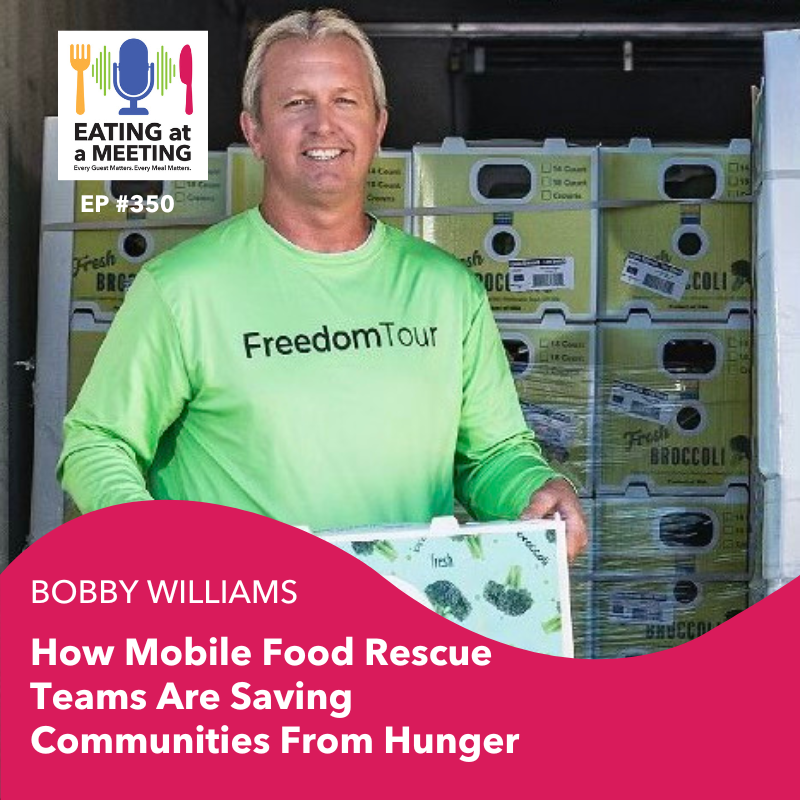
This week on Eating at a Meeting LIVE, I’m talking with Bobby Williams, founder of The Freedom Tour — an operation that began under a carport and now moves millions of pounds of food every month through mobile pantries, school partnerships, and statewide relief efforts.
And for those of us planning meetings and events, this isn’t just inspiring — it’s instructive.
Because your surplus food can become support.
Because your leftovers can become lifelines.
Because partners like this make donation safe, simple, and deeply impactful.
This conversation kicks off a month-long spotlight on organizations that feed communities with dignity, creativity, and heart.
Because every meal can make a difference — even the ones we don’t serve.


Heard on the Episode
“People have disasters every day… the biggest way we can help them is with any kind of food expense.” ~Bobby Williams 02:34
“We take every dollar, we turn to about 50 bucks. Last year we brought in a million dollars and turned in a $65 million gift in kind.” ~Bobby Williams 16:09
“Fresh fruits and vegetables—the kids and families get excited over that. They never get it. Being healthy is so expensive.” ~Bobby Williams 43:41
Key Topics Discussed
Community Hunger & Food Disaster Relief
Daily needs beyond natural disasters
Redefining “disaster” in food insecurity
Food Rescue Logistics
Managing $22.5 million pounds of rescued food
Drive-through pantries to reduce stigma
Box truck and warehouse strategies
Partnerships & Funding
Role of churches, United Way, and event venues
Relying on grants, delivery fees, and donations
Event Venues & Surplus Food
What convention centers donate (prepared meals, produce, drinks)
Legal protections and tax benefits for donors
Overcoming middle-class “safety standards” and maximizing donations
Hurricane & Disaster Response
Pre-storm logistics and EOC coordination
Box trucks reaching hidden communities after storms
Nutrition & Education
Providing snacks for after-school tutoring
Rewards programs to boost school attendance
Key Takeaways
Food “disasters” can be daily—mobile food rescue teams address poverty, not just storms.
Event venues and planners can make an impact by donating prepared but unserved food.
Stigma around food insecurity was reduced during COVID with drive-through systems.
Fresh produce is the most sought-after food item among families and children.
Legal protections (like Food Donation Improvement Act) support safe, effective donation.
Efficient logistics and bold partnerships multiply food relief far beyond donated dollars.
Tips
Engage with local food rescue teams before and during events—offer surplus food.
Use refrigerated transport and volunteer networks to handle large donation volumes.
Understand legal protections to confidently donate food without fear of liability.
Offer fresh fruits and vegetables—not just dry goods—to maximize community benefit.
Keep operations flexible: be ready to respond at any hour for larger impact.
Like what you heard? Subscribe to our newsletter for more episodes and insider content delivered right to your inbox!
Tracy Stuckrath [00:00:00]:
Foreign. Hi, everybody, and welcome to another episode of Eating at a Meeting. And if you saw my post about this episode, which was posted this morning, I am. And, and, and if you saw my newsletter last week, the next couple of weeks, I am going to be focusing on programs and organizations that are feeding the people in our communities in which we meet. We, the meetings industry produces a lot of food for the conventions that we serve, and we have a lot of surplus food that we get from that that is prepared but unserved. And so I'm going to talk to individuals and organizations over the next couple of weeks through the end of the year about how they're helping rescue that food from our venues, our convention centers and hotels to feed the people in the community. So today I'm starting off with this gentleman right here. I do my fingers wrong the whole time.
Tracy Stuckrath [00:01:01]:
Bobby Williams, the founder of the Freedom Tour, which is a mobile food rescue organization feeding tens of thousands of Floridians each month through community partnerships, school pop ups, disaster operations and disaster response operations. And when I asked the Orange County Convention center for a recommendation of who they partner with, they were the first name Bobby and the Freedom Tour are the first names that they gave me. So welcome to the show, Bobby.
Bobby Williams [00:01:30]:
Thank you. Thank you for having me.
Tracy Stuckrath [00:01:32]:
You're welcome. So let's talk about the number that you said just before we started online. How much food did you rescue last year?
Bobby Williams [00:01:40]:
£22.5 million.
Tracy Stuckrath [00:01:42]:
£22.5 million. Wow. And you're feeding people like you've picked it up at the Orange County Convention center, but you're in Polk County, Florida. Do you distribute that food all over Florida or are you centralized in a specific area?
Bobby Williams [00:01:59]:
We're, we're more Central Florida. We're Polk county, you know, Lake Wells, Winter Haven, cities around Polk County. But obviously when a hurricane, hurricane hits, we're all over state of Florida.
Tracy Stuckrath [00:02:09]:
Okay. And so you've done, you've done all kinds of disaster response, feeding people during disaster response, but you also feed people on a daily basis, right?
Bobby Williams [00:02:21]:
Yes, ma'.
Tracy Stuckrath [00:02:21]:
Am.
Bobby Williams [00:02:21]:
Yeah. Well, you know, we call food disaster relief. And some people think disaster, especially in Florida, is a hurricane, but people have disasters every day, you know, and it's just some of them are minimal. Them, some of them are bigger than the others. But, you know, people are struggling. And the biggest way we can help them, you know, is we can help them with any kind of food, Food expense.
Tracy Stuckrath [00:02:39]:
Right. Well, and it, it does. I'm sure it does. And just before we started too, we were talking about the numbers of people that you saw during COVID and, and actually now and then on a daily basis. But can you talk about the numbers of people that you see in the locations that you drop this food off?
Bobby Williams [00:02:58]:
Yeah, during COVID Covid was insane, you know, because there's just such a panic and grocery stores not having food and you know, just the fear of everything. So we were feeding 1500 people a day during COVID Like I said, that was insane numbers. So right now we do. And from COVID it actually created. We created our drive through systems because really prior to Covid, it was walk up. Most people every. Every food pantry everywhere would just walk up. People come, walk, wait in line and do that.
Bobby Williams [00:03:25]:
And there's two things that goes along with that. One was, you know, it created more volume, more people. But it really took the stigmatism away from people waiting in line, you know, is more. It kind of got to where it was like it's kind of like a McDonald's drive through, you know, like everybody's doing it. I mean, you got all the kinds of different types, especially Covet. I mean, you were touching the middle class. You know, all different classes of people were getting touched during COVID because, you know, you couldn't just go to grocery store. You know, I mean, it's like you don't know what's gonna be at the grocery store.
Bobby Williams [00:03:55]:
And hey, they're giving good food out here at this place. You know, it's kind of deal then. So that created, you know, really where we are today. I mean, we do a lot of food drives pretty much one almost every day, but anywhere from 150 to 300 cars, you know, then obviously it's been averaging about that. Well now, you know, the shut. The government shut down. They've almost done. All locations almost doubled.
Tracy Stuckrath [00:04:20]:
Wow, that's. And you said that it hasn't actually been because the shutdown is. Has been stopped, but the numbers are still there, the people are still there.
Bobby Williams [00:04:29]:
Yeah, like, so that even though really. And that's where I don't know if it's comfortability, you know, or they, they realize, hey, I can get food from here. Or like I said, it's almost just society accessible, you know, or not accessible, but it's okay to do it ain't frowned upon in a sense, I guess, you know, that people want to do that. But no, it's like I said, people government's back open, but we still. The lines are longer than they were before.
Tracy Stuckrath [00:04:59]:
Okay, the. So let's go back to how this all Started. Because what I read is that you started it in your carport feeding a handful of families. What was the turning point when you realized that this could become a full scale food relief operation? And was there a specific incidence, that incident that instigated that or it you just saw the need?
Bobby Williams [00:05:24]:
Well, it was really Covid. I mean, we started out feeding five to 10 people under a carport, and it grew to about a hundred, and we were about 100 a week. And we thought, you know, we actually went from 5 to 10 to 100. And we thought we were it. You know what I'm saying? It's like, man, this is it. We're feeding 100 people and, you know, we pray for people. Then we started seeing lives change and make a difference in impact in the community, impacting the lives. Then Covid hit.
Bobby Williams [00:05:47]:
And the difference with COVID was, you know, foods, always people know that there's a shortage of food. Sometimes my people don't know that. They don't understand. A lot of kids go without food. Only time they eat is at schools. They don't understand the single moms that struggle or the fact even not a single mom, single, just the people who struggle every day. So when Covid hit food come to the forefront, it was the number one issue, number one thing. Everybody was talking about it.
Bobby Williams [00:06:14]:
And so it made access to food huge. So we went from maybe doing a semi load a month, semi load every couple months, to 6 to 10 semi loads a day during COVID Wow. So it just, it kind of exploded from that. And really it's. It's gone down this last year. It's this past year, 20, 25, really, we've seen the numbers decrease, as in accessibility. Up until then, it's been, like I said last year, 22.5. The year before that, I think we did 20 million.
Bobby Williams [00:06:48]:
The year before that we did 18 million. But this year we're probably going to be 14, 15, maybe. I don't know. Sure.
Tracy Stuckrath [00:06:54]:
Okay.
Bobby Williams [00:06:55]:
There's not near as high accessibility, but government shutdown, you know, these things happen and people say, okay, it brings it back to the forefront. So we'll see.
Tracy Stuckrath [00:07:04]:
Okay. I mean, that's still a lot of food. Yeah. And you're feeding millions of people. Now when you're going. When you go to the Orange County Convention center and you collect food, is it food that's been prepared and. But unserved in what kind, what kind of things are you picking up from them? And then what other types of organizations do you pick up from?
Bobby Williams [00:07:27]:
Yeah, the convention center Actually it's a ray of stuff we get frozen and refrigerated. Some sandwiches, pre made fruits, vegetables, vegetable cups, drinks, all kind of, kind of stuff. So it's a big variety of stuff we get and it's anywhere from two pallets to sometimes 15, 20 pallets. So it's a, it's a huge blessing for us. But we, we make every bit of it work. Then we're in like Pepsi Cola, which owns Quakers, we're in Quaker, you know, we're in Coca Cola which owns Simple Life. So we get our orange juice, milks from them different kind of fruit drinks. Walgreens is a huge contributor of ours.
Bobby Williams [00:08:02]:
You know, they give us a lot of product, you know, snacks, cookies, cereals. Sometimes we get pancake, pancake mix, different things. Whatever you see in Walgreens shelf, we get a lot of that. Then a lot of it. We're in warehouses. So you got cold storage, frozen storage places.
Tracy Stuckrath [00:08:18]:
Okay.
Bobby Williams [00:08:19]:
And things get damaged, you know, or they're going close out of date or out of date, that kind of stuff. We take it. Then another big thing we get is called rejected loads. So a semi pull into a Walmart warehouse or a Publix warehouse and one or two pallets might be damaged, or one or two boxes might be damaged, but they have right to reject that whole semi load or maybe the temperature is off. So we'll just say it's supposed to be 34 degrees. We've had this lately, a lot of loads coming out of California to Florida. And they get here and they got monitors in them and they say, hey, it's supposed to be at 34 the whole time we went to 42. Well, they're like, we don't want it.
Bobby Williams [00:08:55]:
Well, so then they're calling us and we'll, we'll take it. You know, we'll take anything and everything. So. And make it work.
Tracy Stuckrath [00:09:01]:
And, and sometimes, and I've seen stories about this too. It's like it may be just one box that's been damaged, right? Yeah. And one box damage. And then they like take the whole pallet and say, no, we can't take it.
Bobby Williams [00:09:12]:
Not the whole palette, the whole thing. They reject the whole semi load. So the whole load.
Tracy Stuckrath [00:09:15]:
Wow.
Bobby Williams [00:09:16]:
So we've had them, especially your produce. Your produce they try to stack so high that they'll tip over, you know, going around corners, whatever. So once one's tilt and fail, they go, we don't want to hold ill. Which like I said here the other night, it was 7 o' clock at night. I Got a phone call with three semi loads and it was like celery, lettuce, mixed vegetables, spinach, a lot of green. It's fresh produce out of California. But three of them come in and they were, they the people warehouse. Their excuse was it was out of temperature.
Bobby Williams [00:09:55]:
The truck drivers were kind of told they were full, they had no room for it, so they just go ahead and reject them. But either way, it didn't matter to me. It's free food for us. So it just.
Tracy Stuckrath [00:10:04]:
Right.
Bobby Williams [00:10:04]:
And the good thing about rejected loads, they deliver them to us for free. So no cost, no nothing. They back into us, we unload them and they'd find homes for it.
Tracy Stuckrath [00:10:13]:
Wow. And so who are the partners that you have in the community that you're giving this food to that are feeding the communities?
Bobby Williams [00:10:20]:
So we work with a lot of churches. United Way is a big one. So United Way gets grants from Jenkins Foundation, Publix foundation, different things. And they supplied the funds for us to deliver the food. So like even United Way, I think they do 20 something food drops in Polk County. And we just now picked up two other counties, Highlands and Hardy county, which is all together right there. Then we work with a lot of church. I like a lot of churches.
Bobby Williams [00:10:44]:
So a lot of churches reach out to us and they have the manpower. So I have box trucks. So we, we procure the food, then we will deliver the food. And we use refrigerated box trucks with lift gates and we'll drop them and like so we work main time in pallets.
Tracy Stuckrath [00:10:58]:
Okay.
Bobby Williams [00:10:59]:
And do that. So then we work with Polk county schools, our school boards. So we do like Friday, Friday afternoons, kids going home. So we'll pull a refrigerated box truck in there and they'll give us a count. So we've got 150 families. So we'll try to. Will prepare 150 boxes for them families to take home. So that way car riders and walk homes can take food home.
Tracy Stuckrath [00:11:20]:
That's amazing. And, and, and are so heartbreaking that that many families are taking that food home. Right.
Bobby Williams [00:11:29]:
It's, it's. People don't know the numbers. You know, a pretty cool thing we do with schools too is we provide snacks and sports drinks and that for after school tutoring.
Tracy Stuckrath [00:11:38]:
Oh, okay.
Bobby Williams [00:11:40]:
It makes kids want to come, you know, their tutoring's up. We just implemented this this year to where one of the local schools right next to us, we started providing pizza parties and different food items. And we procure sometimes toys and different things. Sometimes it ain't just food. We get all kinds of stuff. So we've been doing reward programs every month and their attendance went from like 19% being perfect attendance up to like 46%. Wow.
Tracy Stuckrath [00:12:10]:
Yeah.
Bobby Williams [00:12:10]:
Yeah. So we're a huge part of, like I said, education system and helping these kids and just. It's just simple things. We don't think about. A simple pizza party, A simple.
Tracy Stuckrath [00:12:19]:
Right.
Bobby Williams [00:12:20]:
Food, different things that creates excitement of these kids. And they just, they'll do whatever it takes to get that reward.
Tracy Stuckrath [00:12:26]:
Right. So talk about how, like can you walk the, walk through the logistics of delivering these truckloads of food to the different organizations? I mean, I'm assuming that you have a big warehouse or how do you know and how do you mix and match where everything's going? And what's your. How big is your team?
Bobby Williams [00:12:45]:
Yeah, so we have really my team. We're actually smaller than people think. Really. We don't have. We have a couple of different buildings. I have an off site warehouse which is like 15,000 square, but we work out about 3,000 square foot.
Tracy Stuckrath [00:12:58]:
And.
Bobby Williams [00:12:59]:
Yeah, but we got seven box trucks. Really. We only have two and a half employees. Me, one other office manager and a warehouse manager. But so, but the rest does volunteers. We have anywhere from 5 to 10, 15, 20 volunteers a day. So they. But what we do is so either semi delivers to us or we go pick up.
Bobby Williams [00:13:20]:
So there's different, different ways we get stuff. So we get it back to us. Then we put it in refrigeration, frozen. Then we'll sort it, we'll go through it and we know each drop, say each drop's getting 150. So if it's lettuce, 150 lettuce, carrots, 150 carrots. Then we palletize that. So that way we do. We do a lot in watermelon bins.
Bobby Williams [00:13:40]:
So watermelon bins make it easy because you can put it on a pallet, you can maneuver it and you can put everything in there. So if it's frozen, refrigerated, we're bagging it per family. That kind of stuff make it easy on them. Then all our dry products we bring in, we have another building. It's about 3,000 square foot. Like it's. I call two houses down from the other warehouse.
Tracy Stuckrath [00:14:01]:
Okay.
Bobby Williams [00:14:02]:
And really, really they're churches, but they're churches. But we use the. They got extra buildings in them.
Tracy Stuckrath [00:14:07]:
Okay.
Bobby Williams [00:14:07]:
And we use them pantry kind of deals. But they're 2,3000 square foot. But we got one that's like two, two houses down that we do our dry goods. So we'll send our dry goods down there. Then volunteers to go through and put them in bags. So we'll you know, figure out five, six, eight items in a bag so they're pre bagged. Then they go in watermelon bins per 150s. So that way when we.
Bobby Williams [00:14:29]:
Your average, average counts about 150, everything we do. So if some different drops are 150, 175, 300, we know what that is. So we're doing that each week. Then when we're sending them out, you know, we got a huge. Every day we're doing something. So it's just constant, you know, logistics and counts and keeping up with it.
Tracy Stuckrath [00:14:50]:
Well that's amazing that you run it on two and a half staff and, and all those volunteers.
Bobby Williams [00:14:55]:
Yeah. So we did 65 million gift in kind last year off two and a half staff. So. Yes.
Tracy Stuckrath [00:15:02]:
Wow. No. Okay. So you mentioned cost because you said that when the 18 wheelers, they'll deliver them to you. But there is a cost associated with this and I know that the Food Donation Improvement act said that, that you can re kind of collect the hard cost. Right. Not upcharge or anything like that. How do you pay for all of this?
Bobby Williams [00:15:25]:
So I pastor a church. So the church, you know, 100% of the ties and offers that comes to the church goes to freedom tour. So nothing stays in there. So that's 100% there. Then we partner with United Way and they get a lot of grants and, and do a lot of stuff for us. Then we have just other, other churches kind of pay us for delivery. So obviously we don't sell food, can't sell food. But so we deliver the product to them.
Bobby Williams [00:15:49]:
So we make a little money, not make money, but we get money back by you know, delivery charges.
Tracy Stuckrath [00:15:55]:
Okay, gotcha. So I mean this is basically, I mean a nonprofit. That whole goal is just to move from food from one here to somebody's plate. Basically.
Bobby Williams [00:16:06]:
Yeah. So so we take every dollar, we turn to about 50 bucks. So I think last year we brought in roughly a million dollars and we turned in a 65 million gift in kind. So our cost, our cost is our insurance like 45,000 a year because we run five six box trucks. Then we have logistics of we broker a lot of loads. So I get a lot of loads from all over the country. So I just look at the value of it. So actually right before we just started, I got a load out of Georgia.
Bobby Williams [00:16:35]:
I just Accepted it. So I got to broker it from Georgia to here. Cost me about 1900 bucks. So that's my cost in it. Then, like I said, if it's local and smaller loads, we'll send our box trucks. We can hold, like, 12 pallets in our box trucks. So we'll send them. Some warehouses will load box trucks, some won't.
Bobby Williams [00:16:55]:
Just depends. So if they won't, then we have to broker a semi to go in there and pull it back to us.
Tracy Stuckrath [00:17:00]:
Okay.
Bobby Williams [00:17:01]:
Then our fuel. Our fuel cost is about 5, 6, 7,000amonth, too, in diesel.
Tracy Stuckrath [00:17:06]:
Wow. Okay. Yeah, that's a lot. It adds up. And so those grants and those donations help a lot. So talk about to the. Like, the hurricane relief. I mean, do you just take semis to spaces? How does that work when you're doing that?
Bobby Williams [00:17:23]:
So we ought to refrigerate. We got box trucks, so we can hold pallets, and really, we hold about 11 pallets, which, you know, so. And it's easier with a box truck that's got lift gates on it. So we can pull in a neighborhood. We can pull in somewhere. We're not waiting for a forklift or anything. We can just pallet jack out the back. It's got ramps on the back.
Bobby Williams [00:17:41]:
Ramp it down and just unload, unload. Just say if we want to drop a little here, a little there, it helps with that.
Tracy Stuckrath [00:17:48]:
So the. Well, that's great, because then. Then you're. Then they're also probably easier to get into spaces that have been.
Bobby Williams [00:17:55]:
Yeah. So, yeah, a lot of times, you know, your semis can't get in and out of these places. But we work directly with our Polk County EOC emergency oper center.
Tracy Stuckrath [00:18:02]:
Okay.
Bobby Williams [00:18:03]:
So we. We do it for free. But what we do is everything that comes into Polk county comes to us. So, like Herb, we got. Obviously, we got hit by Hurricane Milton last year, Right. So pre storm, I put 10 semi loads of water, 10 similar MREs, five similar tarps at my location. Then I got another partner in Lakeland. We sent the same thing to there.
Bobby Williams [00:18:23]:
So pre storm, which was never really heard of for even Polk County, a lot of county, we were sitting on, you know, 20 pallets. We had a lot of stuff pre storm. Then once a storm hit, we were having semis we'd order through the EOC and they would just pump semis into as much as we could. Then we're taking our box trucks out to the communities, out to the trailer parks that we know that are hidden. So we're working with the EOC obviously we're, we had. I have my office manager in the EOC itself. So she's in there coordinating with fire, rescue, sheriff's department, all these county officials, city officials, so they know where all the issues are, where all the problems are. But then she's radioing back to us and we're delivering all that product for them hit areas.
Tracy Stuckrath [00:19:07]:
That's an amazing partnership, right, Emily, to have her be able to sit there and then, and then she's radioing your team to say here, go to these places. I mean, that makes me want to cry. Because we don't think about it, right?
Bobby Williams [00:19:22]:
Well, for one, you don't think about it and it's rare. And the reason why, because one reason it's rare is a lot of ministries. Like, what's in it for me? Well, if you pay me, I'll go do it. And I'm like, no, people need help. So what the benefit is for me, I get resources. So now I can go with. I have resources, abundant resources to go in these communities and help these people and bring hope, which is ultimately our job.
Tracy Stuckrath [00:19:48]:
So what? Just talking about that hope, are there any stories that stand out to you that you've seen as a result of doing this work?
Bobby Williams [00:19:56]:
How many you want? It's a daily basis. I mean, we've had some where we pull it up. So we go in low income motels, low income trailer parks, just people where we know have need. So we pulled a low income motel here recently and lady comes out like, what's going on? Like, we're here to feed you. And she just starts bawling and crying and I'm like, are you okay? So, well, I just paid all my money to rent and I didn't know how I was gonna feed my kids and my family. Then all of a sudden y', all, y' all show up, right? So, you know, and that's, that's story after story after story after story. It's like the same way with hurricanes. You pull in hurricanes and they've been without food or water for three days.
Bobby Williams [00:20:41]:
Nobody's knocking on the door, nobody shows up and you're showing up. And you know, we just, we didn't know what to do. And it's, it's so cool. We just prayed and we prayed and all of a sudden y' all just show up.
Tracy Stuckrath [00:20:50]:
So. So, wow.
Bobby Williams [00:20:51]:
Just many stories like that. So. So it makes it worth it, you know, it ain't never to me, obviously. We run a very tight ship, so we're always. We pray for money. A lot because it's always tight because I'm, I never say no. It's always go, go, go, go. And when people want to donate food and do it, we'll take it, we'll take it.
Bobby Williams [00:21:09]:
We'll find a home for it and. But you know, a lot of times we just barely get by with finances. But when you go to that family, that mom, that dad, and you see tears in her eyes. And a lot of times it's grown men, you know, sometimes grown men, you see them, you know, we're not supposed to cry, right. Because we're big and tough. But these grown men, I was getting teary eyed because they didn't know how to feed their family or didn't know what to do. And all of a sudden you're showing up with 6, 8, 10 pallets of food and going, what do you want? And it's like, wow. Then they go, what's the catch? Like, there is no catch, man.
Bobby Williams [00:21:37]:
We love you, you know, we just want to show you that God loves you and we're here to bring hope.
Tracy Stuckrath [00:21:42]:
That's amazing. There was a story on CBS Sunday, Sunday Morning, I think I saw it. And talking to a woman who lives in those motels in the extended stays. Right. And, and it's hard to pay. They're more expensive than having a house and a mortgage. Right. So you're with that woman's story that she just paid all, used all her money to pay rent.
Tracy Stuckrath [00:22:04]:
This is. So thank you for that. That's.
Bobby Williams [00:22:06]:
Yeah. And that's where people, you know, everybody says, oh, they need to go get a job. Usually they don't understand. I mean, people are barely getting by these days and they're struggling and, and.
Tracy Stuckrath [00:22:15]:
They'Re having three jobs. Yeah.
Bobby Williams [00:22:17]:
Yeah. Some of them do. Some of them have two or three jobs, you know, and then you got childcare and you got all the other stuff that adds up. And, and that's for me, if I can save somebody 50, 100, 200 bucks a week, a month, you know, in their grocery bill, you know, and just help people out, that's what I want to do.
Tracy Stuckrath [00:22:33]:
That's amazing. So the, the outlook, I mean, from when I was looking up statistics in Polk County, I mean, the numbers are, as you said, they're still there. Right. Of the food insecure and are there. What gaps are you seeing that still need to be that food pantries and like what you're doing are uniquely positioned to fill. And what do you need? Like what other kind of besides the Orange County Convention Center? What Other kind of organizations are you looking to, you know, work with to help continue to feed?
Bobby Williams [00:23:08]:
Well, you know, there's some bigger entities and bigger things and unfortunately I won't get into that. But some of the bigger entities suck up a lot of the stuff that smaller guys can't get and they take it a lot. They pull a lot of stuff out of Polk county and take it to like Hillsborough county, which is on the coast and not near as much comes back into Polk County. But you know, the biggest thing is this. A lot of it's finances. Like there's, there's food all over the country and it's value, you know, I mean, like I said, that PFG load, I'll probably get it. If you had to buy that stuff, it's worth 50, 60, $70,000, you know, but it cost me 1900, 2000 to ship it from Atlanta to me, you know, then. And it's different, different things throughout the country.
Bobby Williams [00:23:49]:
So some of us may be a whole semi load of meats and it might be in Pennsylvania, but you know, if you had to buy at the same price. But I can get it here for you know, three grand, 3500 or whatever. So that's our biggest value. So really all times it's just the finances and money getting this stuff and like things like convention center open doors, which we're actually, we're fixing to lose. We pull a lot out of Kroger and. Kroger and Groveland, like Lake County. I think they just said shutting down in January.
Tracy Stuckrath [00:24:16]:
The grocery store itself is shutting down.
Bobby Williams [00:24:18]:
Well, it's not a grocery store, it's a. We don't have a. We don't have Kroger's in Florida. But what we do have is we have warehouses, but they do delivery. So you online order it. Then their trucks, you know, smaller trucks show up at your door. But I guess obviously they weren't making money sort of shutting that down in January and literally that was probably sometimes a semi load a week of just mixed vegetables and mixed breads and different things that's maybe going away. So.
Tracy Stuckrath [00:24:46]:
Wow. Yeah, well. And I remember seeing something on one of the socials the other day that somebody's like, oh, well, you're using your WIC money or your SNAP money to order through, you know, through the online portals and. But you can't. It's actually only the food that you can buy through that and, and some people are immobile, so they can't. That's the only way they can order.
Bobby Williams [00:25:08]:
Well, you know, it's the. I say this a lot. You can't throw the baby out with a bath water. The old saying, you know, there are some people who take advantage or some people are not. There's some people. You just don't know the situations, you know, we run into. A lot of times in our field, people want to come to us and go, hey, we need to teach people how to eat better. I said, okay, so let me.
Bobby Williams [00:25:28]:
So that's what I did. We do a. There's a program called Books and Cooks. So what they do is they give you free books and you come sign up, but then they'll, you know, give you a meal and different things. But they also teach nutrition, get you to come nutrition classes kind of deal and give you different meals and that kind of stuff. So we had a couple ladies reach out to us, hey, we want to do nutrition classes. I said, well, what you really need to do is look at how these people live. You know, you're doing nutrition classes as you live in your 3 bedroom, 2 bath, full stove, microwave, refrigerator.
Bobby Williams [00:25:59]:
Let me take you these low income motels. And they go there and go, wow. Some of them are just cooking on little bitty grills that are, you know, probably your little bitty backyard grills they have. And that's all they have. They have just a microwave, you know, so I understand what you're trying to do, but these people don't have the ovens and everything you're thinking of. Sometimes we get caught up in our lives, you know, especially the middle class. They get caught up in our lives and how we live. We think everybody lives that way and they don't see the 20, 30% that drive by every day that don't have the necessity.
Bobby Williams [00:26:33]:
We call them necessities, but, you know, necessities of life. So.
Tracy Stuckrath [00:26:38]:
Well, I remember when I was, I lived in Atlanta for a long time and looking at, you know, you can take your money and go to the farmer's market, right, and use your WIC dollars or your SNAP money there. But at the same time, they pick up a vegetable and they don't necessarily have the knife to cut that vegetable or, you know, just exactly like you said of how to prepare that vegetable. So it's, it's a whole circle. It's full circle.
Bobby Williams [00:27:05]:
Yeah. I mean, some of them don't have cars. They don't have any kind of mobility. You know, they live in a. Some of them are just single moms. They walk. I mean, we run that single moms a lot. You know, they're walking to work, they're walking back from work, they got kids going to school, this kind of stuff.
Bobby Williams [00:27:19]:
And you know, so, you know, I know it's easy for us sometimes to look and go, well, we said you need to get a job. You do this, you do that. But they don't understand the whole circumstances behind everything.
Tracy Stuckrath [00:27:30]:
Yeah. Okay, I want to change the topic a little bit. When to food safety. How do you handle when you're doing. I know you've got your box trucks and everything like that. So when you're collecting and sorting and distributing donated across long, you know, long distances and things like that, do you. This is going to be a random question. Do you get inspected by the health.
Tracy Stuckrath [00:27:53]:
By the health department. How does that food safety handle?
Bobby Williams [00:27:57]:
Because we're a church. You know, we're a church. That kind of stuff. We're not USDA deal. So it's. We don't have to do that. But, you know, we try to do best we can. I mean, obviously we try to keep refrigerated that.
Bobby Williams [00:28:09]:
But we've learned during COVID Covid was so. So much so insane, so hot summer that some you're getting refrigerated stuff and you're getting it out of the truck to hand out and it's sitting out there for a long time. But, you know, we never had nobody come back and get sick or complain or, you know, that kind of stuff. And probably unfortunately, but fortunately there's so many chemicals in food these days. You know, the bad thing, but the good thing is preservatives that, you know, food lasts a lot longer. And even, you know, because we get that all the time as even my wife's. That way. We'll take.
Bobby Williams [00:28:41]:
Let's. Let's do dinner on the grill tonight. So I get meat out set in the refrigerator. Well, I changed my mind. So I'm just gonna throw it away. Why are you gonna throw it away? Put in the freezer. You can't do that. I said, why? I've done it my whole life.
Bobby Williams [00:28:52]:
We do it all the time, but just different people. People have different mindsets of food safety. And. And I grew. I grew up poor, you know, and so you did what you had to do. And so. And I. A lot of people, we deal with poverty, so they don't care if it's been a little warm or not be warm.
Bobby Williams [00:29:06]:
They go home, cook it and you know, and make do with it.
Tracy Stuckrath [00:29:10]:
Right. What can. Because. Because this is eating at a meeting podcast and we're talking and I'm really Curious too about, you know, the convention centers and, and the partners. And before we started, you also said that you've gotten from the convention center from trade shows that are food, food oriented shows and that. Can you talk about what you think event planners and venues need to understand about donating the surplus food in terms of helpful and what's. What isn't helpful?
Bobby Williams [00:29:42]:
Well, long is only rotten. It's helpful. There's so many people out there, so many organizations that, you know, are willing to come pick it up. And I think that's the biggest, you know, stigmatism, whatever. They think, oh, nobody's gonna come get this, nobody wants this. But man, like the conversation we had earlier, sometimes we get stuff in bulk, even like a coffee creamer or something. And you're like, nobody's gonna want this. But you be everybody take it.
Bobby Williams [00:30:07]:
They're, you know, very innovative. They'll take it and they'll put it in a jar, put it in a bag, whatever that is, Ziploc bag or something and utilize it. You know, I think we're so, I hate to use this, but we're so middle class that we just think everything, you know, comes right off public shelves and goes into our refrigerator and we cook it. And that's where everybody. The stand, like you said, safety and standard. And so many people have safety and standards. And a lot of these poor people don't have any of that kind of stuff. They might buy something in the grocery store or the farmer's market, take it home and sit on the counter half a day till they get time to cook it because they don't have refrigeration in their motels or whatever, different things.
Bobby Williams [00:30:45]:
And I think we're so sometimes safety conscious that we throw so much away. But there's a, you know, there's legislations out there I can't. We talked about earlier, I don't remember the name. But that protects the donor from getting sued. So there's so many, like I said, there's so many non profits and ministries that, that are, we get, we get hundreds of phone calls a week from churches and ministries. How can you help? Because they see how big we are and what we do. How can we get food from you? How can we get food from you? How, how do you do what you do? Where do you get food from? And there's just such a need out there in every aspect. Not just need, you know, the needy people, but there's needy ministries that need stuff to feed the people.
Bobby Williams [00:31:24]:
And it's just, there's so much need that, you know, every people are willing to do whatever it takes to go pick up food and get food.
Tracy Stuckrath [00:31:31]:
That's amazing. Yeah.
Bobby Williams [00:31:33]:
So when you got convention centers.
Tracy Stuckrath [00:31:34]:
Yeah.
Bobby Williams [00:31:35]:
I mean, whether it's, you know, I get convention centers, they do like Walmart do a trade show, you know, so all their big vendors bring all their stuff in and they pick out what they want to put on their shelves.
Tracy Stuckrath [00:31:45]:
So then, right.
Bobby Williams [00:31:46]:
You know, the convention center call us and sometimes it's semi loads, you know, all kinds. I mean, you're talking anything and everything, you know, from beef jerky to candy to your spinach to celery, all that stuff that goes on your shelves at Walmart. And it's perfect product that would be sold to Walmart, you know, on their shelves. But obviously it gets donated to us, so.
Tracy Stuckrath [00:32:07]:
Right.
Bobby Williams [00:32:08]:
But even the ones that do, they're feeding people, they're making hot meals and doing that and they're like, ah, nobody's gonna eat this. Or you know, we're just gonna, it's been out, you know, five, six hours. We're gonna throw it away. Like, no. You'll be surprised how many ministries go and collect that and go feed people with it. And people are very, very, I mean, no matter what you do, you're gonna have 10 that complain. I've already learned that in life you give a million million dollars and ain't gonna be enough.
Tracy Stuckrath [00:32:34]:
Right.
Bobby Williams [00:32:34]:
But the not. But the 90% are very, very appreciative. They'll tell you, even the families or the ministries, we'll take anything, everything you got.
Tracy Stuckrath [00:32:42]:
Thank you. I mean, and I think that's really, really important because it is. How do we use that, utilize that food? It can be used, you know, it could be cooked, it could be reutilized in a variety of different ways. So how do we maximize that? And how do we look at what we're doing and what we're preparing and then donating it? Because it. Those donate donors can do something with it as well as the people who are getting it. So I appreciate that perspective, but you.
Bobby Williams [00:33:08]:
Just reiterate a little bit, you know, so, so many corporations and people are so caught up in food safety.
Tracy Stuckrath [00:33:14]:
Right.
Bobby Williams [00:33:14]:
So scared you're gonna get food poisoned. So scared somebody's gonna get sick. But I've been doing this for 10 years now and I've seen stuff, we get stuff. And just because it come in on a semi and we had no place to put it, and I'll do it. I created a tech system. So I did. Because Kobe got so big so huge and difficult to manage to what I did. Whether you're in a city or municipality or whatever, you got a certain text number which then I group people in 50 90s, 1/ hundreds, 3/ hundreds, 5/ hundreds, whatever.
Bobby Williams [00:33:48]:
So if I got a semi load, just say semi load pulled in day. I know where to store it, but we'll just say it's similar to cabbage. And obviously I've got nowhere to store this guy can't. You know, you got to get rid of it. So I'll do a text, a long semi sitting out. We'll try to get in shade the best we can and just do a quick text. And sometimes it's two, three hours. But, you know, people take it and it's usually it's still good, but a lot of you all it's been out in the sun for two hours.
Bobby Williams [00:34:13]:
You just got to throw it away. I'm like, no, I haven't want. I haven't had one person come by and go, hey, we're sick. Especially Covid was insane. You know, two or three years of that. And this just showed that it was a perfect example of, you know, not that we know of. Nobody come back, got sick, nobody complained or that and just difference. It's a.
Bobby Williams [00:34:31]:
The old smell test, right. You get home with it, it's bad. Smell it, throw it away. It's like old milk, you know? Yeah. Used to when we were kids, you took milk, you smelled it, right. You may pour it a little bit. Smelled it, right. It was bad, you threw it away.
Bobby Williams [00:34:43]:
Now we just look at the date. Oh, the date's bad. And we just throw it away.
Tracy Stuckrath [00:34:46]:
And I know there's legislation out there trying to change those that use body dates.
Bobby Williams [00:34:51]:
Because that's all marketing scheme. Whether people want to believe that or not. That's all. Because what's going on? What. What. What does average American do? They throw it away and they'll go buy something else. Compared to back when we were kids, you like I said, you smelled it. Check if still good, it stays in refrigerator, you know.
Bobby Williams [00:35:05]:
So it. That's more of a marketing scheme. That's what we get. A lot of stuff that's best buy or out of date, and it's probably 50 of what we get.
Tracy Stuckrath [00:35:14]:
Wow.
Bobby Williams [00:35:14]:
And we give it away. And I use example of this. I mean, how many times you ever went to your freezer and grabbed a pizza out and it was six months, eight months year old, right? You threw it, you cooked in, you ate it. You know what I'm saying? It's, you know, I mean, I'm a deer hunter. So we'll shoot a deer and I'll throw it in the freezer and it might, I might not eat a two or three deer. I mean, I'll kill four or five a year. So I might be eating on the next two, three, four years, you know.
Tracy Stuckrath [00:35:39]:
Right.
Bobby Williams [00:35:39]:
Because really, like frozen has no really expiration date at all.
Tracy Stuckrath [00:35:43]:
Yeah. As long as it's maintained that frozen status. Yeah, exactly. Yeah.
Bobby Williams [00:35:47]:
Yeah.
Tracy Stuckrath [00:35:48]:
So that's. Thank you so much for what you do. This is just mind blowing about how you, how much you're helping people. What would be an ideal partnership for you? Like looking at this for convention centers and other organizations. I mean, especially since that Kroger distribution center is potentially going to close or is closing. What do you want to fill that with? Who. What kind of organization would you love to fill that with?
Bobby Williams [00:36:18]:
You know, there's a lot of them. I mean, we'd love to get in public for public is. You know, there's a big entity out here called Feeding America, which unfortunately they feed a lot of people, but they suck up a lot of food from different, smaller independent food and more organizations and banks. But, you know, there's, there's a lot of them out there. You got Publix, you got Audi's, you got Winn Dixies. And like I said, a lot people don't know this, but really there's a. I wouldn't use the word fight or a battle over trying to get food. I mean, really, it's because it needs out there so bad.
Bobby Williams [00:36:49]:
People are doing so much that, you know, it's just, it's almost a battle trying to get in these places. And then when you get in there, you got to keep the reason why. I'll never say no. So I don't care if a semi driver calls me at midnight, two in the morning, or a warehouse calls me on a Saturday or Sunday. I go, I'll find a way to get it and unload it. Because if not, they're going to the next person and you may never hear or see from them ever again.
Tracy Stuckrath [00:37:14]:
Wow. Okay.
Bobby Williams [00:37:15]:
But it is, there's, there's a big. It's a, it's a. Like I said, it's a challenge to get in these organizations. Then it's a challenge, you know, not just keep them, but just keep everybody out, you know, because everybody. How do you do what you do? And I can tell them, but I don't want to give them all the details because what happens is they're in there trying to get your donor away from you. Be you'll be surprised is if you, you think ministry and food and you don't think that, but there's, you know, we call it the back door. So many people will backdoor you, you know, and try to find out your donor, take your donor away from you. That it's, it's actually not very nice, we'll say that.
Tracy Stuckrath [00:37:53]:
Okay, that's kind of crazy. It is like you're all trying to do the same thing, right? Yeah.
Bobby Williams [00:38:00]:
Well, so what happens is obviously the more you do, the more, the more the notoriety you get, the bigger the name you get. Then obviously the bigger financial donors you get. So now you got financial donors. So you're trying to do more and get more, you know, and it just, it keeps, it's in reality it's a non profit business, but really it's a business in a sense, you know, because you're trying to grow and you're doing more than you're fighting for product and.
Tracy Stuckrath [00:38:25]:
Right.
Bobby Williams [00:38:26]:
Different things. So yeah, it's really a nitty gritty behind the scenes sometimes that people don't know or see. So.
Tracy Stuckrath [00:38:33]:
Okay.
Bobby Williams [00:38:34]:
It's not easy to get in these places.
Tracy Stuckrath [00:38:36]:
No, I bet not. Well, and, and I can understand that from the planner perspective too is because as a planner, I'm like, okay, well I want to make sure that I donate all my food at the end of the conference. Anything that's prepared and not served. Well, no, we can't do that because we'll get sued. Right. And so they don't want to take the effort for that. And I think it's important to understand, for them to understand where you can come in and help them do that. Right.
Tracy Stuckrath [00:38:59]:
And manage that and collect it for them.
Bobby Williams [00:39:02]:
Well, so one is, you know, there's legislation there, you can't sue, you know, a donation figure, you can't sue, can't get sued. But two, you're going to throw in a dumpster, which is cost, you know, it's costing some. You got the time, the effort of going throw it in trash, getting trash and throw it in a dumpster compared to us, leave it on a pallet, we'll come pick it up, you know, we'll pal Jack in there, move it for you, whatever that is. So it helps a lot of warehouses, a lot of people, you know, you get donation receipts too, you know what I'm saying? Tax, write off receipts, we'll give you donation receipts, all that kind of stuff. But a lot of times what it gets into, where I benefit from compared to other ministries is, well, it's Thanksgiving. Everybody's closed or, or like the whole week of Thanksgiving. A lot of ministries close. So we stay open for that reason.
Bobby Williams [00:39:47]:
So when somebody calls us, hey, hey, we'll come. But my question, my question is back to trying to get food. If I come during Thanksgiving, I want you to still help me out during the year because I'm going to help you out kind of deal.
Tracy Stuckrath [00:39:57]:
Right.
Bobby Williams [00:39:58]:
So, you know, but it is. So that's. We, we. We get a lot just because the willingness to. Saturday, Sundays, midnight, two in the mornings or. And like a lot of our local organizations, they'll call us, I'll stop here in 30 minutes. They're like, do what I said, yeah, I'll send a guy right now. You know, and that.
Bobby Williams [00:40:16]:
That's what makes a difference, you know, customer service and doing that. A lot of ministries, you know, don't want to do that. So what, what, what donors on your end you're talking. The struggle they run into sometimes is, you know, the local church shows up in a minivan. You know, they can't hold but six boxes and you got 16 pallets sitting there. So that's my thing is it don't matter if you got six pallets or six cases, we're willing to come pick it up because somewhere it turns into 16 pallets, you know.
Tracy Stuckrath [00:40:49]:
Right, yeah. Because that food multiplies when you create meals. Right?
Bobby Williams [00:40:54]:
Right. Yeah.
Tracy Stuckrath [00:40:55]:
Oh, my gosh. There's so much to it. And I thank you for tack. For tackling it. It's amazing.
Bobby Williams [00:41:02]:
There's a lot to it. People don't understand that. So especially, you know, the three years of COVID I call it. You know, we were seven days, you know, 16, 20 hours a day just running non stop. And it was. Covid wasn't just food. So I was hand sanitizer and wipes and bleach and cleaning supplies and. And, you know, a product called Clorox 360, which fall Covid.
Bobby Williams [00:41:22]:
There's so much to that. But there was just so much available and they would ship a lot of stuff to you for free. So it was just steady moving and shaking and just doing it. And. And obviously now, you know, unfortunately, our government seems like that every year they create some kind of pandemic of some sort.
Tracy Stuckrath [00:41:39]:
Of some sort? Yes, of some sort.
Bobby Williams [00:41:42]:
So, yeah, or disaster hurricanes. You know, Florida this year. We've been, you know, exceptionally great. We had it. But the last three, four or five years, it seems like at least minimum one to three a Year somewhere affecting Florida. So.
Tracy Stuckrath [00:41:55]:
And the recovery takes a lot longer than just, hey, the storm is gone now.
Bobby Williams [00:42:00]:
Well, that's. And that's what people don't understand. So some people unfortunately live by the news, so they think, oh, the news ain't reporting it. People are done now. There's, you know, people still struggling. They don't even have a house no more, don't have roofs no more, don't have power no more. And that sometimes goes on for 2, 3, 4, 5, 6 months at a time, you know, or just like the most perfect example was like when Hurricane Helene come through. It hit Florida before you guys.
Bobby Williams [00:42:26]:
But everybody was news was just all north, North Carolina, North Carolina, North Carolina, North Carolina. And people will call me, man, what are you doing in North Carolina? I've said I sense stuff there, but I'm Florida first. And buddy, Florida got hit by, you know, these two back to back hurricanes, you know.
Tracy Stuckrath [00:42:42]:
Right.
Bobby Williams [00:42:43]:
It was Helene and another one, Adelia, I think, or Helene and Adelia or whatever. There were two back to back that we got hit by. But the news was in North Carolina. So they think, oh, there's no issues in Florida. But you know, there's a lot of people without power and houses and still struggling.
Tracy Stuckrath [00:42:57]:
Yeah, yeah. It doesn't. Just because the storm's gone doesn't mean that the need is gone. Well, so again, thank you so much for what you do. I have a couple of rapid fire questions for you.
Bobby Williams [00:43:07]:
Yes, ma'.
Tracy Stuckrath [00:43:08]:
Am.
Bobby Williams [00:43:08]:
Give them to me.
Tracy Stuckrath [00:43:09]:
What is your most in demand item on mobile teams? On give out. Teams give out.
Bobby Williams [00:43:16]:
The funny thing is, why would. Think about it, it's fresh fruits and vegetables.
Tracy Stuckrath [00:43:21]:
Okay. All right.
Bobby Williams [00:43:22]:
You know, kid kids. You know, I was a kid, I wanted a Dorito, the ice cream or, you know, the pizza. But when you pull up with fresh grapes, that's like grapes and just like watermelon or different things. Fresh fruits and vegetables. It's crazy. The kids and families get excited over that.
Tracy Stuckrath [00:43:40]:
That's awesome.
Bobby Williams [00:43:41]:
They never get it. You know, they all, you know, obviously being healthy is so expensive, you know.
Tracy Stuckrath [00:43:46]:
Right.
Bobby Williams [00:43:46]:
So when you show up with grapes and peaches and strawberries, they get so excited over that.
Tracy Stuckrath [00:43:51]:
And you're, you've got all that kind of vegetables. Fruits and vegetables in Florida too, which is great.
Bobby Williams [00:43:56]:
Yeah, yeah. Kroger was a big part of that. So we'll see how God works that one out. But you know, they, we used to get, you know, four, five, six, eight pallets a week from Kroger. Fruits, vegetables, grapes, that kind of Stuff.
Tracy Stuckrath [00:44:10]:
Okay, what's your favorite on the road, tool or piece of equipment that you use to make all of this work?
Bobby Williams [00:44:18]:
Electric pallet jacks. Okay, Electric. They're, they're walk. They're just walk behind battery operated pallet jack. So you can. We put everything in watermelon bins on pallets. So we run that pallet jack in there, lift it up. It's, you know, electric up, electric out, ramp down.
Bobby Williams [00:44:34]:
You can put in a parking lot, run around, you know, then when you're. If we'll just say so. Our goal is kind of give. Make it acceptable and decent sometimes. So we let people shop. So each watermelon bin might have something different in it. So one's got bread, one's got pastries, one's got fruits and vegetables. One might have meat.
Bobby Williams [00:44:52]:
So we will get that electric power jack, pallet jack them into the parking lot, set them up, let them walk through, grab something and go. Then we can pallet jack them right back in the truck.
Tracy Stuckrath [00:45:02]:
Okay, that's pretty cool. Okay, your volunteers, how many volunteers do you have? And in one word, what would you, how would you describe your volunteers?
Bobby Williams [00:45:14]:
Resilient, you know, faithful. So we have anywhere from five to 20 volunteers. I got five that are faithful every day. And funny thing is most of them are 60s or 70 years old. You know, when. Yeah, and they come in. I got one lady, she is 77, and she, she, she'll outwork them all. And she hustles and goes and, and every day shows up and she, she'll, she'll show up before some of them and leave, leave after all of them.
Bobby Williams [00:45:44]:
And. But they're just, they're faithful, you know, resilient and faithful. The two words I'd say, you know, willing to do whatever it takes.
Tracy Stuckrath [00:45:51]:
Okay. All right, two more questions. The most rewarding moment you've experienced delivering.
Bobby Williams [00:45:57]:
Food, just seeing faces light up, you know, tears come down their eyes when the, the mom or the kid says, we don't. We didn't know what we had to eat or could eat. And all of a sudden we prayed. Then literally, we just prayed. And you show up.
Tracy Stuckrath [00:46:12]:
Wow, that's heart wrenching.
Bobby Williams [00:46:15]:
Yeah.
Tracy Stuckrath [00:46:16]:
And, and, and again, I'm going to thank you five zillion times for doing what you're doing. All right, and the final question is. Finish the sentence. Every meal should.
Bobby Williams [00:46:29]:
Bring hope to a family.
Tracy Stuckrath [00:46:31]:
Okay, I love that. Now, how can everybody get a hold of you?
Bobby Williams [00:46:36]:
Www.thefreedomtour T-O-U r.org okay, so that's www.thefreedomtour.org or 863-2473256, you know, is our office number. So go on our website. There you go. Website, Facebook, that kind of stuff. Mind us messages.
Tracy Stuckrath [00:46:57]:
Okay.
Bobby Williams [00:46:58]:
Yes, ma'.
Tracy Stuckrath [00:46:58]:
Am. Thank you so much. And. And thank you for doing this. I. What. I talk. I called you on Monday, right?
Bobby Williams [00:47:04]:
Yeah, yeah, call me on Monday.
Tracy Stuckrath [00:47:07]:
Go.
Bobby Williams [00:47:07]:
Hey, we need to do a podcast. Yeah, yeah, let's go. So.
Tracy Stuckrath [00:47:10]:
All right, well, keep up the good work. Work.
Bobby Williams [00:47:13]:
Thank you. Because, you know, my biggest thing is we don't. We don't do what we do for notoriety. You know what I'm saying? We don't. I don't need nobody to know what I do. But ultimately, you need to know what people do because of, you know, donors and. And people giving back. Because a lot of people, you know, they look at non profits and they hear the bad news and non profits or the bad news of, you know, people not doing the right thing.
Bobby Williams [00:47:35]:
You know what I'm saying? So people want to hear about people doing the right thing for the right reason. So people like you give me that opportunity to say, hey, this is who we are, is what we're doing. You know, we do it all in the end of the day, free, you know, to the end consumers, free to them. Don't cost them a dime. No offerings, no nothing. It's just. We just go out and give, just to see smiles and bring hope to families.
Tracy Stuckrath [00:47:58]:
That's a good thing. Very, very good thing. So, Bobby Williams with the Freedom Tour again, go to the freedomtour.org online and check them out and see how you can help and be one of those resilient and. And volunteers that he has. So. Yes.
Bobby Williams [00:48:17]:
Yes, ma'.
Tracy Stuckrath [00:48:17]:
Am. All right, well, everyone, thank you so much for tuning in. As I said, for the next couple of weeks, I'm going to highlight companies just like Bob, people and companies just like Bobby, and the Freedom Tour that are feeding our communities and with where we meet. So until then, next time, stay safe and eat well. Thanks for listening to the Eating at a Meeting podcast where every meal matters. I'm Tracy Stuckrath, your food and beverage inclusion expert. Call me and let's get started right now on creating safe and inclusive food and beverage experiences for your customers, your employees, and your communities. Share the podcast with your friends and colleagues at our Eating at a Meeting Facebook page and on all podcast platforms.
Tracy Stuckrath [00:49:04]:
To learn more about me and receive valuable information, go to tracystuckrath.com and if you'd like more information on how to feed engagement nourish inclusion and bolster your bottom line. Then visit Eating at a Meeting dot.
Bobby Williams [00:49:27]:
Sa.
President The Freedom tour
flessness whose journey began under a modest carport in 2016. With a heart tuned to the needs of his community, Bobby started by feeding a handful of families in Eloise, Florida. Today, his grassroots mission has evolved into a lifeline for thousands across Florida—proof of what relentless compassion can achieve.
In just one month, The Freedom Tour, under Bobby’s stewardship, distributes over one million pounds of essential goods—entirely free of charge. Driven by a deep understanding of the working-class struggle, Bobby knows that many families live just one paycheck away from crisis. His outreach targets food deserts, low-income motels, and trailer parks, ensuring that even the most isolated are not forgotten.
Bobby’s impact has expanded far beyond traditional food banks. Since 2020, his collaboration with the Polk County School Board has introduced pop-up pantries and weekly food drives to local elementary schools. By placing resources directly in schools, Bobby removes barriers—and shame—associated with food insecurity, offering fresh produce and supplies to parents with dignity.
His initiative also partners with the Polk County Sheriff’s Department and Emergency Operations. Through these alliances, he’s forged statewide connections, from Panama City to Fort Myers, distributing over 20 million pounds of goods for hurricane relief alone. In moments of crisis, The Freedom Tour becomes a beacon of hope.