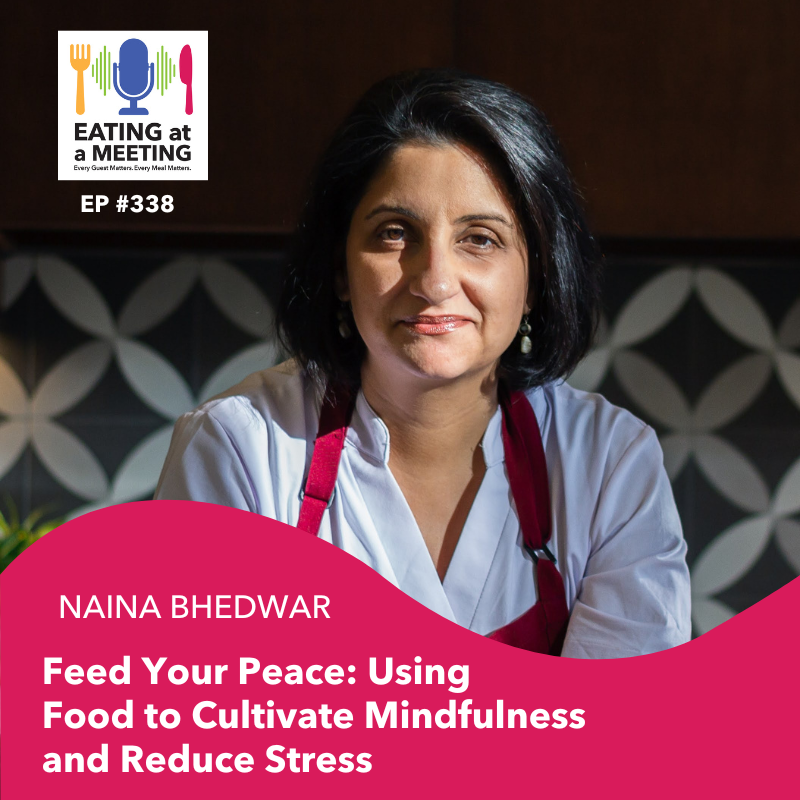
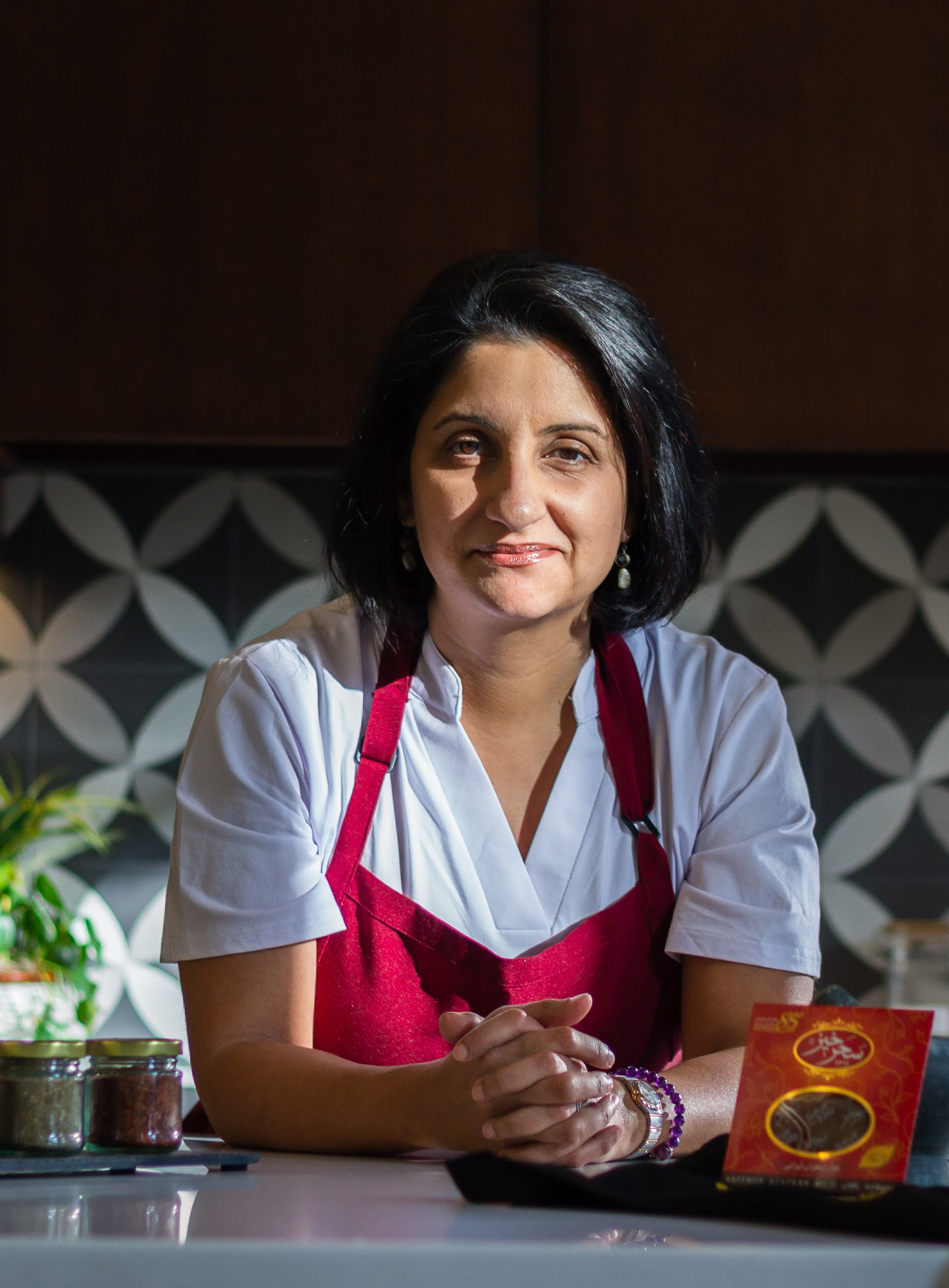
Naina Bhedwar [00:00:00]:Foreign.Tracy Stuckrath [00:00:07]:Hey, everybody, and welcome to another episode of Eating at a Meeting. I'm your host, Tracy Stuckrath, and I.Naina Bhedwar [00:00:13]:Am so excited to bring to you.Tracy Stuckrath [00:00:14]:This woman right here. She is my friend, Chef Nina Bedwar from Atlanta, Georgia. And she is, as her name says, they're a culinary instructor and a coach at Kesar Kitchen out of Atlanta. And. But I did meet her, oh, my gosh, it's been 10, 15 years, something like that.Naina Bhedwar [00:00:36]:Yeah.Tracy Stuckrath [00:00:37]:Through the Cook's Warehouse, which is a cooking store and school in Atlanta. And she was teaching classes. And I would work her classes as a.Naina Bhedwar [00:00:45]:And I would work yours. I would. Yeah, yeah, yeah.Tracy Stuckrath [00:00:48]:So. But last week or two, a couple weeks ago, Nina posted on Facebook that she was doing this cooking class at the Atlanta Botanical Gardens called Feed your Peace and. And talking about mindfulness and. And reducing stress using food. And so that's why we're here.Naina Bhedwar [00:01:08]:So.Tracy Stuckrath [00:01:08]:Hello, my friend.Naina Bhedwar [00:01:10]:Hello, my friend.Tracy Stuckrath [00:01:12]:Okay, so tell me. I mean, when I first said it, I literally like texted you like three minutes after I saw that on Facebook and said, you have to be on eating in a meeting. So tell us about what the. What the class is Feed your Peace and why, how you came up with it.Naina Bhedwar [00:01:30]:So it was all kind of. My background is actually not in cooking. Even though I'm a chef now, I'm self taught. But most of my training, my formal training is actually in psychology. I'm a trained therapist. I've worked with. Before I moved to the US I lived in the UK for many years and I worked with special needs children there. And that was actually where I started my journey on sensory integration, sensory processing, all of the things that are very.Naina Bhedwar [00:02:00]:That are a very big part of seizures and those two areas, my teaching of neurodivergent children and the sensory side of things. I also have a yoga and meditation practice. It was. It was all very well combined. And then I moved to the US in 2013 and started the cooking thing, which was actually something that I've always wanted to do, but then the sensory stuff kind of got pushed to the side and was carrying on parallel but didn't have anything to do with the cooking. And then in September 2023, I was invited by the Piedmont Hospital Women's Heart Program, who I also do a lot of cooking for, cooking classes for. And they were doing a 10th anniversary celebration down in Serenity, which did not have any kind of kitchen facility. So there was nothing.Naina Bhedwar [00:02:52]:I. There was no sinks. I couldn't clean up. I couldn't do anything. Oh, wow. And they Said, but we still want you to have a presence. So I said, but if I can't cook, then what do you want me to do? So they. Because I was so used to being in that role, right.Naina Bhedwar [00:03:05]:I had a look at the, at the schedule, and it was like meditation and then there was like body scanning and there was all this kind of, you know, more of the spiritual stuff. And I thought, hang on a minute, I do so much of that as well. And I started thinking about where the two would meet and the, all the sensory work and all the yoga and all the stuff I've done in my, in my parallel life kind of came in and it made me realize that there is nothing more sensory on this planet than food and especially the creation of food. Right. And the more, the more I dug around, the more I found that there's so much, so much out there on eating mindfully, on sourcing your food mindfully, on all of that sort of thing. But there was hardly anything on cooking mindfully, on actually preparing the food in a mindful way. In energy healing circles, there's a lot of stuff about, you know, the energy that food carries, the energy that the chef carries that goes into the food.Tracy Stuckrath [00:04:06]:You know, but there is angry food.Naina Bhedwar [00:04:10]:Yeah. And vice versa. Yeah. And of course, I'm aiming this more at the home cook, but there is absolutely no reason why it can't be employed on a wider scale. But the, you know, things like art therapy, play therapy, they're all amazing and wonderful, but they generally tend to cater to one sensory channel, whereas cooking, if you see it as a quote unquote therapy, and I use that word with care, it can appeal to every single sensory modality that exists. So if you're more of a visual person, there's something for you. If you're more of a texture person, there's something for you. If you're more of a auditory person, there's something for you.Naina Bhedwar [00:04:51]:And also it opens up avenues for the sensory channels that you maybe don't use as much and can start to create a little bit of balance. You know, it's because you, you notice if you tend to be more of a hands on texture kind of person, maybe take a moment to look at patterns more or to look at organization more, or to look at more, you know, colors or things like that, there's something to offer.Tracy Stuckrath [00:05:17]:There's. So the two things are popping into my brain when I'm listening to you speak is one, when I. One year when I was teaching kids cooking camp, and so this has to have been left in 2017. So 2016, 2017, maybe that summer.Naina Bhedwar [00:05:31]:And.Tracy Stuckrath [00:05:32]:And, you know, Thursday was the cooking competition where the teams would get judged and they were freaking out. So. But on Monday, I'm like, okay, everybody, 12 o' clock every day, we just stopped and we took a deep breath in. And we took a deep breath out. And this is kids from 8 to 13. Right. That I was teaching classes to. And, like, on Tuesday, they were like, okay, Tracy, when are we doing our breathing? I'm like.Tracy Stuckrath [00:05:56]:And so it really helped them hone in. But then I'm like, I know that I've read some stories about people coming out of prison, and there are these programs to help them get into culinary. Because it does give them or even PTSD and things like that. Because it does provide that sense of mindfulness that you are talking about.Naina Bhedwar [00:06:19]:Yeah. Because there's so much to anchor your attention to. And that basically, that is, if you really boil it down, mindfulness is basically just where you place your attention, where you choose to place your attention. And understanding that our attention is like a spotlight that we have control over that we don't have to. And, like, mindfulness is one of the main things that is actually recommended to people with ADHD who. People who we traditionally think of as not having control over their attention.Tracy Stuckrath [00:06:56]:Right.Naina Bhedwar [00:06:56]:Are taught techniques and taught ways to harness consciousness, bring it down, and use it like a spotlight. So I am choosing to attend to what is right in front of me right now. Right. And when. Yeah, go ahead. No, go ahead.Tracy Stuckrath [00:07:13]:I was gonna say, like, in.Naina Bhedwar [00:07:14]:In me.Tracy Stuckrath [00:07:15]:You know, at Cook's, we learned from all the chefs, you know, me and plots. Put everything in its place. Right. Get your cookie sheet out and get all your spices together, and you're. You measuring spoons, etc. So that when class starts, everybody who's learning how to cook, everything's there for them. And so. But it would also be interesting to get them to put that in.Tracy Stuckrath [00:07:37]:Well, but having 30 people in a class trying to do that is too hard. But, you know, as, you know, as the. The prep cook, we helped them do that, put that everything in place, that they had it there to calm them down.Naina Bhedwar [00:07:49]:That is. That is such a perfect analogy because when you use sensory information in a mindful way, that's exactly what happens in your brain. Things get into place. And. And then when you launch into the. The recipe, which is life, you're able to. You're able to attend to everything that's coming at you in a much more. In a much More measured and calm way and not let it throw you off balance as much and you know, develop things like anxiety and stuff like that that then tend to spiral well and.Naina Bhedwar [00:08:24]:Yeah. So Drew to be like a me zone for us. Oh yeah. There's so many. There's so many analogies. It's ridiculous.Tracy Stuckrath [00:08:29]:Yeah, well, and like. And when I don't do it when I'm home, I'm like, okay, I need to get this and I need to get this and oh crap, I already put this on the oven and now I need to add this. And it adds chaos. So when you're teaching these classes, I mean, is botanical gardens hands on or are you just teaching the class? I mean, cooks where.Naina Bhedwar [00:08:50]:Go ahead. I decided that the only way that I could get this across is in some kind of hands on way. I have not. I've even done. I've even done virtual with somebody in, in England and stuff. But it has been. See, they've been cooking and I've been cooking and we've got the same recipe and we're mirroring each other. But the practical aspect so far, at least in how far I've developed it is I feel like needs to be experienced in order to understand it.Naina Bhedwar [00:09:17]:So we, I do discuss the theory. And then so for example, we do like a no heat recipe at the beginning of the class, like a salad or something like that, where we start to understand how sensory information enters our bodies and how we can use that to. To get into our bodies, out of our heads and into our bodies. And as soon as you do that, the chatter up here starts to calm down a little bit. And basically that's what mindfulness does. Mindfulness puts space between your thoughts until gradually, gradually you're just not up here so much and you're more grounded. More grounded means what? Means more in your body, Right? Yeah. Focusing.Naina Bhedwar [00:10:00]:Yeah. Yeah. And there are so many ways that you can do that. You can go to a yoga class, you can go to the gym, you can go see a somatic therapist, you can go for a swim, you can go for a walk in nature. You can do all of these things. But most. And they're all amazing. And I'm not dissing any other kind of approach, but all of those things require you to take time out of your routine and your schedule.Naina Bhedwar [00:10:23]:Whereas what I'm hoping to get across in this method is that this is something that you weave into something that you're already doing. So everyone has. Everyone has to eat. And it doesn't matter what it is that you're cooking. You can be making a packet of instant ramen, or you can be making a three course French meal. This has a. This has application in both of those scenarios. It can.Naina Bhedwar [00:10:48]:You can, you know, you can use it when you're making a cup of tea or, you know, it can be done for five seconds. It can be done for five minutes, for 50 minutes. No amount of conscious effort ever goes unnoticed. It all goes into a piggy bank that, you know, slowly, slowly builds up and eventually rewires you well.Tracy Stuckrath [00:11:09]:And that was going to go into my next question that I was asking. How can we flip that narrative into one, One of presence and peace in the kitchen. And it is that it's like. Like you, because you mentioned tea and like steeping your tea, like for five, 10 minutes, like using that time when. While the water's boiling, and then you're steeping the tea, but using that five or 10 minutes. All right, my friend Emily is over and. Oh, Perry, Peppy Perry is on here, I think. Hi, Peppy Perry.Naina Bhedwar [00:11:41]:I love it. Yeah.Tracy Stuckrath [00:11:44]:She is asking your Instagram handle, and I am gonna pop it in here. There it is. It's gonna. Oops.Naina Bhedwar [00:11:51]:Save.Tracy Stuckrath [00:11:52]:Put it on the ticker. But it's Casar Kitchen. Do you see that, Emily? I'll tap. I'm gonna put it up there, and then I'll tag it and put it into the Instagram feed. So she's watching on Instagram and so is Peppy Perry. Yes. I love Peppy Perry. He used to work at the Brookhaven store where.Tracy Stuckrath [00:12:09]:Yeah, there we go. I just typed it in or posted it into Instagram. So now I love. I just. I love that because it's. It's taking the time to think about what you're doing. And even my mom made both Bolognese last night. Did I say Bolognese for.Tracy Stuckrath [00:12:30]:Well, medical stuff that hit the. Hit the fan. But everybody's okay. But the time that she, you know, I can hear her clicking away down there, getting all her spices out, and she's really focused. Right?Naina Bhedwar [00:12:42]:Yeah. And I think that is the Zen space that a lot of people talk about with cooking and that. But I. I do believe that this approach, if adopted correctly, can even help people who don't particularly like cooking and who approach it as a chore and approach it as a. Something of a punishment. And the beauty of it is it's done in teeny, tiny, incremental steps. It's not, you know, I thinking of myself at one of my early yoga classes where there's this woman next to me who was tying herself into a pretzel. And I was thinking, oh, my God, what am I doing here? And, you know, it's like, whereas this is just quiet, it's just you in your kitchen.Naina Bhedwar [00:13:23]:You know, there might be things going around, going on around you, but it's a very personal practice, and the only one you have to measure up against is yourself. And even then, because it takes into account that we are different people every day, and we bring the different us, a different you to the kitchen every day. You're going to. It's going to manifest in different ways as well. I mean, on some days I really notice patterns and colors, and some days I'm really notice noticing the auditory side of things. Like even, even. Even, you know, when you chop. Right.Naina Bhedwar [00:13:58]:Just listening to that. And actually the. The crux of this method, that. That's kind of level one is dealing with the five external senses. And that's. That's where everybody begins, and that's where I begin and continually keep returning to as well. But the next level after that is to understand that we have three further senses that are internal that most people are not aware of, which is one. One of them is the vestibular sense, which is balance, which has, you know, a huge amount to do with just being able to stand here and not fall over.Naina Bhedwar [00:14:35]:And we. We certainly know when that sense is off because, you know who. You know, everybody hates feeling dizzy. And, you know, that's. That's so you. It's one of those things where, you know, when it's not there, right? But when. But when it's there, you're not all that aware of it. And it's just.Naina Bhedwar [00:14:52]:And that is part of our design. Part. It's part of our design as evolved human beings to put all of these things in the background and. And let our thinking mind lead. But the problem is our current society has gone to the other extreme, where our sensory information and our bodies have gone so far into the background and this has come so far forward that it's just all off kilter. So actually, what I'm teaching is nothing new. It's nothing new. It's just.Naina Bhedwar [00:15:20]:It's a. It's a confluence. It's a bringing together, and it's just an attempt at regaining balance because things. Everybody can. I think everybody can admit that we are balance as a society, as a world, as people. Something's not right, and we need to. We need to just right the ship a little bit. Right? Yeah.Naina Bhedwar [00:15:40]:So. So there's Our vestibular sense, which is the sixth one, then our proprioceptive sense is the seventh one. And that is our awareness of our body in space. So the fact that I can hold my hands out right now and do this and not knock over the glass of water that's next to me is a combination of my vestibular sense and my proprioceptive sense. The way I'm standing right now, I'm. I've got my left hip cocked up a little bit and my right hip a little bit lower just to keep myself comfortable. That's my proprioceptive sense. And that in the kitchen is things like how you hold yourself when you're chopping, how you transfer a heavy pot of water from the sink to the stove.Naina Bhedwar [00:16:20]:You know, these are all things that engage your proprioceptive sense. And when you bring awareness and consciousness to these actions, I mean, it seems silly in a way that why should I pay attention to my body when I'm moving a heavy pot of water to the stove? You do anyway. You do anyway. Otherwise you'd be spilling the water all over the place. But when you come coming back to that spotlight, when you actually give it your full attention, whatever you're doing, doing it, doing it 100%, you give it. You. When you give it your full attention, you're here. You're not off in your mind thinking about where that pot of water is leading you and when is it going to be finished and when is it going to boil, and, you know, when's this going to be done? And you're.Naina Bhedwar [00:17:02]:You're always staying one step ahead of yourself, which is also not necessarily a bad thing. But when you can fully engage, it's something that can only benefit you. It can never hurt. Yeah. Well, and.Tracy Stuckrath [00:17:17]:And like, it's like when you cut your finger or with a knife or even like you've gone somewhere else.Naina Bhedwar [00:17:23]:Right.Tracy Stuckrath [00:17:23]:Because you weren't paying attention. And. And I. That just puts Gina Berry in the back of my head as well. Tracy, you don't have your fingers curled or whatever.Naina Bhedwar [00:17:32]:Right.Tracy Stuckrath [00:17:32]:But not. Not focusing on that task at hand because it can be dangerous when you've got a pot of boiling water or a knife in your hand. And so that mindfulness of being present in what you're doing makes that important.Naina Bhedwar [00:17:45]:Yeah. I mean, it provides psychological safety and physical safety both. Yeah. Okay. And was there. Yeah. The third and final one, which is actually the most important. And this is the one that I hope to, in the future be able to do, like, retreats and things with this approach so that we can really go deep, because it's very difficult to, to get deep enough in like a three and a half hour workshop.Naina Bhedwar [00:18:10]:But I do allude to it, which is our interoceptive sense. And this is so unknown that on the computer you get a red line underneath, like it's not even a word. You get, you get interceptive, but you don't get interoceptive. And interoceptive is basically our ability to sense what's going on inside, okay, and, and listen to and interpret those signals correctly. So the most, the two most important interoceptive senses we have are hunger and thirst, both of which are intimately connected with food. And those two are senses that we are mostly taught about right from childhood. That, you know, are you feeling hungry? And here's what we should do about it. But what is, what is lesser known is that every single emotion that we feel, every single, also has a sensory component.Naina Bhedwar [00:19:03]:So when you feel nervous, something's going on inside. When you feel excited, something's going on inside. And we're not taught about how those emotions feel on a strictly sensory level. So to put it in a nutshell, what Feed your Peace is attempting to do is get you to return first to your five senses, get so intimately familiar and so good at receiving those that you develop a level of psychological safety that allows you to then feel okay about going inside. Because generally speaking, our generation and even the generation before us, we are taught to avoid what's going on inside. We're taught to think about the story behind it and think about what's happened as externally to cause that or, you know, think about the other person that did this or did that or. But not to attend to how we're feeling about it. And I mean literally feeling on a sensory level, like, where do you feel? When you feel nervous, where do you feel it? When you feel excited, where do you feel it? Where do you feel? Yeah, so for you it's shoulders.Naina Bhedwar [00:20:18]:For me it's belly. And everybody, you know, different people will shift around your body, will do all sorts of things to accommodate that sensation. And when you bring awareness to that process. So awareness and noticing it is the first step, and then accepting it with compassion is the second step. But that's further down the line. Just being able to accept and notice that something is showing up on a sensory level inside of you is already a huge win. Because your whole system just goes like, you know, you know, you know, the, the common saying, which is someone I've come across in America, which is I feel seen yes. Right.Naina Bhedwar [00:21:03]:So your system feels seen, right. And it feels heard because you are directing that non judgmental awareness and attention inward.Tracy Stuckrath [00:21:17]:So how does that translate? And I'm, because I'm going to tie this a little bit to, at a meeting or whatever. But, but even at the dining room table at home, right. How does that translate to the eater then? Like what you're doing in the kitchen, how does that sensory awareness of that chef translate to the dining table?Naina Bhedwar [00:21:38]:I don't have any way to scientifically prove this, but I, I, I am beyond convinced that translates to, because it alters the chef's energy, so it alters the energy that is transmitted into the food. And I call this technique an invitation to a new way of being in the kitchen and beyond. With the beyond being really important that, that begin in the kitchen because, purely because, not only because I love cooking, but because cooking offers so many avenues to, to anchor onto. But then once, you know, I've been practicing this pretty much my whole life in the, in the more traditional teaching environment that I was in before and in the cooking environment, I think I've been doing it consciously for maybe the last three years. And the difference I feel when I leave the kitchen and I go out, like I'm practicing this sensory awareness when I'm driving, I'm doing it when I'm interacting with my kids, I'm doing it when I'm interacting with my family, with friends, with colleagues. It's constantly, it's in the background, but it's constantly on. And the lovely thing is it's not on in a pressured, oh, God, this is one more thing I have to do or one more skill I have to learn kind of way. You're actually switching on something that's on anyway, but you're, you're doing it in a really soft, really curious, playful, oh, look, I just noticed this.Naina Bhedwar [00:23:14]:Oh. And so I have a good analogy. When we go, when we travel, especially when we travel to a place that is really different from where we live, we are so on. Like, oh my God, look how, look at that beautiful red awning over the store and all that smell that's coming from that food stall. Or oh my gosh, look at that person's beautiful colorful dress. Right? You're noticing, noticing, noticing because it's all a little bit different and outside of your, of your usual zone. But, and that's, that's a reason why most of us travel because we want to notice these different things and we want to, obviously we want to learn and we want to Grow and all of that. But the feeling that is behind that, noticing that feeling, that's what we're after.Naina Bhedwar [00:24:01]:You're getting it through a experience, of course, and the experience is helping you to achieve that. But what you're really after is the feeling of, like, how is that making me feel? It's making me feel like I'm online, like I'm here. I'm me.Tracy Stuckrath [00:24:19]:So after Nina mentioned that she was doing this class and then she taught one at Cook's Warehouse a couple of weeks ago, she launched the program, and six of the 12 seats were booked by students from Georgia Tech. And she was pleasantly surprised and assumed it was likely to be a professor staff attending. And. And it wasn't.Naina Bhedwar [00:24:41]:It was.Tracy Stuckrath [00:24:41]:Six young students walked in who were 17 to 21. And she's like, are you guys here because you were told to be here? And the response was no. We were told about the workshop, and I. And thought it looked really interesting, so they all came.Naina Bhedwar [00:24:58]:So.Tracy Stuckrath [00:24:58]:And here's a picture of those students that participated in her class. And so it really resonated. And look at all that delicious food and that she. That they made. I'm going to come back to the studio and see Chef Nina add to the stage. See, look, there you are. Okay. And I've got your class over here showing the pictures of your Facebook thing.Naina Bhedwar [00:25:23]:So talk.Tracy Stuckrath [00:25:23]:Facebook class. Your Facebook class. Your class that you shared on Facebook. So tell us a little bit about that class. I'm gonna take that off now. So you're back in here. So these six students from Georgia Tech. Did professor tell them about it or.Naina Bhedwar [00:25:40]:I was floored because I saw Ga Tech on the booking thing, and I just assumed it was professors or staff or something like that. And these six students walked in, and my first question to them was, is this a community service? Were you told to be here? Or at least, like, some hours you have to fulfill? Like, we're part of a scholarship program, and every month, they give us options of different things we can do. And this workshop was one of the options. We found it really cool. And. And more than six students, three guys.Tracy Stuckrath [00:26:10]:Wow.Naina Bhedwar [00:26:10]:Which, you know, up. Up until now, I've had all, you know, only women. I've had two men at my Botanical Gardens class. But, you know, generally speaking, these sorts of workshops tend to attract more women. And it's so much. I think it's, you know, just as important for it to be.Tracy Stuckrath [00:26:26]:So what. And at the end of the class, what did they say?Naina Bhedwar [00:26:30]:They were really pleased. And. And. And though they Were so engaged. And I actually have meant to. I haven't got around to it, but I wanted to email all of them just to see whether. Because the, you know, university life. I don't know how much they're actually cooking and how much of an opportunity that they get to practice.Naina Bhedwar [00:26:46]:But they did say, you know, there's a kitchen with our dorm, and, you know, so hopefully they do get some opportunity. But it was funny because they were all engineers, and they kind of like, wow. And they were in a group together, and we were making a dessert that involved folding filo pastry. So as we were doing it, I was guiding people about, you know, feeling the texture of the pastry, looking at how thin it is, closing your eyes and feeling the smoothness. You know, even taking in the kind of raw flour aroma, even things. Things that you wouldn't normally pay attention to, and the fold, the folding technique. So we had a night that was all my age or older. It's all kind of quite rustic, and there were bits poking up here and there.Naina Bhedwar [00:27:34]:And, you know, it was kind of a little uneven. And these engineers had the most perfect. I was like, did you use a ruler? It was just, like, absolutely, like, even. And the same length, not one little bit sticking out this side, that side. It was just. So it was fun to see malates also come out in the way you do things.Tracy Stuckrath [00:27:58]:So that's awesome.Naina Bhedwar [00:27:59]:That was it.Tracy Stuckrath [00:28:00]:So, I mean, as a teacher of that, you mean, what did you learn from them?Naina Bhedwar [00:28:07]:What did I learn from them? Yeah, just. I mean, the openness with which they were approaching this, they had a lot less. They had much fewer layers of stuff than you do at the age of 50 plus. So it was. It was easier, in a way, to get through. To get through. Even though we have this idea in our head that you have to be older to be interested in, you know, pursuits like this. And I think that really, it challenged my assumptions and made me see that I absolutely do have an audience in the younger folks.Naina Bhedwar [00:28:48]:Right.Tracy Stuckrath [00:28:49]:No, that's awesome. I mean, and that could be because, I mean, school is stressful in and of itself. Right? And I know I didn't have a kitchen in our dorm, so the fact that they have a kitchen in their dorm to be able to go cook in, you know, is something completely different and offers, you know, a new avenue.Naina Bhedwar [00:29:07]:And so many chefs go into a culinary. Not just culinary school, but culinary environments at such young, tender ages of them. It's a escape for some of them. It's, you know, what they want to do. But they're generally high stress environments. And knowing that you have a tool literally at your fingertips that you could, you can employ in short bursts here and there to just, just keep yourself online, is that of value.Tracy Stuckrath [00:29:40]:What do you notice in the participants and anyone that you've talked to that's taken it after the fact? You know, what shifts in participants do you notice in both in the kitchen and themselves when they're practicing mindful cooking or, you know, have they said anything after the fact?Naina Bhedwar [00:29:59]:I've had a couple of people get back to me. One person was already a very avid yoga practitioner and stuff like that. And who said it's again, it's this idea that I didn't take everything I've learned out of the yoga studio off the mat and into life. And this is a, this is an approach that is not only, not only are you developing them, practicing it and muscle while engaged in an everyday activity. Right. So you can't help but make that bridge that gap between what you love, what your, how your system is rewiring because it's happening, happening in real time.Tracy Stuckrath [00:30:44]:Well, and it makes me think because like, so we'll be done with this. And I need to go down and lunchtime is my worst and I'm spoiled rotten because I live with my parents and my mother makes dinner every night so I don't really have to think about it. But when I go down for lunch, I'm opening up the refrigerator or the cabinet and I'm like, okay, what am I going to cook? Right. What am I going to eat? And I don't use it as an opportunity to be mindful to myself and say, hey, all right, what are you having the rest of the day? And yeah, how can, is there a way to use this to prep meals in advance so that like when I go down to lunch, hey, there it is. And I can grab and go. Or is it more of cooking the meal and then sitting down to can.Naina Bhedwar [00:31:29]:I mean if you, if you ask me, it can be done no matter what you're doing. So like right. Talking to you. But I 5% of my attention on my feet, right. And feeling the position of my feet and moved. And you're just, you're just kind of keeping these things in your awareness. And what does, is it keeps that frustrated voice at bay. It keeps that, okay, on to the next thing.Naina Bhedwar [00:31:57]:On to the next thing. Now do I do now what do I do now? And you know, we live in such a productive, productivity, focused society and such a goal focused society and there's nothing wrong with golf, they're fantastic. But when you are, when it's always eyes on the prize and not on the process and you're rushing through the process in order to get to the goal. So even when you're meal prepping and meal planning, you have your goal in mind that this is to eventually make your lunchtimes easier or whatever. But as you are doing so, you're taking in colors and you're taking in patterns and thinking about quantities and you're thinking about quality and you're thinking about the sounds of the thing is as blindingly simple as the sound of the Tupperware box snapping shut. Right? Yeah. You're listening to it. I know they're going to be going to be people out there.Naina Bhedwar [00:32:51]:We're thinking, what a waste of time. But, but, you know, that's because we've been fed this myth that our time has to be used in this way that produces something every time, that there has to be some sort of bolt at the end of every 15 minute portion of your day there you have to have something to show for it. And with this approach, you absolutely do have something to show for it. But it's inside. So you, so you can't really quantify it in a very measurable way. But you feel different, you feel more, you feel calmer, you feel able to approach more triggering aspects of your life in a more balanced way. And it's not overnight like, like anything. It's, it's a muscle you have to build.Naina Bhedwar [00:33:40]:It's a practice. But because it's part of the every day, I say it's easier to, you know, schedule that therapist appointment and go and figure it out and then do the whole.Tracy Stuckrath [00:33:55]:So, and I think I read this somewhere in something that you wrote about this class and it, I can epitomizes what you just said and it's practical spirituality. I think it epitomizes what you just said, you know, but can you sum that up and what you mean by that?Naina Bhedwar [00:34:12]:Practical has the word practice at its root and it is a practice that is woven in with the everyday. So it's very easy to be practical about. And again, to emphasize the fact that it can be done in the smallest of increments and it doesn't have to be an hour long thing you can do it for. You can literally start with just your morning cup of coffee and leave it at that.Tracy Stuckrath [00:34:42]:Okay, there's. When you shared this event on Facebook, you wrote in here, so many of us hear about and are told to be more Mindful, more conscious. But what does that truly mean on a personal mind? You know, psychologically, neurologically, mentally, emotionally, the list goes on. Penetrate and elevate are near limitless. And it brings me back to thinking of something that you said. If, you know, when you. A few minutes ago, you were like, hey, you can literally. Your fingertips like, it made me think of massaging kale and then chopping onions and sauteing the.Tracy Stuckrath [00:35:20]:What's the onion? Green garlic and celery. Yeah, yeah. You know those different things in the aromas that you smell or when the cookies are coming up? I mean, those are just. Those things bring about what you're talking about.Naina Bhedwar [00:35:38]:Yeah. Because what do they do? They just bring us into the moment. That's all any of that does. And when you think about. So back to the. To the travel thing is like a more a novel experience that brings you into the. And in the class, I share the fact that, you know, we go to live. We go to watch live music, we play musical instruments, we take.Naina Bhedwar [00:36:02]:We do. We create art. We engage in thrilling sports like surfing and rock climbing and things like that. And we do all of these things because they keep us present. I, you know, once again, we think it's about the content of the experience. It's not about the content. It's about the feeling that that content is awakening in us. And because our systems are design, our nervous system designed to stay present, we love it.Naina Bhedwar [00:36:33]:Your system starts to hum. You start to, you know, you have less anxiety, you have better sleep, you have fewer aches and pains. You have better vision. You have all kinds of things. Your hair, nails, and teeth are better. And that's just, you know, that's just absolutely the tip of the iceberg. And it's not. It's because this works.Naina Bhedwar [00:36:52]:And it's because mindfulness has been talked about for thousands of years, and now finally, we have science to back it up. And that is gradually, slowly, slowly starting to catch up and close that gap. But it's. Our systems start to humor in a really pleasant way when we work with our design rather than. But in order to work with your design, you have to understand what your design is. You have to understand it, you know, in, in. And I try to keep it in as get me talking about the brain. And I could go on for like.Tracy Stuckrath [00:37:29]:Okay, so what. And I have taken mostly your Indian classes, right. Your Indian cooking classes. And you are my go to. To say, okay, can I eat this or not? But are you teaching. When you're teaching these classes, are you Teaching Indian cuisine or are you teaching farmers market? What are you teaching so far? Does it matter?Naina Bhedwar [00:37:49]:So far it's been a little bit more on the Mediterranean side. Okay. But almost always involves saffron, which is my favorite number one spice. And because my, my business is named after it, I absolutely love it. And because it offers so much in the sensory department.Tracy Stuckrath [00:38:08]:It'S so expensive, though. All right, lost her. All right, there's Nina's website, Kesar Kitchen. And on the ticker that I was showing is her Instagram handle is Kesar Kitchen as well. All right, can you hear me? I don't know why your camera keeps going out. There we go.Naina Bhedwar [00:38:27]:Okay, back. You're back.Tracy Stuckrath [00:38:31]:Oh, you can't.Naina Bhedwar [00:38:32]:Sorry, this is.Tracy Stuckrath [00:38:33]:No, that's okay. Technology, right? No, that's okay. So I was just showing your website there and that's also her Instagram handle. Can you hear me now? No, no, no. All right, let's. Yes. Okay, go down to the. Oh, you can't hear me.Tracy Stuckrath [00:38:54]:Okay, so let's see if she's. I'm going to look and see if she's got any other classes coming up to show her.Naina Bhedwar [00:39:01]:Come back in again.Tracy Stuckrath [00:39:02]:Yes, yes.Naina Bhedwar [00:39:04]:Yeah, yeah.Tracy Stuckrath [00:39:06]:I'm going to show you her website real quick. Share screen and so that you can check out her website. So very pretty website here. But current events, so if you want to. Private events. Let's see, you can hire her to teach, you know, some private events for you on doing that. And then. Oh, here's your feed, your piece.Tracy Stuckrath [00:39:29]:So again, if you're in Atlanta, that's where she is. But as you heard her say, she's also does them virtually so and she's been doing these, teaching these at Cook's Warehouse in Atlanta as well as the Atlanta Botanical Gardens, which has a beautiful outdoor kitchen space. Okay, here she comes back in. Okay. Can you hear me? Okay, I was just showing off your website. Yes.Naina Bhedwar [00:39:55]:And yes, yes. You put it together.Tracy Stuckrath [00:39:59]:Your 9 year old son.Naina Bhedwar [00:40:02]:My 11 year old.Tracy Stuckrath [00:40:03]:Your 11 year old son. Oh, my goodness. Well, tell him it looks beautiful. Yes, it looks beautiful. Okay, so what, I'm gonna do some rapid fire questions for you. Well, I was. You were talking about saffron because you said it's your favorite spice. It's a little.Tracy Stuckrath [00:40:18]:It's expensive for that little tiny thing of, of saffron.Naina Bhedwar [00:40:23]:Yeah, yeah. But the reason for. Because the threads, the individual threads come from the crocus flower and each flower only gives three every year and.Tracy Stuckrath [00:40:35]:Wow. And who's responsible for plucking that you.Naina Bhedwar [00:40:39]:Should see the videos on YouTube and that, that is one of my top bucket list items is to go to Iran finally, when it's safe, mind some of my sites that my family is originally from and pick saffron. I mean that would just. I could die after that. Very.Tracy Stuckrath [00:40:56]:Okay, well that I look forward to seeing that trip for you.Naina Bhedwar [00:41:02]:Three per hour here. Hand picked, hand dried, hand packed, very labor intensive industry. Oh, more expensive than gold by weight. But we use a hell of a lot less than you doing so. Right. It works. Yeah.Tracy Stuckrath [00:41:21]:And how when you're using it, how many? Because three per. Like in a recipe. Do you need just one string?Naina Bhedwar [00:41:27]:It's impossible to measure. Don't ever try to measure saffron because it will fall out of the spoon, it will go all over your counter and you to single thread. So you just take, you just take a pinch and generally what fits between finger, forefinger and thumb is a small pinch, two fingers and thumb is a medium pinch and three fingers and thumbs is a, is a very generous pinch. It's very unlikely that you would ever have to do that. It's mostly either one or two. And then you, you put it into one of these little pestles which have like a, a slightly gritty interior. Right. As a pinch of sugar because you need something that is a bit abrasive to help break this.Naina Bhedwar [00:42:08]:And then you grind it and it turns into this beautiful rose ash like powder. And that's actually another big part of feeder piece which I really draw people's attention to, which is transformation. There's so much transformation in cooking when things go from one state to another. And just, just appreciating that, you know, a second ago you had these beautiful delicate threads and now they're in this powder which looks different, acts different. And it's also how you can make parallels between that transformation and your own transformation.Tracy Stuckrath [00:42:42]:There is a chef on LinkedIn that I follow and you would love it because he talks about, he's been showing different ways to reduce food waste. And so he would take saffron or whatever and he's like, here's 12 different ways that saffron is this or. And like he took a piece of bread and he's like, here's breadcrumbs, here's powder, here's this and it. That just reminded me of that. And it's just so very interesting because we. That's part of that whole feed your feed your piece too is like understanding how this food can be used in a variety of different ways.Naina Bhedwar [00:43:21]:You start to Relate to it differently so that you. You have a little bit more reverence. Right. More. You take a bit more care.Tracy Stuckrath [00:43:28]:I need to go back and find what his name is because I. His. All of his posts are very intriguing to me, but. Okay, so some fire, rapid fire questions and I will send you his link when I find it. What's your go to comfort food when you need peace?Naina Bhedwar [00:43:46]:Almost certainly something Indian. And for me it's a texture thing, so it has to be something soft and like a little bit squidgy. A little baby food. Baby food kind of texture.Tracy Stuckrath [00:43:56]:Okay.Naina Bhedwar [00:43:57]:So in Indian food, you have this lovely dish called kitchari, which is like a mixture of rice and lentils. It's kind of like a lentil risotto. Really soft and it's nutty. And then you have this spiced oil on top with garlic and onions. And I think I might make myself some for lunch.Tracy Stuckrath [00:44:14]:I was like, I might go to the Indian restaurant downtown. Okay. And you already answered this question. But the spice you couldn't live without, so. Right. Saffron.Naina Bhedwar [00:44:23]:Yeah. Cooking, dad. Laughing, going, yeah. You would pick the most expensive one, wouldn't you?Tracy Stuckrath [00:44:28]:Hey, you taught me well, dad.Naina Bhedwar [00:44:30]:Right?Tracy Stuckrath [00:44:30]:Yeah.Naina Bhedwar [00:44:32]:Yeah.Tracy Stuckrath [00:44:32]:Cooking solo or cooking with others? What feeds your piece more?Naina Bhedwar [00:44:37]:I think based on my current phase in life because I'm a mother of two young kids and I get quite a lot of people interaction in my classes. So it used to be with people, but I think in the phase of my life that I currently am solo is. Yeah, yeah. Especially when there's nobody home. It's joy.Tracy Stuckrath [00:44:58]:One mindful habit you practice daily outside of the kitchen.Naina Bhedwar [00:45:02]:It's like I said, it's this sensory processing, sensory integration thing and just always being kind of a little bit aware. And then when I'm. When I know that I'm not, I come back. So in the same way as yoga teaches you to come back to your breathing, I tend more sensory things. So, like, even when I'm driving, I'll feel the seat behind my back. It kind of brings you back.Tracy Stuckrath [00:45:28]:I like turning off the radio.Naina Bhedwar [00:45:30]:Yes.Tracy Stuckrath [00:45:32]:Because it just. I mean, then there's no noise. Yeah.Naina Bhedwar [00:45:35]:One less channel that's being. Yeah, yeah.Tracy Stuckrath [00:45:38]:It's very peaceful. Yeah. Okay, two more. If you could describe feed your peace in one word, what would it be?Naina Bhedwar [00:45:46]:Oh, grounding. Okay.Tracy Stuckrath [00:45:50]:Yeah, that makes sense. Completely. That's the point of it, right?Naina Bhedwar [00:45:55]:Yeah. Yeah.Tracy Stuckrath [00:45:56]:All right, and the last question. Finish this sentence. Every meal should.Naina Bhedwar [00:46:02]:Should be relished with gratitude.Tracy Stuckrath [00:46:07]:I like that. I like that.Naina Bhedwar [00:46:10]:Well, thank you.Tracy Stuckrath [00:46:11]:My friend, I'm so excited. I. I think I'm coming down in November, so I will let you know when I am. Yes. And everybody, if you want to have Nina, hire Nina, take nine as classes. There's her website, Kiss Our Kitchen, and again, it is her Instagram handle. And your Facebook page is that too, right? Everything. Is that so?Naina Bhedwar [00:46:33]:Yep.Tracy Stuckrath [00:46:34]:So check her out there.Naina Bhedwar [00:46:36]:I'm doing these feed your peace classes virtually as well, so people who are listening from other parts of the world, it absolutely translates to the screen when you don't always keep cutting out like, all is good. We're good. Well, well, thank you so much.Tracy Stuckrath [00:46:52]:So good to see you.Naina Bhedwar [00:46:54]:You're welcome.Tracy Stuckrath [00:46:55]:All right, everybody, thank you for tuning in. Next week I am going to be in Las Vegas for imax, so I'm going to come to you live on Monday, Tuesday and Wednesday. Monday, we're talking about similar something this neurodiverse, neurodiversity and food. Tuesday is all about Toronto as a culinary destination. And three, Wednesday is about technology and helping your attendees eat, feel safe about what they're eating with more knowledge. So tune in next week and I.Naina Bhedwar [00:47:30]:Will see you then.Tracy Stuckrath [00:47:32]:Thanks, everybody for being here. And until then, stay safe and eat well. Thanks for listening to the Eating at a Meeting podcast where every meal matters. I'm Tracy Stuckrath, your food and beverage inclusion expert. Call me and let's get started right now on creating safe and inclusive food and beverage experiences for your customers, your employees, and your communities. Share the podcast with your friends and colleagues at our Eating at a Meeting Facebook page and on all podcast platforms. To learn more about me and receive valuable information, go to Tracy Stuckra. And if you'd like more information on how to feed engagement, nourish inclusion, and bolster your bottom line, then visit eating@ameeting.com.